
- The Wealth Illusion: Having a multi-million-dollar portfolio guarantees financial survival, but does not guarantee happiness, purpose, or vitality.
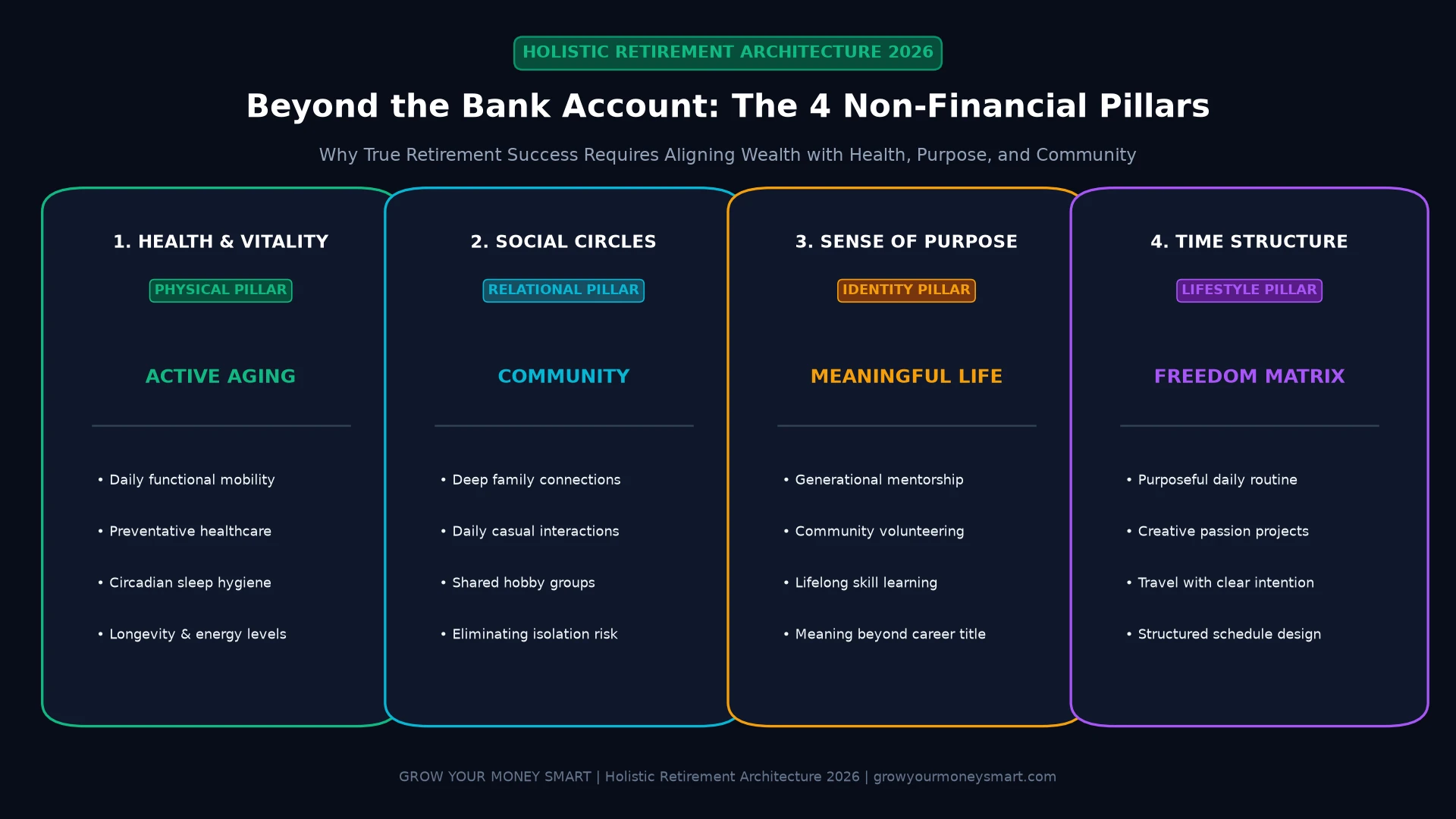
- The 4 Non-Financial Pillars: Holistic retirement success rests on 1. Physical Health & Mobility, 2. Social Circles & Community, 3. Purpose & Legacy, and 4. Time Architecture & Routine.
- Navigating the 4 Phases: Understanding Dr. Riley Moynes’ framework (Vacation → Feeling Lost → Trial & Error → Reinvention) prevents post-career depression and identity loss.
- Proactive Transition: Begin cultivating non-work hobbies, mentorship opportunities, and community networks 3 to 5 years prior to retirement.
For decades, conventional financial planning has fixated almost exclusively on quantitative metrics: 401(k) balances, safe withdrawal rates, asset allocation, and tax brackets. Yet, empirical data reveals a startling paradox: thousands of individuals reach their exact target retirement number, walk away from their careers, and quickly find themselves overwhelmed by boredom, loneliness, and a profound loss of identity.
True retirement readiness requires looking far beyond the bank account. A truly successful retirement is not merely an exit from employment—it is an engineered transition into a vibrant, purpose-driven lifestyle. To balance your numbers alongside lifestyle design, utilize our interactive Household Budget Calculator and review the 5 Stages of Retirement Planning.
The 4 Non-Financial Pillars of Holistic Retirement
When you leave the workplace, you forfeit more than just a paycheck; you leave behind a structured schedule, an identity, and a daily social network. To build a balanced life in retirement, you must actively architect four non-financial pillars:
Pillar 1: Physical Health, Nutrition & Functional Vitality
Your health is your primary wealth multiplier. Without functional mobility and cognitive clarity, financial resources cannot deliver life satisfaction. Maintaining regular resistance training, cardiovascular exercise, and preventative health screenings ensures you can travel and stay active throughout your 60s, 70s, and 80s.
Pillar 2: Social Circles & Interpersonal Connection
The landmark Harvard Study of Adult Development—the longest longitudinal study on happiness ever conducted—concluded that the single strongest predictor of health and longevity in later life is the quality of close personal relationships. Building social ties through clubs, shared hobbies, and community groups eliminates the severe cognitive risks of isolation.
Pillar 3: Sense of Purpose & Post-Career Identity
When asked “What do you do?”, working professionals instinctively state their job title. When that title disappears, an identity vacuum occurs. Rebuilding purpose involves volunteering, consulting, mentoring younger professionals, or dedicating time to artistic and philanthropic endeavors—a concept deeply integrated into how retirement is viewed across different cultures, such as the Japanese pursuit of Ikigai.
Pillar 4: Structured Freedom & Time Architecture
Endless unscheduled free time sounds appealing during high-stress work years, but quickly becomes paralyzing. High-functioning retirees establish a “freedom framework”—a predictable weekly rhythm that incorporates creative work, physical exercise, social lunches, and unstructured relaxation.
The Psychological Transition: Dr. Riley Moynes’ 4 Phases of Retirement
Retirement is not a static event; it is an emotional and psychological journey. In his acclaimed research, educator and author Dr. Riley Moynes identified four distinct psychological phases that almost every retiree experiences:
• Phase 1: The Vacation / Honeymoon Phase: Typically lasting from a few weeks to a year, this phase is marked by pure relief, sleeping in, traveling, and celebrating newfound freedom.
• Phase 2: Feeling Lost & The “Retirement Crash”: The novelty fades, and the loss of the “Big 5” hits: loss of routine, loss of identity, loss of workplace relationships, loss of purpose, and loss of power. Many experience anxiety and boredom.
• Phase 3: Trial & Error: Retirees begin actively asking, “How can I contribute? What brings me genuine joy?” They experiment with new hobbies, courses, and volunteer roles.
• Phase 4: Reinvention & Meaning: Only approximately 50% to 60% of retirees intentionally reach Phase 4, where they align their unique skills with meaningful service and achieve profound fulfillment.
Comparative Matrix: Financial-Only vs. Holistic Retirement Planning
Comparing a traditional finance-first approach with a modern holistic strategy highlights why lifestyle engineering is essential:
| Dimension | Traditional Financial-Only Model | Holistic Lifestyle Architecture |
|---|---|---|
| Core Goal | Accumulate a specific net worth balance | Align capital to fund health, freedom & purpose |
| Day 1 Focus | Setting safe withdrawal rate (4% rule) | Executing a purposeful weekly time schedule |
| Social Strategy | Unplanned; relies on existing workplace circle | Proactively joins community & hobby cohorts |
| Health Strategy | Purchasing Medicare & supplemental policies | Daily functional mobility + preventative wellness |
| Identity Anchor | Anchored to past career achievements | Reinvented through mentorship, arts & service |
The Non-Financial Fulfillment Index: Longevity & Happiness Data
Quantitative longevity research underscores that emotional well-being is not driven by financial assets alone. The chart below illustrates the relative contribution of non-financial lifestyle pillars to post-career happiness scores:
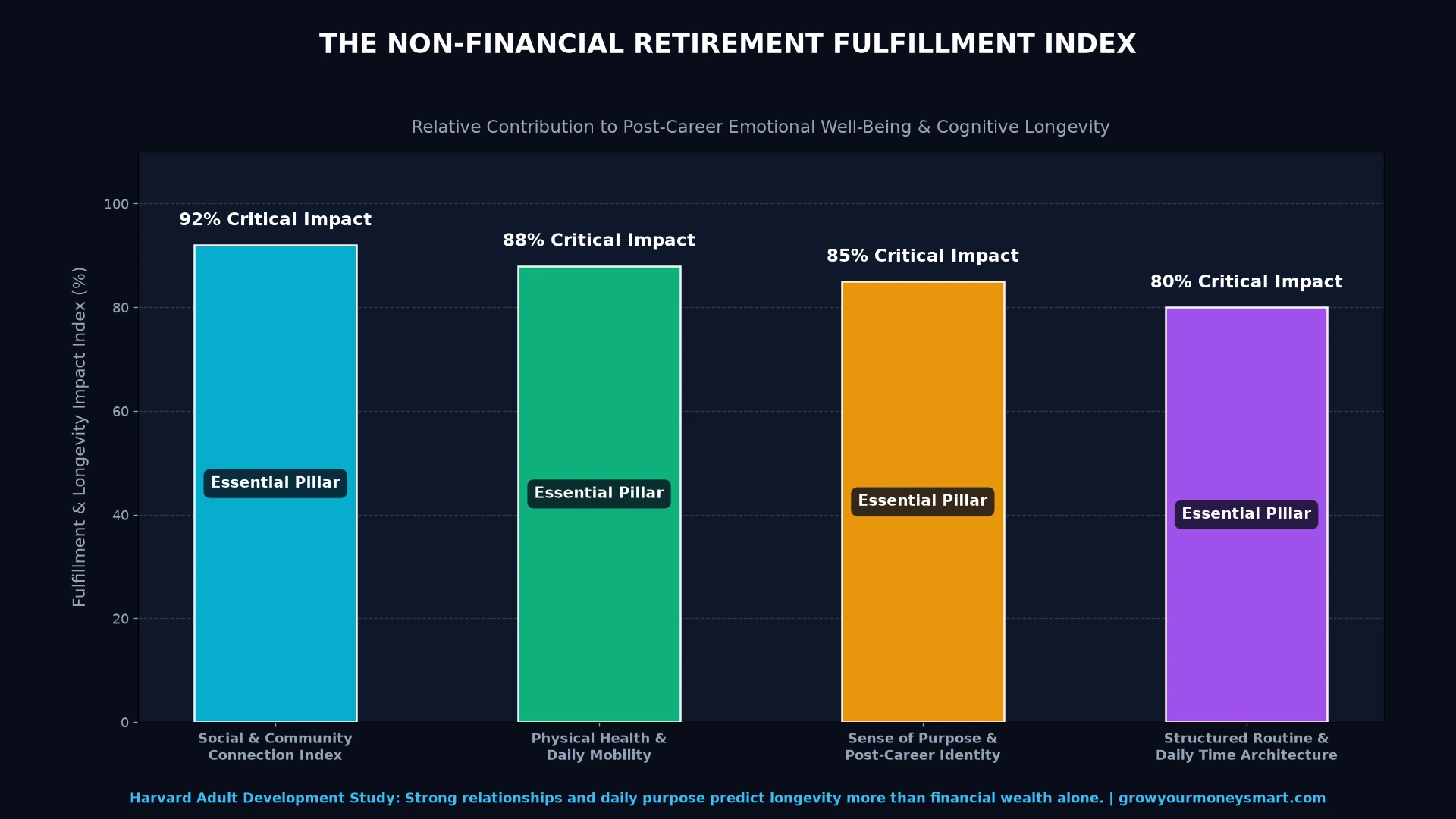
As illustrated, social connection and daily purpose account for over 85% to 92% of perceived life satisfaction. When combined with a stable financial foundation, retirees achieve total life independence. Learn how to align your portfolio with your multi-decade timeline in our guide to Investment Time Horizons.
Actionable 5-Phase Lifestyle Transition Blueprint
To ensure a seamless transition from full-time professional to thriving retiree, execute this 5-phase timeline:
Phase 1: 3 Years Prior – Hobby & Community Incubation
Test-drive new interests before leaving your job. Join local cycling clubs, woodworking guilds, or photography groups. Develop friendships outside your primary industry.
Phase 2: 2 Years Prior – The “Phased Work” Exploration
Explore whether your employer allows transitioning to a 3-day workweek or consulting role. A phased glide-path cushions the sudden psychological shock of full retirement.
Phase 3: 1 Year Prior – Design Your Ideal Weekly Blueprint
Map out an explicit 168-hour weekly calendar. Allocate dedicated time blocks for fitness, creative projects, family connection, and community service.
Phase 4: Month 1 to 6 – Intentional Vacation & Reflection
Embrace the initial rest phase without guilt, but set a calendar milestone (e.g., 6 months) to begin implementing your structured routine.
Phase 5: Year 1 Onward – Purpose Reinvention & Legacy
Commit to a primary cause or mentorship avenue. Sharing your wisdom with younger generations generates profound cognitive vitality and enduring fulfillment.
Frequently Asked Questions (FAQs)
Below are clear, actionable answers to the most common questions regarding non-financial retirement and lifestyle planning:
While money provides financial security, it does not provide daily purpose, social connection, or mental fulfillment. Research from the Harvard Study of Adult Development indicates that retirees who lack non-financial plans often experience sharp declines in cognitive health, increased depression, and a loss of identity, regardless of their net worth.
The 4 pillars are: 1. Health & Physical Vitality (maintaining mobility and preventative wellness), 2. Social Circles & Community (preventing isolation through deep friendships and group activities), 3. Sense of Purpose & Identity (finding meaningful projects, mentorship, or volunteering), and 4. Time Architecture & Routine (designing intentional daily structure).
The four phases are: Phase 1 (The Vacation/Honeymoon Phase – initial euphoria and relaxation), Phase 2 (Feeling Lost & Loss of Identity – realization of lost routine and work friends), Phase 3 (Trial & Error – experimenting with new hobbies and roles), and Phase 4 (Reinvention & Meaning – discovering deep fulfillment through service and personal mastery).
Workplaces provide built-in daily social interaction and intellectual stimulation. Leaving without a replacement community can cause ‘Retirement Shock,’ characterized by loneliness and identity confusion. Establishing new community groups, volunteer networks, and regular social commitments prior to retirement buffers against this risk.
Implement a ‘Time Architecture Matrix’ dividing days into 4 quadrants: Physical vitality (exercise/walks), Intellectual stimulation (reading/skills), Social connection (lunches/clubs), and Passion projects (volunteering/creative arts). Having anchor habits in the morning and afternoon preserves daily momentum.
Experts recommend beginning non-financial planning 3 to 5 years before your intended retirement date. This allows you to test hobbies, build social networks outside of your workplace, and gradually transition your identity before stepping away from full-time employment.
Phased retirement involves gradually reducing work hours (e.g., transitioning from full-time to 3 days a week or consulting) rather than stopping abruptly. This smooths the psychological shock, maintains social interaction, and provides time to build fulfilling post-career routines.
Physical mobility directly dictates the quality of travel, social engagement, and independent living. Prioritizing daily functional strength, cardiovascular endurance, and preventative care ensures that retirees can fully enjoy the financial freedom they worked decades to achieve.
⚡ Lifestyle Design & Post-Career Transition Guides
Plan both the financial and human sides of your retirement transition with these essential guides:
- Emotional Peace: Explore our guide on psychological benefits and peace of mind from retirement planning to eliminate financial anxiety as you transition into retirement.
- Redefining Work: Explore our guide on redefining retirement work options and semi-retirement to balance creative fulfillment with part-time earnings.
- Core Strategy: Explore our guide on essential guide to securing your retirement future to align lifestyle goals with rigorous financial milestones.
Final Expert Takeaways
Retirement is the beginning of your life’s most liberated chapter, not the end of your productive contribution. By intentionally designing your lifestyle around the four pillars of health, community, purpose, and time structure, you transform financial wealth into a rich, deeply meaningful, and enduring legacy.
Integrating holistic well-being, community support, and health autonomy into your financial plan supports lasting cognitive and physical vitality. Consult the official U.S. Administration for Community Living (ACL) Older Adults Resources for statutory guidelines and consumer protections.
🌺 Holistic Retirement Planning: Health, Purpose & Longevity
Design a vibrant, purposeful post-career life with these lifestyle and health preservation guides:
- Mental Well-Being: psychological perks of basic retirement planning — maintaining purpose, cognitive vitality, and social connection.
- Phased Work Options: redefining retirement: does it mean stopping work entirely? — integrating flexible part-time work and creative entrepreneurship.
- Leisure Budgeting: how much do you really need to retire at 60? — budgeting accurately for travel, hobbies, and active retirement years.
- Health Autonomy: is long-term care insurance worth it in 2026? — preserving personal dignity, autonomy, and family assets in later years.

Jaiveer Hooda is the Lead Financial Researcher & Personal Finance Analyst at Grow Your Money Smart. Specializing in personal wealth optimization, index fund compounding, high-yield savings mechanics, and consumer debt elimination strategies. With a background in computer engineering, he applies mathematical modeling, cashflow simulations, and empirical risk analysis to evaluate personal finance vehicles and credit products. Every analysis is backed by verified regulatory disclosures, IRS tax schedules, and empirical APY compounding math.
Areas of Expertise: Personal Finance · High-Yield Savings Accounts (HYSA) · Index Funds & S&P 500 Compounding · Retirement Planning (401k/IRA) · Debt Optimization · Credit Card APR Mechanics.
Transparency & Editorial Policy: Editorial Standards | Report a Correction