
- The Classic Architecture: Retirement stability traditionally relies on three interlocking legs: 1) Social Security (the guaranteed government floor), 2) Employer-Sponsored Plans/Pensions (matched workplace capital), and 3) Personal Investments (tax-advantaged Roth, IRA, and brokerage wealth).
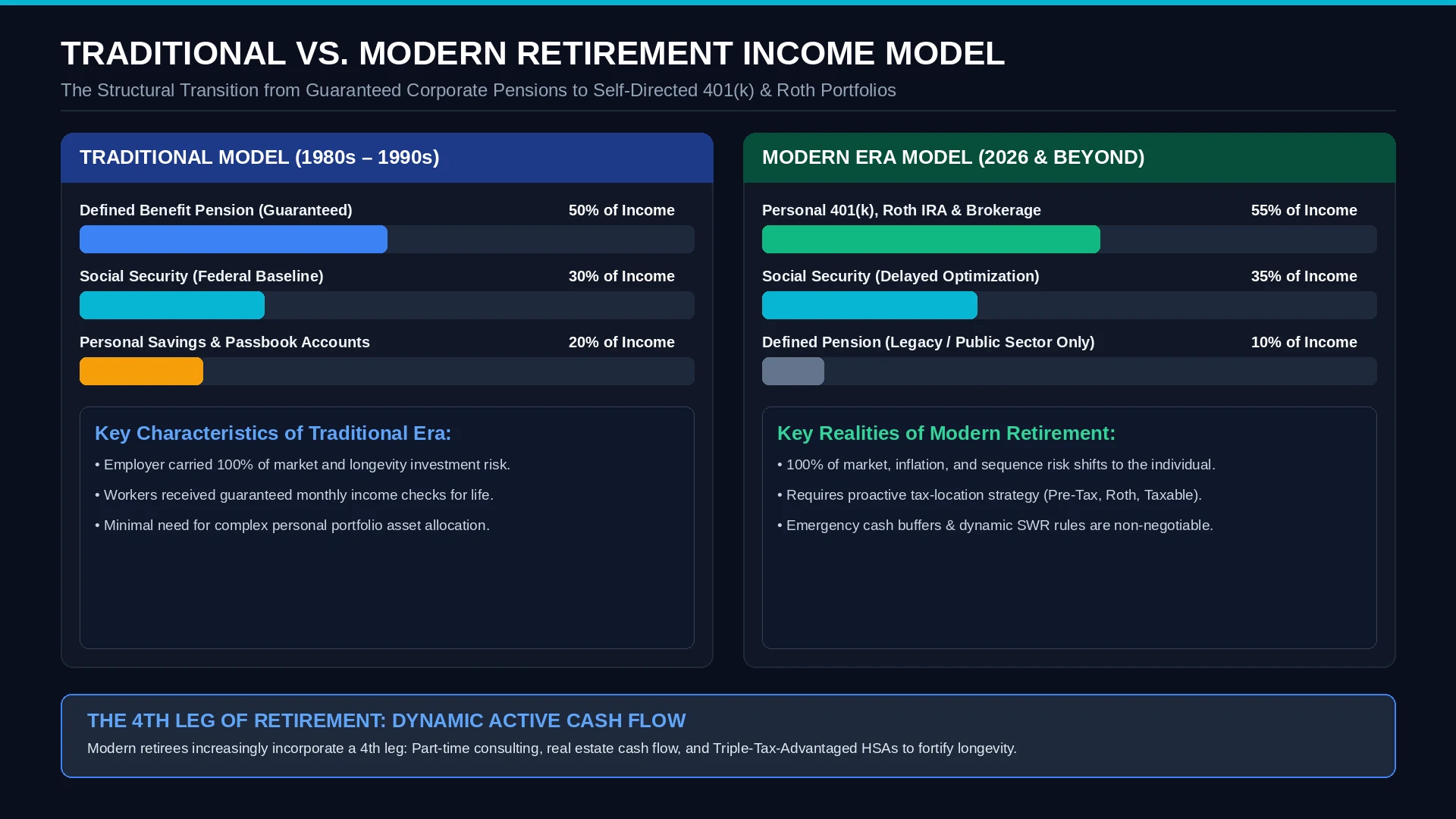
- The Modern Pension Collapse: With private-sector defined-benefit pensions dropping from 38% in 1980 to under 15% today, Leg 3 (Personal Wealth) must now generate 55% to 70% of total retirement cash flow.
- The 2025/2026 Regulatory Boost: SECURE 2.0 raises 401(k) limits to $23,500 ($24,500 in 2026) and introduces the $11,250 “Super Catch-Up” for ages 60–63, accelerating pre-retirement compounding.
- The 4th Leg Evolution: Modern retirees reinforce the stool by integrating a 4th leg: Part-time consulting, rental cash flows, and Triple-Tax-Advantaged Health Savings Accounts (HSAs) to defend against sequence of returns risk.
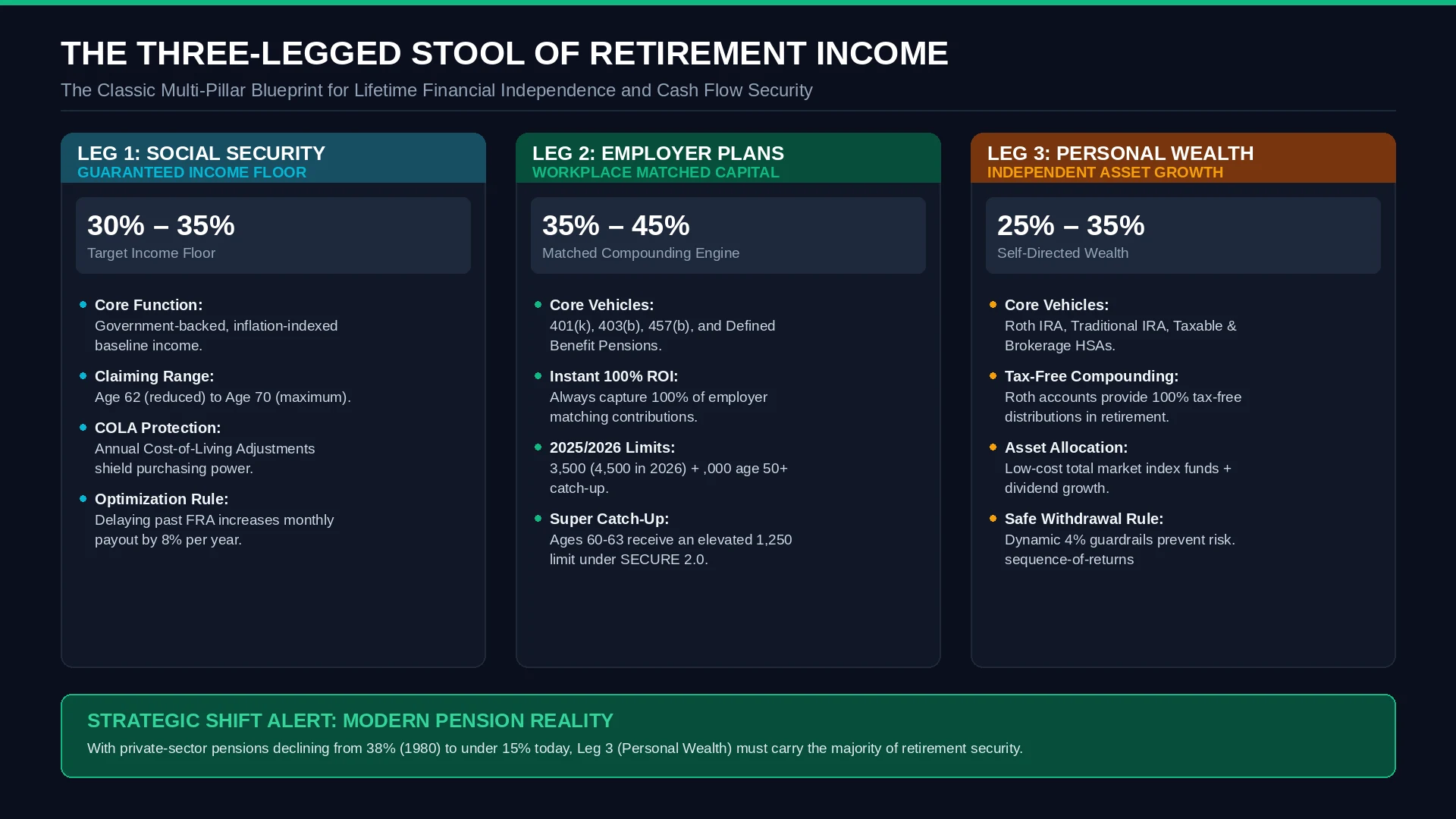
Achieving complete financial independence and building a resilient retirement cash flow engine requires mastering a foundational concept: The Three-Legged Stool of Retirement Income: A Simple Explanation. First conceptualized in 1949 by Reinhard A. Hohaus, an actuary for Metropolitan Life Insurance, this timeless framework demonstrates that a secure retirement cannot stand on a single income stream. Just like a physical three-legged stool, if any single leg is weak or missing, the entire structure wobbles and collapses. While different societies prioritize these pillars differently—as explored in our deep dive on how retirement is viewed across different cultures—the mathematical imperative remains identical.
In modern macroeconomics—marked by persistent cost-of-living increases, shifting tax brackets, and the near-total extinction of private corporate pensions—understanding how to balance and reinforce each leg of your retirement stool is the difference between financial anxiety and multi-generational prosperity. To model your exact monthly debt and savings obligations before allocating capital, utilize our interactive Debt Payoff Calculator and Household Budget Calculator.
The Core Anatomy: Breaking Down the Three Classic Legs
To construct an unshakeable retirement distribution engine, investors must understand the specific mechanics, tax treatments, and strategic roles of each pillar:
Leg 1: Social Security (The Guaranteed Foundation Floor)
Social Security represents the non-negotiable baseline of American retirement security. Backed by the full faith and credit of the United States government, it provides lifetime, inflation-indexed annuity income that cannot be outlived. Key strategic dynamics governing Leg 1 include:
• Automatic COLA Adjustments: Annual Cost-of-Living Adjustments protect retirees from structural monetary debasement.
• The Delayed Claiming Advantage: While benefits can be claimed as early as age 62 (at a permanent 25% to 30% reduction), delaying past your Full Retirement Age (FRA, age 67 for those born in 1960 or later) earns an 8.0% annual increase in Delayed Retirement Credits up to age 70.
• Longevity Insurance: Social Security eliminates sequence of returns risk for your baseline survival budget (housing, food, baseline healthcare).
Leg 2: Employer-Sponsored Plans & Pensions (Matched Capital)
Historically, Leg 2 consisted of employer-funded Defined Benefit (DB) pensions that paid a guaranteed monthly salary for life based on years of service. In the 21st century, Leg 2 has transitioned almost exclusively into Defined Contribution (DC) plans, including workplace 401(k), 403(b), and 457(b) programs:
• The Employer Match (100% Instant ROI): Capturing your full employer matching contribution is the single highest guaranteed return in personal finance.
• Automatic Payroll Deduction: Removing behavioral friction allows pre-tax capital to compound systematically before it hits your personal checking account.
• Institutional Fee Advantages: Large workplace plans often grant access to low-cost institutional share classes not available to retail investors.
Leg 3: Personal Savings & Tax-Advantaged Investments (The Growth Engine)
Leg 3 encompasses all self-directed wealth accumulated outside employer walls. Because you maintain 100% control over account selection, asset allocation, and withdrawal timing, this leg serves as your primary vehicle for building customized, tax-efficient wealth:
• Roth IRAs & Backdoor Roths: Provide 100% tax-free growth and tax-free distributions in retirement, completely exempt from Required Minimum Distributions (RMDs).
• Taxable Brokerage Accounts: Offer maximum flexibility with no contribution limits, no early-withdrawal age restrictions, and favorable long-term capital gains tax rates (0%, 15%, or 20%).
• Health Savings Accounts (HSAs): Deliver unmatched triple-tax advantages (tax-deductible contributions, tax-free growth, and tax-free withdrawals for qualified medical expenses). To align your risk tolerance with your withdrawal runway, read our complete analysis on Investment Time Horizons.
The Historical Shift: Why the Traditional Three-Legged Stool Broke
When the three-legged stool model was popularized in the mid-20th century, corporate America operated under an implicit social contract: an employee dedicated 30 years to a company, and in exchange, the company guaranteed a lifetime pension. In 1980, over 38% of private-sector workers were covered by defined-benefit pensions. Today, that number has collapsed to under 15% (primarily concentrated in public-sector, government, and military roles).
This seismic structural shift transferred 100% of the investment risk, inflation risk, and longevity risk from corporations onto the shoulders of individual workers. Consequently, Leg 2 transformed from a guaranteed income floor into an account balance subject to market volatility. Savers who fail to actively build Leg 3 find themselves attempting to balance on a precarious two-legged stool. Learn more about navigating each stage of your financial timeline in our deep dive into the 5 Stages of Retirement Planning.
Comprehensive Strategic Comparison Matrix: The 4 Pillars
The table below provides a side-by-side strategic breakdown of each retirement income pillar under current economic conditions:
| Income Pillar | Primary Asset Vehicles | Target Income Share | Tax Treatment at Withdrawal | Core Strategic Role |
|---|---|---|---|---|
| Leg 1: Guaranteed Floor | Social Security & Fixed Annuities | 30% – 35% | 0% to 85% taxable (provisional income) | Covers baseline non-discretionary survival budget |
| Leg 2: Employer Matched | Workplace 401(k), 403(b), 457(b) | 35% – 45% | Ordinary income tax rates | Captures 100% employer match & pre-tax compounding |
| Leg 3: Personal Growth | Roth IRA, Brokerage, Index Funds | 25% – 35% | 100% Tax-free (Roth) / Capital Gains | Generates dynamic growth & tax bracket arbitrage |
| Leg 4: Longevity Shield | HSAs, Part-Time Work, Cash Buffer | 10% – 15% | 100% Tax-free (HSA) / Ordinary income | Shields against bear market sequence-of-returns risk |
2025/2026 Statutory Contribution Limits & SECURE 2.0 Legislation
To maximize the accumulation velocity of Leg 2 and Leg 3, savers must leverage updated statutory contribution limits established under the landmark SECURE 2.0 Act and official IRS revenue procedures:
• Workplace 401(k) / 403(b) Elective Deferrals: Set at $23,500 for 2025 ($24,500 in 2026) with a standard catch-up limit of $7,500 ($8,000 in 2026) for savers age 50 and older.
• SECURE 2.0 “Super Catch-Up” (Ages 60–63): Workers aged 60, 61, 62, and 63 qualify for an elevated catch-up threshold of $11,250, offering an accelerated compounding sprint immediately prior to retirement.
• Mandatory High-Earner Roth Catch-Up (2026 Rule): Starting in 2026, employees earning over $150,000 in prior-year FICA wages must direct all catch-up contributions into after-tax Roth accounts rather than pre-tax accounts.
• Individual Retirement Accounts (IRAs): Annual contribution limits are $7,000 ($7,500 in 2026) with a $1,000 catch-up allowance.
• Health Savings Accounts (HSAs): Limits stand at $4,300 for self-only and $8,550 for family coverage ($4,400 and $8,750 in 2026), with an additional $1,000 catch-up for individuals age 55+.
Quantitative Modeling: Mathematical Compounding & The 4% Rule
Understanding the exact mathematical mechanics behind the three-legged stool demonstrates why systematic contributions into Leg 3 are non-negotiable. Consider a simulation of a 30-year-old saver contributing $1,000 per month split across a workplace 401(k) (Leg 2) and a Roth IRA (Leg 3):
• Total Capital Contributed over 30 Years: $360,000 ($12,000/year × 30 years).
• Terminal Wealth at 8.0% Annualized Return: $1,490,360 ($1.13 Million in pure compound growth).
• Annual Safe Cash Flow via the 4% Rule: $59,614 per year ($4,967/month), completely independent of Social Security!
When combined with an estimated $2,500/month Social Security benefit (Leg 1), this saver secures over $7,467 per month in stable, multi-stream retirement cash flow. For foundational guidance on structuring your holistic wealth roadmap, consult our comprehensive guide on What is Retirement Planning?.

Expert Video Walkthrough: The Three-Legged Stool of Retirement Income
To explore how top fiduciary financial planners structure these cash flow streams to mitigate longevity risk and tax liabilities, watch this authoritative breakdown by Castle Wealth Group Legal:
5-Phase Actionable Implementation Protocol
To implement the principles of the three-legged stool of retirement income with institutional rigor, follow this structured five-phase roadmap:
Phase 1: Conduct a Holistic Cash Flow & Expense Audit
Calculate your baseline annual living expenses divided into “essential survival needs” (housing, food, utilities, baseline healthcare) and “discretionary lifestyle desires” (travel, dining, hobbies). Ensure Leg 1 (Social Security) and guaranteed pensions cover 100% of essential survival costs.
Phase 2: Maximize Workplace 401(k) Matching (Leg 2)
Contribute enough to your workplace retirement plan to secure 100% of your employer match. Never leave free company matching funds on the table.
Phase 3: Max Out Triple-Tax HSAs & Roth IRAs (Leg 3)
Direct subsequent investment dollars into a Health Savings Account (HSA) and max out an individual Roth IRA (or execute a Backdoor Roth IRA if your income exceeds statutory thresholds). For a head-to-head tax comparison, check our guide to how to max out 401(k) and Roth IRA at the same time.
Phase 4: Construct a 24-Month Defensive Liquidity Buffer
Maintain 12 to 24 months of living expenses in an FDIC-insured high-yield savings account or short-duration Treasury ladder. This cash buffer prevents forced share liquidations during market corrections. Calculate your liquidity cushion with our Emergency Fund Calculator.
Phase 5: Optimize Tax-Efficient Withdrawal Sequencing
In retirement, harvest distributions in an engineered hierarchy: 1) Cash dividends and bond coupons; 2) Taxable brokerage long-term capital gains; 3) Pre-tax 401(k) distributions up to standard deduction brackets; and 4) Tax-free Roth funds for higher spending years to avoid stepping into higher marginal tax brackets.
Frequently Asked Questions (FAQs)
Below are authoritative answers to the most common questions regarding the three-legged stool of retirement income planning:
The three-legged stool of retirement income is a foundational personal finance model created in 1949 by Reinhard A. Hohaus. It states that a secure retirement rests on three distinct pillars: 1) Social Security (guaranteed government floor), 2) Employer-sponsored plans (pensions or 401(k) matches), and 3) Personal savings and investments (IRAs, Roth accounts, and brokerage portfolios).
The traditional stool is considered broken because defined-benefit corporate pensions (Leg 2) have almost entirely disappeared in the private sector, plummeting from 38% coverage in 1980 to under 15% today. This shifts 70% or more of the retirement funding burden directly onto individual savers through self-directed 401(k)s and personal accounts.
In the modern era, a balanced target is: Social Security providing 30% to 35% of essential living costs, employer-matched 401(k) accounts providing 35% to 45%, and personal Roth IRAs/taxable brokerage investments providing 25% to 35%. If an employer pension is absent, personal investments must expand to 55% or more.
The fourth leg is dynamic active cash flow, which includes part-time consulting or phased retirement work, rental real estate income, and Triple-Tax-Advantaged Health Savings Accounts (HSAs) specifically designated to absorb medical and long-term care costs without liquidating equities.
For every year you delay claiming Social Security past your Full Retirement Age (FRA, age 67 for those born in 1960 or later) up to age 70, your guaranteed monthly benefit increases by 8.0% per year through Delayed Retirement Credits. Delaying to age 70 results in a 24% higher permanent, inflation-adjusted monthly payout.
For 2025/2026, the 401(k) elective deferral limit is $23,500 ($24,500 in 2026) with an $8,000 catch-up for ages 50+. Under SECURE 2.0, savers aged 60 to 63 qualify for an elevated ‘Super Catch-Up’ of $11,250. IRA limits stand at $7,000 ($7,500 in 2026) with a $1,000 catch-up, and HSA limits are $4,300 self-only and $8,550 family ($4,400 and $8,750 in 2026).
The 4% Safe Withdrawal Rule dictates how much you can harvest from Leg 3 (Personal Investments) and Leg 2 (401(k)). You calculate your total annual retirement expenses, subtract guaranteed income from Leg 1 (Social Security) and any pensions, and multiply the remaining gap by 25 to determine your required portfolio target.
To minimize lifetime tax drag: 1) Harvest cash reserves and dividend yields first; 2) Withdraw from taxable brokerage accounts up to favorable long-term capital gains brackets; 3) Take distributions from pre-tax 401(k)s up to the standard deduction threshold; and 4) Pull from tax-free Roth IRAs for higher discretionary expenses or to avoid jumping tax brackets.
Final Expert Verdict: Building Your Enduring Stool
Mastering The Three-Legged Stool of Retirement Income: A Simple Explanation is not about predicting stock market movements—it is about engineering a diversified, resilient capital architecture. By locking in a reliable Social Security foundation (Leg 1), maximizing employer-sponsored 401(k) matching (Leg 2), and aggressively compounding tax-advantaged Roth and brokerage assets (Leg 3), you construct a fortress of lifetime cash flow that withstands any economic cycle.
Balancing pensions, personal savings, and Social Security provides a resilient multi-source income framework throughout your retirement years. Consult the official Social Security Administration (SSA) Official Portal for statutory guidelines and consumer protections.
🏛️ Multi-Pillar Retirement Income & Pension Strategy
Construct an unbreakable multi-pillar income foundation with these companion guides:
- Master Framework: 5 stages of retirement planning lifecycle — orchestrate Social Security, employer plans, and private portfolios seamlessly.
- Social Security Payouts: Social Security spousal benefits: maximize payouts — unlock maximum guaranteed monthly checks for you and your spouse.
- Personal Tax Accounts: how to max out 401(k) and Roth IRA — building the third and largest leg of your retirement income stool.
- Pension Vulnerabilities: got a pension? why you still need personal retirement savings — why defined-benefit pensions require personal investment cushions.
- Safe Withdrawal Math: the 4% rule safe withdrawal rate explained — computing sustainable annual income from your personal portfolio leg.

Jaiveer Hooda is the Lead Financial Researcher & Personal Finance Analyst at Grow Your Money Smart. Specializing in personal wealth optimization, index fund compounding, high-yield savings mechanics, and consumer debt elimination strategies. With a background in computer engineering, he applies mathematical modeling, cashflow simulations, and empirical risk analysis to evaluate personal finance vehicles and credit products. Every analysis is backed by verified regulatory disclosures, IRS tax schedules, and empirical APY compounding math.
Areas of Expertise: Personal Finance · High-Yield Savings Accounts (HYSA) · Index Funds & S&P 500 Compounding · Retirement Planning (401k/IRA) · Debt Optimization · Credit Card APR Mechanics.
Transparency & Editorial Policy: Editorial Standards | Report a Correction