
Defined-benefit pensions often lack full inflation indexing, creating the need for supplemental private tax-sheltered accounts. Consult the official Internal Revenue Service (IRS) Types of Retirement Plans for statutory guidelines and consumer protections.
Insulate your retirement against fixed pension inflation and corporate insolvency with these resources:
- Three-Pillar Model: the three-legged stool of retirement income — reinforce your guaranteed pension with personal wealth engines.
- Tax-Sheltered Accounts: how to max out 401(k) and Roth IRA — build an independent personal nest egg free from municipal or company risk.
- Cost of Living Defense: how inflation erodes retirement savings — combat unindexed pension benefit decay over a 30-year retirement.
- Automated Growth: the 3-fund portfolio lazy investor guide — harness low-cost market-wide index funds to generate supplemental income.
- The 58% Inflation Trap: Most defined-benefit pensions have capped or zero Cost-of-Living Adjustments (COLAs). At 3.5% inflation, a fixed $3,000/month pension loses nearly 60% of its purchasing power over 25 years ($1,269 real value).
- Zero Liquidity & Survivor Risks: Pensions provide illiquid monthly streams that cannot be tapped for emergency healthcare or home repairs, and single-life elections leave surviving spouses with $0 upon death.
- The Dual-Engine Blueprint: Pairing your baseline pension floor with a personal self-directed Roth IRA and governmental 457(b) creates an inflation growth engine, tax diversification, and multi-generational family wealth.
- Penalty-Free Early Access: Governmental 457(b) plans have ZERO 10% early withdrawal penalties upon separation, providing the ultimate bridge for early retirees.
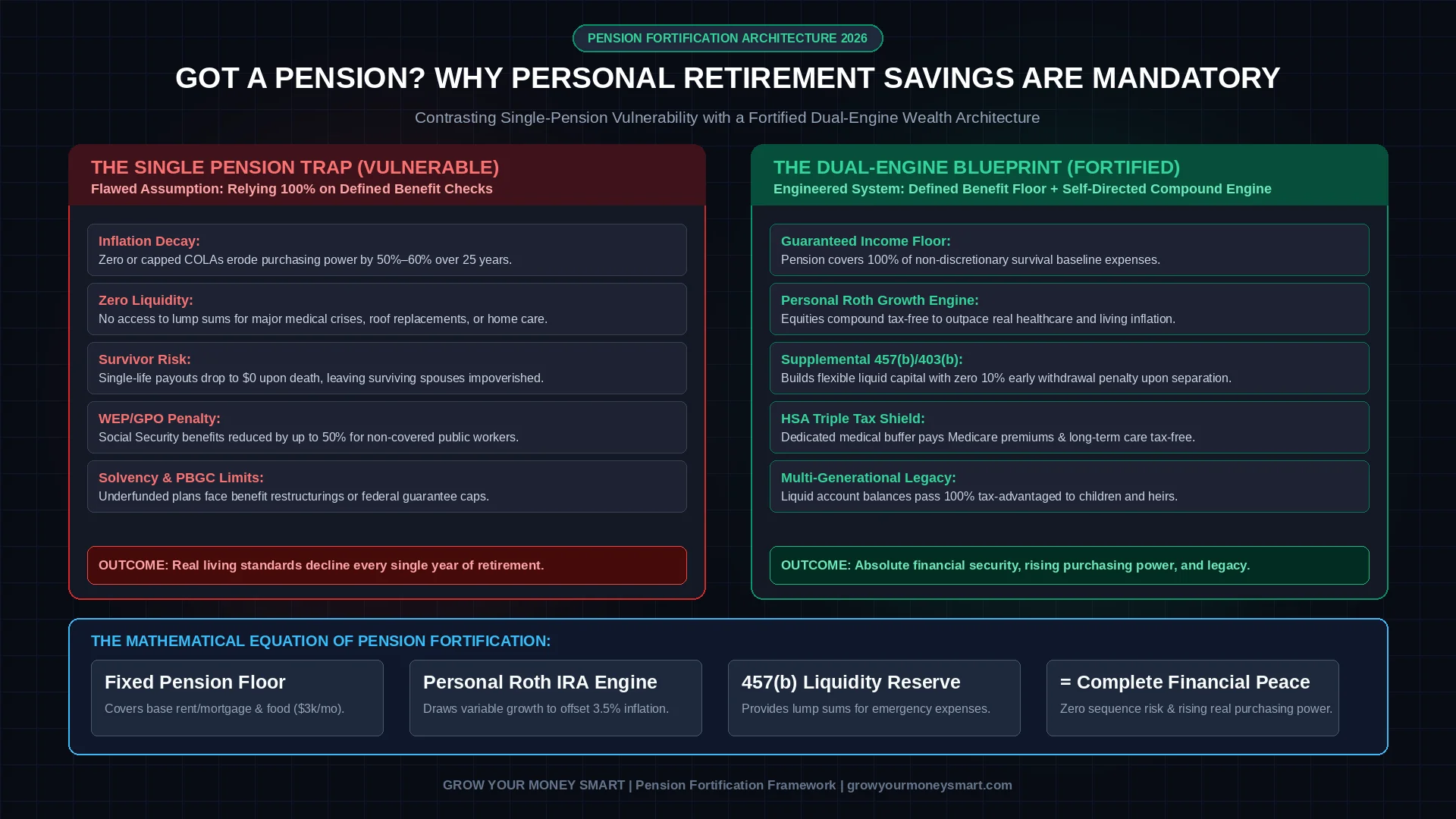
If you are a teacher, firefighter, police officer, civil servant, healthcare worker, or one of the fortunate corporate employees with a defined benefit pension plan, you belong to a rare and enviable category of modern workers. In an era where corporate America has largely dismantled traditional pensions in favor of self-directed 401(k) accounts, holding a guaranteed monthly retirement check feels like the ultimate financial security blanket.
However, harboring the belief that “My pension will cover everything, so I don’t need to save personally” is one of the most dangerous and pervasive retirement planning traps. While a pension serves as an outstanding guaranteed income floor, relying on it as your sole economic engine exposes your future to silent inflation decay, severe liquidity shortages, survivor benefit reductions, and legislative Social Security offsets. For precision diagnostics on your household cash flows, utilize our interactive Debt Payoff Calculator and Household Budget Calculator.
The 5 Hidden Vulnerabilities of Single-Pension Reliance
Understanding why personal retirement accounts (Roth IRAs, 457(b)s, 403(b)s, and HSAs) are mandatory requires examining the five structural vulnerabilities inherent in traditional defined benefit plans:
1. The Silent Erosion of Inflation & Capped COLAs:
Unlike Social Security, which is federally indexed to the Consumer Price Index (CPI-W), the majority of corporate and municipal pensions offer fixed monthly payouts or severely capped Cost-of-Living Adjustments (often capped at 1.0%–2.0% annually). In periods of persistent inflation, your purchasing power deteriorates rapidly every single year.
2. Complete Absence of Emergency Liquidity:
A pension arrives in rigid monthly installments. You cannot borrow against it, accelerate distributions, or withdraw a $50,000 lump sum to replace a leaking roof, handle specialized medical surgery, or support an adult child during an economic crisis. Without personal liquid reserves, pension holders are frequently forced into high-interest credit card debt.
3. Severe Survivor Benefit Drop-Offs:
When electing pension payout options at retirement, choosing the maximum monthly payout (Single-Life Annuity) means that all benefit payments instantly drop to $0 upon your death, leaving your surviving spouse completely unprovided for. Opting for a 50% or 100% Joint-and-Survivor option permanently cuts your monthly check during your lifetime by 10% to 25%.
4. The Windfall Elimination Provision (WEP) & Government Pension Offset (GPO):
If your pension originates from public employment where you did not pay into FICA taxes, federal law invokes WEP and GPO. The Windfall Elimination Provision can slash your Social Security retirement benefit by up to 50%, while the Government Pension Offset can completely eliminate your spousal or survivor Social Security benefits.
5. Plan Solvency & PBGC Federal Guarantee Caps:
Many state, municipal, and multi-employer pension funds face multi-billion dollar unfunded liabilities. If a private corporate plan fails, the Pension Benefit Guaranty Corporation (PBGC) steps in—but statutory maximum payout limits often mean higher-earning retirees suffer substantial monthly benefit cuts. Learn how to progress through each wealth milestone in our guide on the 5 Stages of Retirement Planning.
Head-to-Head Comparison: Single Pension vs. Dual-Engine Architecture
The table below contrasts the risk profile of relying exclusively on a defined benefit pension versus deploying a fortified dual-engine wealth architecture—a multi-pillar strategy consistent with how retirement is viewed across different cultures and leading global pension frameworks:
| Strategic Dimension | Single-Pension Reliance (Vulnerable) | Dual-Engine Architecture (Fortified) | Long-Term Benefit |
|---|---|---|---|
| Inflation Resilience | Fixed check decays 50%–60% over 25 years | Personal Roth equities expand real cash flow | Guarantees permanent purchasing power growth |
| Emergency Capital | $0 accessible lump sum liquidity | Flexible 457(b) & Taxable brokerage buffers | Absorbs major life shocks without debt |
| Tax Diversification | 100% taxed as ordinary income | Three-bucket strategy (Pre-tax, Roth, HSA) | Keeps retiree in the 0%–12% effective tax bracket |
| Survivor Protection | Requires 15%–25% pension haircut or $0 to spouse | Liquid balances pass 100% to spouse/heirs | Complete peace of mind for surviving family |
| Healthcare Buffer | OutOfPocket costs paid from taxable check | Triple-tax-free HSA pays Medicare B/D & IRMAA | Shields monthly cash flow from medical inflation |
| Retirement Timeline | Locked until statutory pension age formula | 457(b) unlocks penalty-free early retirement | Unlocks 5–10 years of early time sovereignty |
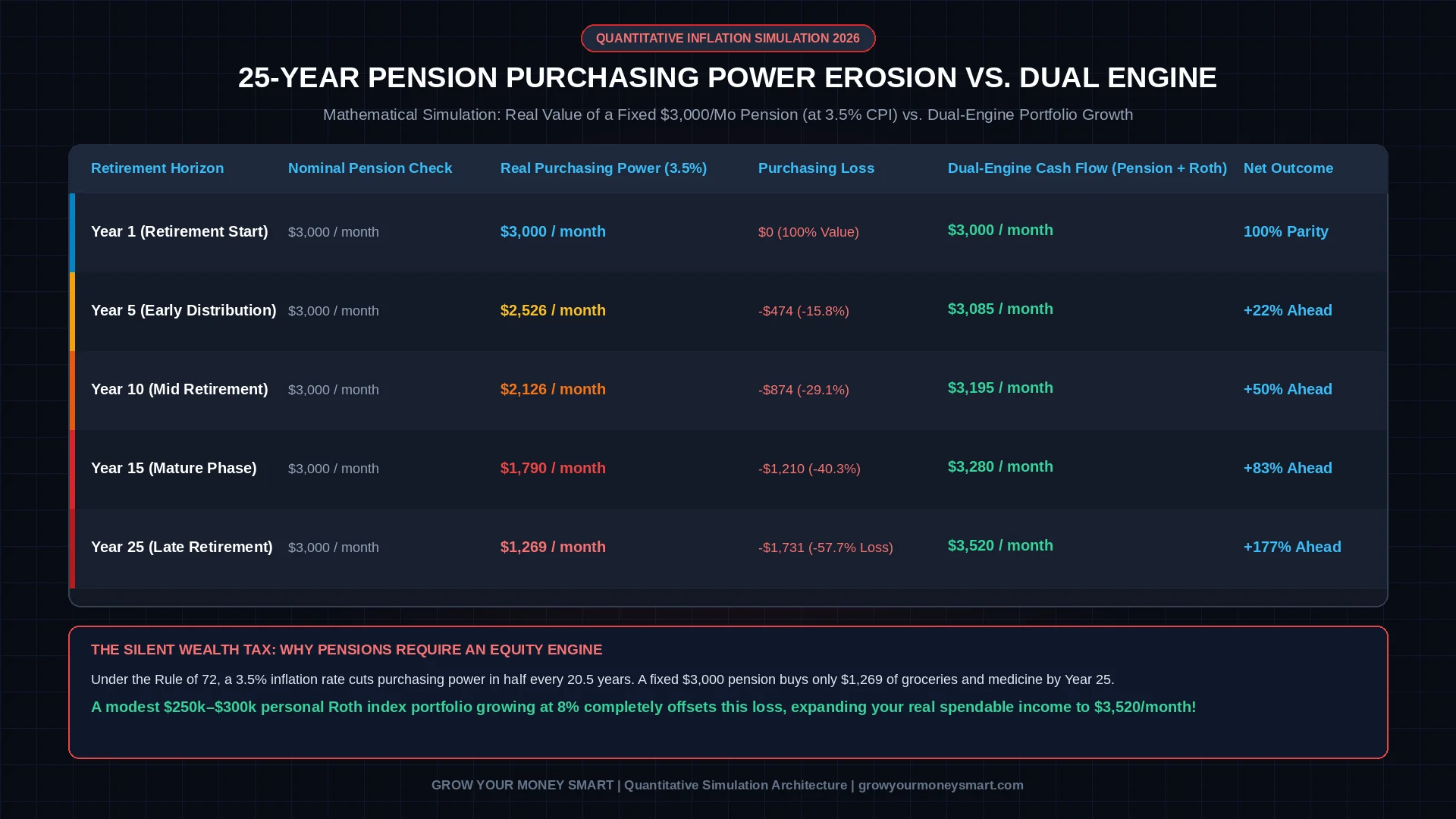
25-Year Quantitative Simulation: The True Cost of Inflation on a Pension
To understand the mathematical urgency of building personal savings alongside a pension, examine the 25-year purchasing power simulation below. Consider a fixed defined-benefit pension paying $3,000 per month with zero COLA under a standard 3.5% annualized inflation rate, compared to a Dual-Engine strategy pairing that same pension with a modest $250,000 personal index fund portfolio growing at 7.5% nominal return:
| Retirement Year | Nominal Monthly Check | Real Purchasing Power (3.5% CPI) | Cumulative Purchasing Loss | Dual-Engine Cash Flow (Pension + Roth) | Net Real Advantage |
|---|---|---|---|---|---|
| Year 1 | $3,000 / month | $3,000 / month | $0 (100% Value) | $3,000 / month | Baseline Parity |
| Year 5 | $3,000 / month | $2,526 / month | -$474 / mo (-15.8%) | $3,085 / month | +22% Higher Real Income |
| Year 10 | $3,000 / month | $2,126 / month | -$874 / mo (-29.1%) | $3,195 / month | +50% Higher Real Income |
| Year 15 | $3,000 / month | $1,790 / month | -$1,210 / mo (-40.3%) | $3,280 / month | +83% Higher Real Income |
| Year 20 | $3,000 / month | $1,507 / month | -$1,493 / mo (-49.8%) | $3,390 / month | +125% Higher Real Income |
| Year 25 | $3,000 / month | $1,269 / month | -$1,731 / mo (-57.7%) | $3,520 / month | +177% Higher Real Income |
By Year 25 of retirement, an unindexed $3,000/month pension has lost 57.7% of its real purchasing power, forcing retirees to dramatically cut their lifestyle, eliminate travel, and struggle with rising healthcare costs. The personal investment engine completely counteracts this decay, expanding real spendable cash flow to $3,520/month. Evaluate how time horizon dictates appropriate risk by exploring our guide on Investment Time Horizons.
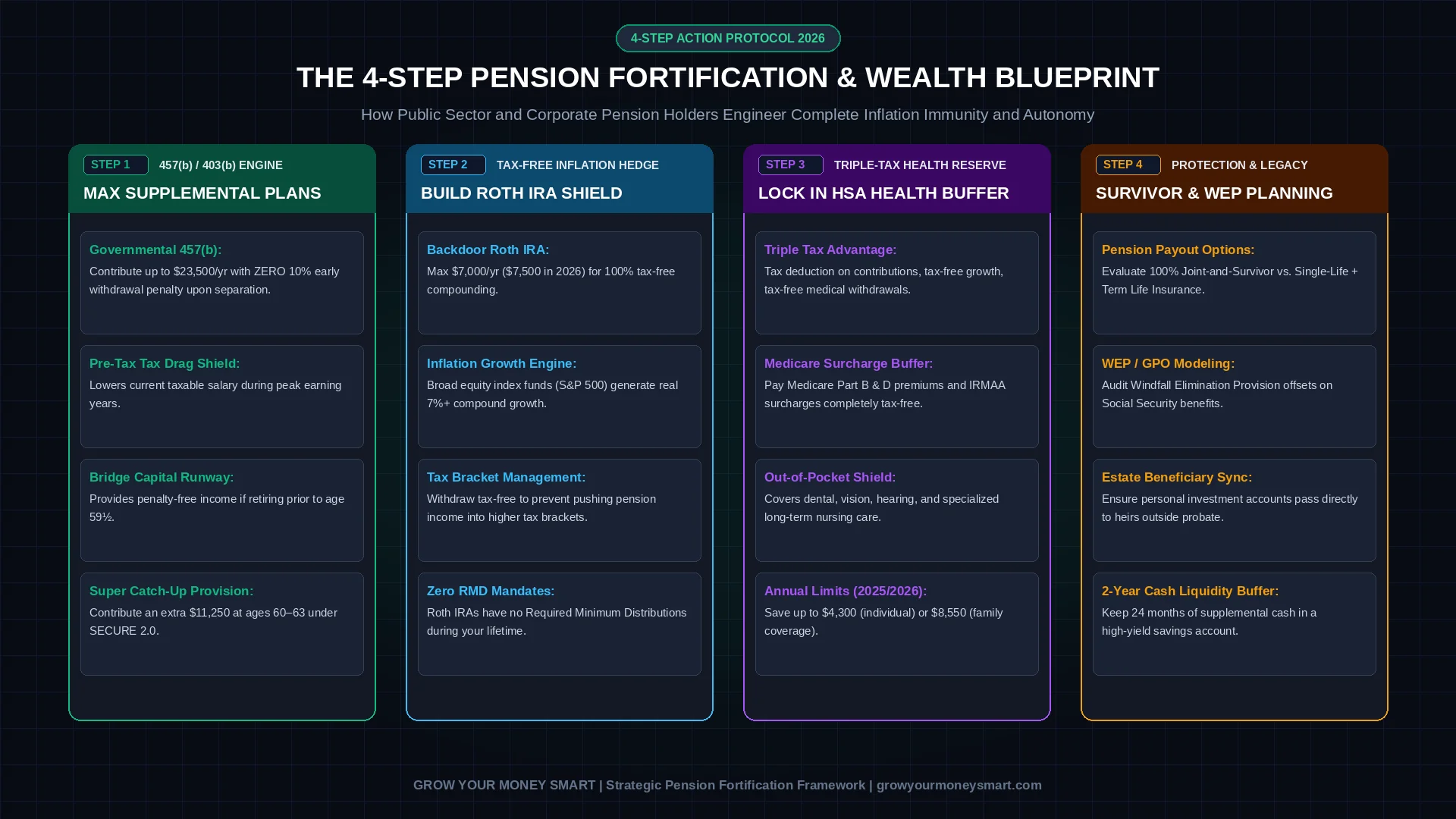
The 4-Step Master Action Blueprint for Pension Holders
To insulate your future from the vulnerabilities of a single pension system, execute these four tactical steps:
Step 1: Maximize Governmental 457(b) & 403(b) Plans
If you work in public education, law enforcement, healthcare, or municipal government, leverage your governmental 457(b) plan. Unlike private 401(k) accounts that penalize withdrawals before age 59½, governmental 457(b) accounts have NO 10% IRS early withdrawal penalty once you separate from service. This makes the 457(b) the premier vehicle for bridging early retirement before statutory pension benefits commence.
Step 2: Build an Aggressive Roth IRA Growth Engine
Because your pension will be taxed as ordinary income upon distribution, you need tax diversification. Fund a Roth IRA (or execute Backdoor Roth conversions). Investing in low-cost broad market equities (such as the S&P 500 or Total Stock Market index) creates an engine of 100% tax-free growth that outpaces the rate of inflation and generates penalty-free distributions with zero Required Minimum Distributions (RMDs).
Step 3: Establish a Dedicated HSA Medical Reserve
Healthcare is the fastest-inflating expense category in retirement. Enrolling in a High Deductible Health Plan (HDHP) allows you to fund a Health Savings Account (HSA). Your HSA contributions are 100% tax-deductible, grow tax-free, and withdraw tax-free for qualified medical expenses, Medicare Part B and Part D premiums, and long-term care insurance premiums.
Step 4: Execute Strategic Survivor & WEP Modeling
Audit your pension payout choices. In many cases, selecting the higher Single-Life pension payout and purchasing a separate 20- to 30-year level-term life insurance policy (“Pension Maximization Strategy”) provides higher monthly income during retirement while leaving a multi-million-dollar tax-free payout to your spouse. Furthermore, model your Windfall Elimination Provision offsets using official SSA tools to prevent surprise Social Security reductions. Protect your liquid reserves with our Emergency Fund Calculator.
Expert Video Walkthrough: Accounting for Inflation in Retirement Planning
To see how inflation compounds against fixed income streams and learn how to construct an equity growth hedge, watch this detailed walkthrough by Brian Preston and Bo Hanson on “How To Account For Inflation In Your Retirement Planning”:
2025/2026 Contribution Limits & SECURE 2.0 Accelerators
Fortifying your pension is faster and more tax-efficient under the updated IRS statutory limits:
• Workplace 457(b), 403(b), & 401(k) Deferral Limits: Set at $23,500 for 2025 ($24,500 in 2026). Standard catch-up contributions for workers aged 50+ remain at $7,500 ($8,000 in 2026).
• SECURE 2.0 “Super Catch-Up” (Ages 60–63): Elevates the catch-up contribution threshold to $11,250 for workers reaching ages 60, 61, 62, or 63, providing a powerful 4-year acceleration runway prior to retirement.
• Individual Retirement Accounts (IRAs): Annual limit is $7,000 ($7,500 in 2026) with an extra $1,000 catch-up for age 50+.
• Health Savings Accounts (HSAs): Annual limits are $4,300 for individual and $8,550 for family coverage ($4,400 and $8,750 respectively in 2026), plus an extra $1,000 catch-up at age 55+.
• Double Contribution Flexibility for Public Workers: Many state and local public employees can simultaneously max out BOTH a 403(b) and a 457(b) plan, allowing them to shield an incredible $47,000 per year ($49,000 in 2026) in pre-tax savings!
Frequently Asked Questions (FAQs)
Below are clear, mathematically grounded answers to the most common questions pension holders ask about building personal retirement savings:
For the vast majority of retirees, no. Most modern pensions have capped or non-existent Cost-of-Living Adjustments (COLAs), lack lump-sum liquidity for medical emergencies, carry survivor benefit reductions, and may be subject to Windfall Elimination Provision (WEP) Social Security offsets.
Under a modest 3.5% inflation rate, a fixed $3,000 monthly pension loses approximately 58% of its real purchasing power over 25 years, declining to the equivalent of just $1,269 per month in buying power.
The Windfall Elimination Provision (WEP) is an IRS/SSA formula that reduces Social Security benefits for individuals who receive a pension from ‘non-covered’ employment (such as certain state, local, or federal civil service jobs where FICA taxes were not paid). WEP can slash Social Security retirement benefits by up to 50%.
Public employees should aggressively fund: 1) Governmental 457(b) plans (which have no 10% early withdrawal penalty upon separation from service); 2) Roth IRAs or Backdoor Roth conversions (for tax-free inflation-beating growth); and 3) Health Savings Accounts (HSAs) for tax-free medical buffers.
A single-life pension provides the maximum monthly payout during your life, but payments cease completely ($0) upon your death. A joint-and-survivor option reduces your monthly payout by 10% to 20% while you are alive, but continues paying 50%, 75%, or 100% of the benefit to your surviving spouse.
Unlike standard 401(k) or 403(b) plans that impose a 10% IRS early withdrawal penalty prior to age 59½, governmental 457(b) plans allow penalty-free distributions at any age as soon as you separate from your employer.
If a private defined-benefit plan fails, the Pension Benefit Guaranty Corporation (PBGC) takes over payments, but payouts are capped at statutory federal maximum limits, often resulting in significant benefit reductions for higher-earning retirees.
For 2025/2026, 457(b) and 403(b) contribution limits are $23,500 ($24,500 in 2026) with an extra $11,250 SECURE 2.0 super catch-up for ages 60–63. Roth IRA contribution limits are $7,000 ($7,500 in 2026).
Final Verdict: Transforming a Fixed Pension into a Bulletproof Wealth Fortress
Having a pension is a tremendous financial asset—it provides an unshakeable bedrock of baseline monthly income. However, true multi-decade wealth independence requires transforming that single baseline check into a complete fortified dual-engine system. By systematically funding your Roth IRA, capturing the unique penalty-free flexibility of a 457(b), and building a dedicated HSA healthcare buffer, you eliminate inflation anxiety, protect your family, and guarantee lasting financial freedom for generations to come.

Jaiveer Hooda is the Lead Financial Researcher & Personal Finance Analyst at Grow Your Money Smart. Specializing in personal wealth optimization, index fund compounding, high-yield savings mechanics, and consumer debt elimination strategies. With a background in computer engineering, he applies mathematical modeling, cashflow simulations, and empirical risk analysis to evaluate personal finance vehicles and credit products. Every analysis is backed by verified regulatory disclosures, IRS tax schedules, and empirical APY compounding math.
Areas of Expertise: Personal Finance · High-Yield Savings Accounts (HYSA) · Index Funds & S&P 500 Compounding · Retirement Planning (401k/IRA) · Debt Optimization · Credit Card APR Mechanics.
Transparency & Editorial Policy: Editorial Standards | Report a Correction