
Freelancers and variable earners require baseline expense modeling and larger reserve buffers to navigate unpredictable monthly compensation. Consult the official Consumer Financial Protection Bureau (CFPB) Budgeting Strategies Guide for statutory guidelines and consumer protections.
Smooth out income peaks and valleys with these irregular cash flow strategies and tools:
- Frictionless Tracking: track spending without a spreadsheet — simple monitoring methods for busy freelancers and commission earners.
- Annual Bill Buffers: how to set up sinking funds for irregular expenses — insulate against quarterly tax bills and insurance premiums.
- Emergency Reserves: emergency fund savings calculator — calculate higher 6-to-9 month cash cushions for variable income security.
- Downloadable Tracker: free monthly budget spreadsheet and net worth tracker — dynamic spreadsheet built to accommodate fluctuating monthly wages.
- Moderate Salary Model: how to budget a $4,000 monthly salary — benchmarking variable income against standard salaried allocations.
Living on an unpredictable income—whether you are a freelancer, independent contractor, real estate agent, gig economy professional, or commission-based sales rep—can make traditional personal finance advice feel entirely detached from reality. When your monthly earnings fluctuate from $2,500 during a slow month to $7,500 during a peak season, standard static monthly budgets quickly break down.
The secret to mastering variable income is not predicting the future—it is engineering a cash flow stabilization architecture. By replacing guesswork with a systematic baseline floor, a segregated tax reserve, and a dedicated holding buffer account, you can create the consistency of a steady corporate paycheck while capitalizing on the massive upside of your high-earning months.
- Anchor to Your Baseline Floor: Calculate your non-negotiable living costs (housing, groceries, utilities, minimum debt) based on your lowest historical earning month.
- Implement the Two-Account Holding Buffer: Deposit all gross revenue into a business or holding account, then transfer a predictable, fixed “salary” to your personal spending account twice a month.
- Segregate Taxes First: Always sweep 25% to 30% of every invoice or commission check into a separate tax holding account before calculating personal take-home income.
- Build a 6 to 9-Month Safety Runway: Variable income earners require larger cash reserves than salaried workers to absorb multi-month contract delays and market cycles.
- Automate the Surplus Waterfall: Route windfalls from peak earning months through a structured hierarchy: 1) Tax Reserve, 2) Baseline Salary, 3) Hill-and-Valley Buffer, 4) Debt Payoff and Investments.
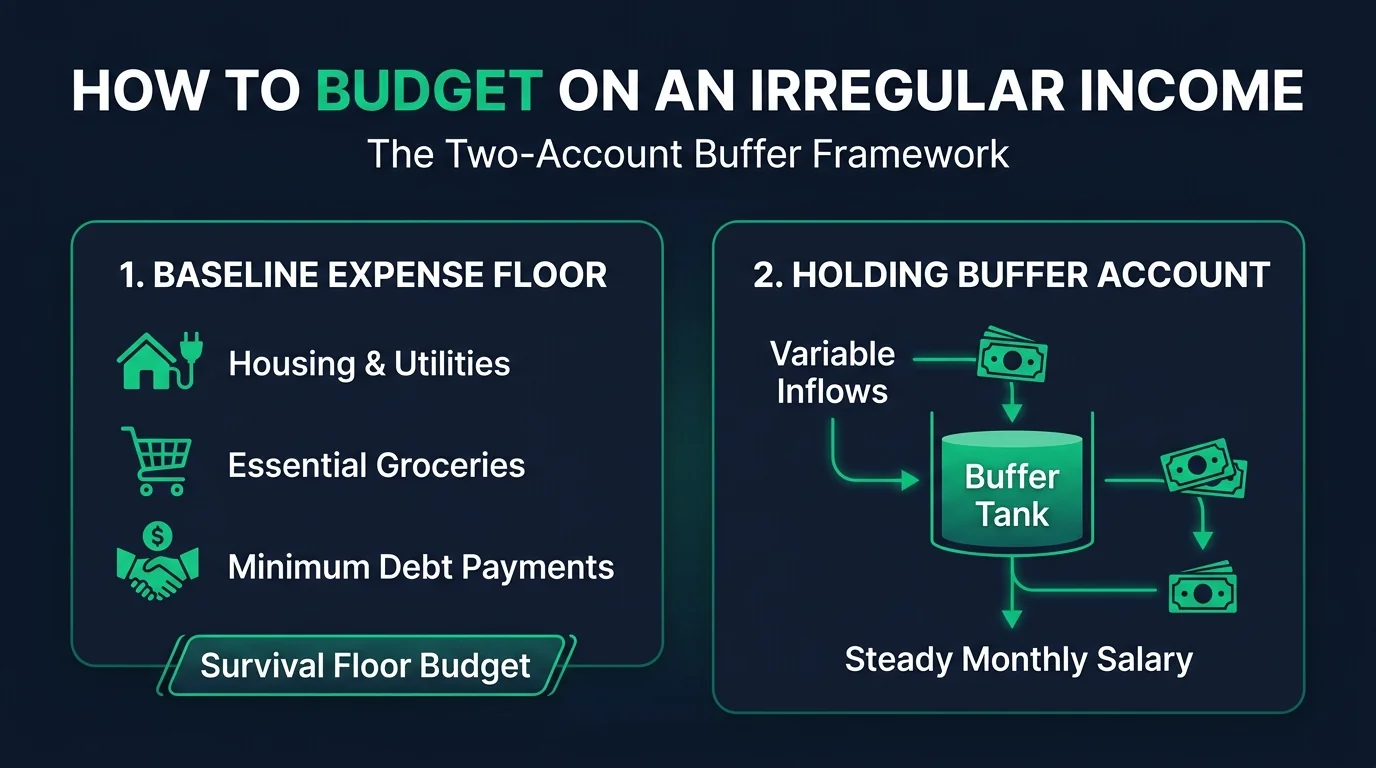
The Core Problem: Why Traditional Budgeting Fails Variable Earners
Traditional personal budgeting methodologies like the standard 50/30/20 rule assume a constant, linear stream of bi-weekly direct deposits. When a salaried earner allocates 50% to needs and 20% to savings, their dollar amounts remain fixed each pay period. However, when a variable income professional applies percentages directly to volatile gross receipts, three critical failure points emerge:
1. The “Feast-or-Famine” Lifestyle Trap: During a $7,000 revenue month, spending naturally expands to fit the influx (lifestyle creep). When income drops to $2,800 the following month, fixed obligations cannot shrink quickly enough, forcing individuals to rely on high-interest credit cards or drain long-term investments.
2. Underestimating Estimated Tax Liabilities: Freelancers and 1099 contractors who fail to withhold self-employment tax (15.3% FICA) plus federal and state income taxes on every check face devastating lump-sum quarterly tax penalties.
3. Irregular Expense Timing: Annual insurance premiums, vehicle maintenance, quarterly software subscriptions, and medical deductibles do not arrive on a smooth monthly schedule. When these hit during a lean revenue month, financial stress skyrockets.
To eliminate this volatility, you must decouple your personal standard of living from your monthly revenue fluctuations. If you want to simulate your numbers or compare different living cost allocations, utilize our interactive budget calculator to establish your benchmarks.
The 4-Pillar Variable Income Architecture
Rather than attempting to forecast fluctuating client billings, modern financial planning relies on an E-E-A-T validated cash flow architecture consisting of four segregated layers:
| Account / Layer | Primary Function | Target Allocation / Rule | Optimal Account Type |
|---|---|---|---|
| 1. Tax Withholding Reserve | Protects against IRS & state quarterly liabilities | 25%–30% of every incoming check | High-Yield Savings (Segregated) |
| 2. Holding Tank (Buffer) | Absorbs revenue spikes; distributes smooth salary | Holds 1–3 months of baseline expenses | Separate Checking / Business Account |
| 3. Personal Living Checking | Funds fixed monthly personal living expenses | Fixed monthly “artificial salary” draw | Personal Checking Account |
| 4. Strategic Emergency Runway | Protects against catastrophic multi-month droughts | 6–9 months of baseline living costs | Dedicated High-Yield Savings Account |
Step 1: Calculate Your 3-Tier Budget Floors
Before designing your cash flow system, audit your bank statements from the previous 12 months. Categorize every dollar into one of three distinct budget tiers:
Tier 1: The “Survival” Baseline Floor (Non-Negotiables): This is the absolute minimum dollar amount required to keep a roof over your head, food on the table, lights on, and credit accounts current. It includes rent/mortgage, basic utilities, core groceries, essential health/auto insurance, and minimum debt payments. If you are currently managing consumer loans, review our comprehensive guide on debt management strategies and download our free debt payoff Excel & Google Sheets template to streamline minimum obligations.
Tier 2: The “Comfortable” Baseline (Standard Living): This includes your Tier 1 floor plus modest lifestyle expenses: moderate dining out, gym memberships, routine streaming services, and routine personal care. This is the baseline number you will use to set your fixed monthly salary draw.
Tier 3: The “Expansion” Tier (Windfall Priorities): These expenses are funded only during peak revenue months after your holding buffer is fully replenished. They include extra retirement contributions, accelerated principal debt payoffs, family vacations, home improvements, and luxury purchases.
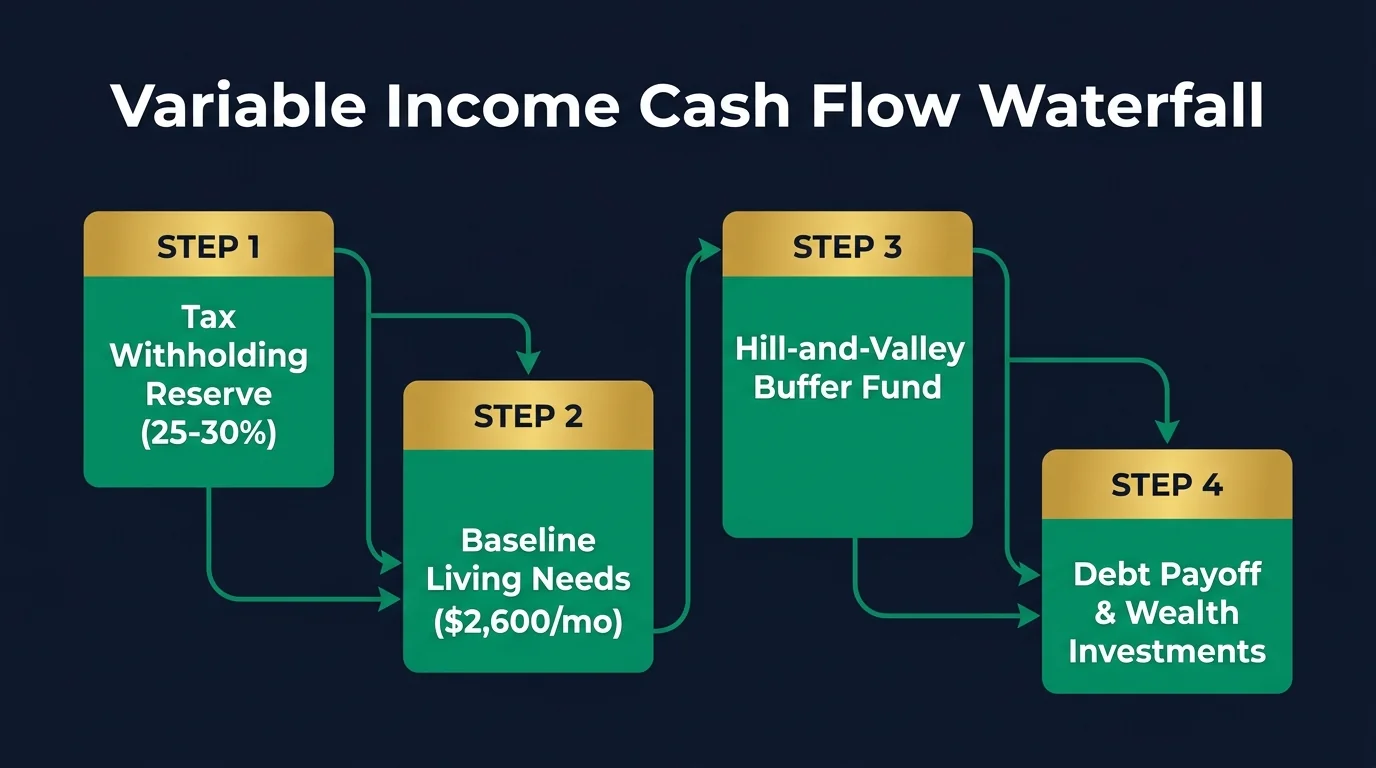
Mathematical Simulation: Lean Month vs Peak Month Cash Flow
To understand the mechanics of the Holding Tank buffer, let’s examine a freelance consultant whose gross monthly earnings fluctuate dramatically over a 6-month cycle between $3,200 (lean month) and $6,500 (peak month), with an average monthly revenue of $4,800. Their comfortable personal baseline salary is set at $2,800/month net after taxes.
| Month & Cycle Stage | Gross Receipts | Tax Reserve (30%) | Net Revenue | Salary Draw Paid | Buffer Net Inflow / (Draw) | Ending Buffer Balance |
|---|---|---|---|---|---|---|
| Month 1 (Average) | $4,800 | $1,440 | $3,360 | $2,800 | +$560 | $3,560 |
| Month 2 (Peak) | $6,500 | $1,950 | $4,550 | $2,800 | +$1,750 | $5,310 |
| Month 3 (Lean) | $3,200 | $960 | $2,240 | $2,800 | ($560) | $4,750 |
| Month 4 (Very Lean) | $2,800 | $840 | $1,960 | $2,800 | ($840) | $3,910 |
| Month 5 (Peak Blitz) | $7,200 | $2,160 | $5,040 | $2,800 | +$2,240 | $6,150 |
| Month 6 (Average) | $4,500 | $1,350 | $3,150 | $2,800 | +$350 | $6,500 |
Notice what occurs during Months 3 and 4: even though net monthly client payments fell to $2,240 and $1,960 (well below living costs), the consultant experienced zero lifestyle disruption and zero debt accumulation. The holding buffer seamlessly absorbed the deficit. When Month 5 produced a massive $7,200 peak, the surplus immediately replenished the reserve fund.
If you have variable debt payments or want to compare how extra income accelerates payoff schedules, test your numbers on our debt payoff calculator or explore our analysis on how to budget a $3,000 monthly income for lower-baseline benchmarks.
Step-by-Step Action Blueprint: How to Execute the System
Setting up your variable income financial engine takes less than one weekend. Follow these five ordered steps to establish complete control:
Step 1: Open Your Holding Tank and Tax Checking Accounts: Maintain your existing personal checking account for household spending. Open a separate business checking account (or secondary holding checking account) and a high-yield tax savings account at a modern institution.
Step 2: Route 100% of Incoming Invoices to the Holding Tank: Change client billing details, direct deposits, payment gateways (Stripe, PayPal, Square), and payroll platforms so all revenue lands exclusively in your Holding Tank. Never spend directly from this account.
Step 3: Execute the “Tax Sweep” Immediately: Every time a payment hits your Holding Tank, immediately transfer 25%–30% into your dedicated Tax Savings Account. Do not wait until the end of the month. Treat this money as if it does not belong to you.
Step 4: Set Up an Automated Bi-Weekly or Monthly Salary Transfer: Choose a fixed schedule (e.g., the 1st and 15th of each month) to transfer your predetermined baseline salary (e.g., $1,400 on the 1st and $1,400 on the 15th) from the Holding Tank into your Personal Checking Account. Budget your personal life strictly within this fixed amount.
Step 5: Fund Your Strategic Emergency Runway: Before allocating surplus cash to speculative investments, build a dedicated emergency runway of 6 to 9 months. Use our emergency fund calculator to compute your exact reserve requirements, and read our tactical guide on paying off debt vs saving an emergency fund to balance liquidity with debt reduction.
Video Walkthrough: Budgeting with Variable Income
Watch this visual step-by-step masterclass demonstrating how to structure zero-based budget categories when paychecks vary from week to week:
Advanced Strategies: Taxes, Sinking Funds & Wealth Acceleration
Once your holding buffer and salary automation are functioning, implement these three advanced wealth accelerators:
1. Sinking Funds for Lumpy Operating & Personal Costs: Non-monthly expenses (such as annual auto registrations, quarterly software tools, property taxes, or holiday gifts) should be divided by 12 and funded monthly inside dedicated savings sub-accounts. This ensures a $1,200 annual car insurance bill never threatens your monthly cash flow.
2. The “Hill-and-Valley” Cap Rule: Establish a ceiling on your Holding Tank buffer (typically 3 months of baseline living expenses). Once the buffer reaches this cap, 100% of additional peak surplus should be routed directly toward wealth building: maxing out a Roth IRA, funding a Solo 401(k), or investing in broad market index funds based on your investment time horizon.
3. Starting from Scratch with Low Starting Capital: If you currently have $0 in your buffer account, start by saving your initial $1,000 safety floor. Review our battle-tested guide on how to save your first $1,000 on a low income to build your foundational seed cushion in under 60 days.
Frequently Asked Questions (FAQs)
Below are clear, actionable answers to the most common questions freelancers, contractors, and commission earners ask when budgeting on variable income:
To budget when your paycheck fluctuates, calculate your baseline survival budget (housing, food, utilities, minimum debt) based on your lowest-earning month over the past 12 months. Route all income into a dedicated Holding Tank buffer checking account and pay yourself a fixed, predictable monthly salary. During high-earning months, leave the surplus in the buffer to fund lean months.
The baseline floor budget calculates the absolute minimum dollar amount required to sustain your household without discretionary spending. It includes essential housing, utilities, basic groceries, healthcare, transportation, and minimum debt payments. Every variable income budget is anchored to this floor so you never face a cash deficit in slow months.
While traditional salaried workers need 3 to 6 months of expenses, freelancers, 1099 contractors, and commission earners should hold 6 to 9 months (and ideally up to 12 months) of baseline expenses. This is split into an operational holding buffer (1-2 months) and a true emergency fund (6-9 months) in a high-yield savings account.
Freelancers and self-employed individuals should automatically transfer 25% to 30% of every client invoice into a dedicated, segregated business tax savings account before calculating personal take-home pay. This covers federal income tax, state income tax, and the 15.3% self-employment tax (FICA), preventing painful quarterly tax surprises.
Yes, but you must apply the 50/30/20 rule to your stabilized artificial salary or your lowest monthly baseline rather than fluctuating gross revenue. In lean months, needs may consume 70% or more of incoming cash, while in peak months, savings and buffer allocations may jump to 50% or higher. The holding account smooths these percentages.
During peak months, strictly maintain your predetermined fixed salary draw to avoid lifestyle inflation. Direct 25-30% to taxes, fund your fixed salary, fill your Hill-and-Valley buffer to its target cap (2-3 months of baseline), and route remaining windfalls toward high-interest debt payoff or long-term investments.
A Hill-and-Valley account acts as an intermediary financial surge protector between your business/freelance income and your personal spending checking account. High months (the hills) deposit surplus funds into the buffer, and slow months (the valleys) draw from the buffer to ensure your personal checking account always receives the exact same salary on time.
Pay all minimum debt obligations inside your baseline floor budget each month. When surplus windfalls occur after funding your tax reserve and 1-month operational buffer, direct extra lump-sum payments toward your highest-interest debt (Avalanche) or smallest balance (Snowball) rather than increasing monthly fixed debt commitments.

Jaiveer Hooda is the Lead Financial Researcher & Personal Finance Analyst at Grow Your Money Smart. Specializing in personal wealth optimization, index fund compounding, high-yield savings mechanics, and consumer debt elimination strategies. With a background in computer engineering, he applies mathematical modeling, cashflow simulations, and empirical risk analysis to evaluate personal finance vehicles and credit products. Every analysis is backed by verified regulatory disclosures, IRS tax schedules, and empirical APY compounding math.
Areas of Expertise: Personal Finance · High-Yield Savings Accounts (HYSA) · Index Funds & S&P 500 Compounding · Retirement Planning (401k/IRA) · Debt Optimization · Credit Card APR Mechanics.
Transparency & Editorial Policy: Editorial Standards | Report a Correction