
The Federal Reserve’s long-anticipated interest rate decision has finally dropped, and if you have cash parked in an online savings account, the clock is officially ticking. Over the past two years, savers enjoyed an unprecedented golden era of risk-free yields hovering comfortably between 5.00% and 5.50% APY. But with the Fed executing a aggressive 50-basis-point benchmark rate cut, online banks—including Marcus, Ally, Discover, and Capital One—have already begun quietly slashing high-yield rates.
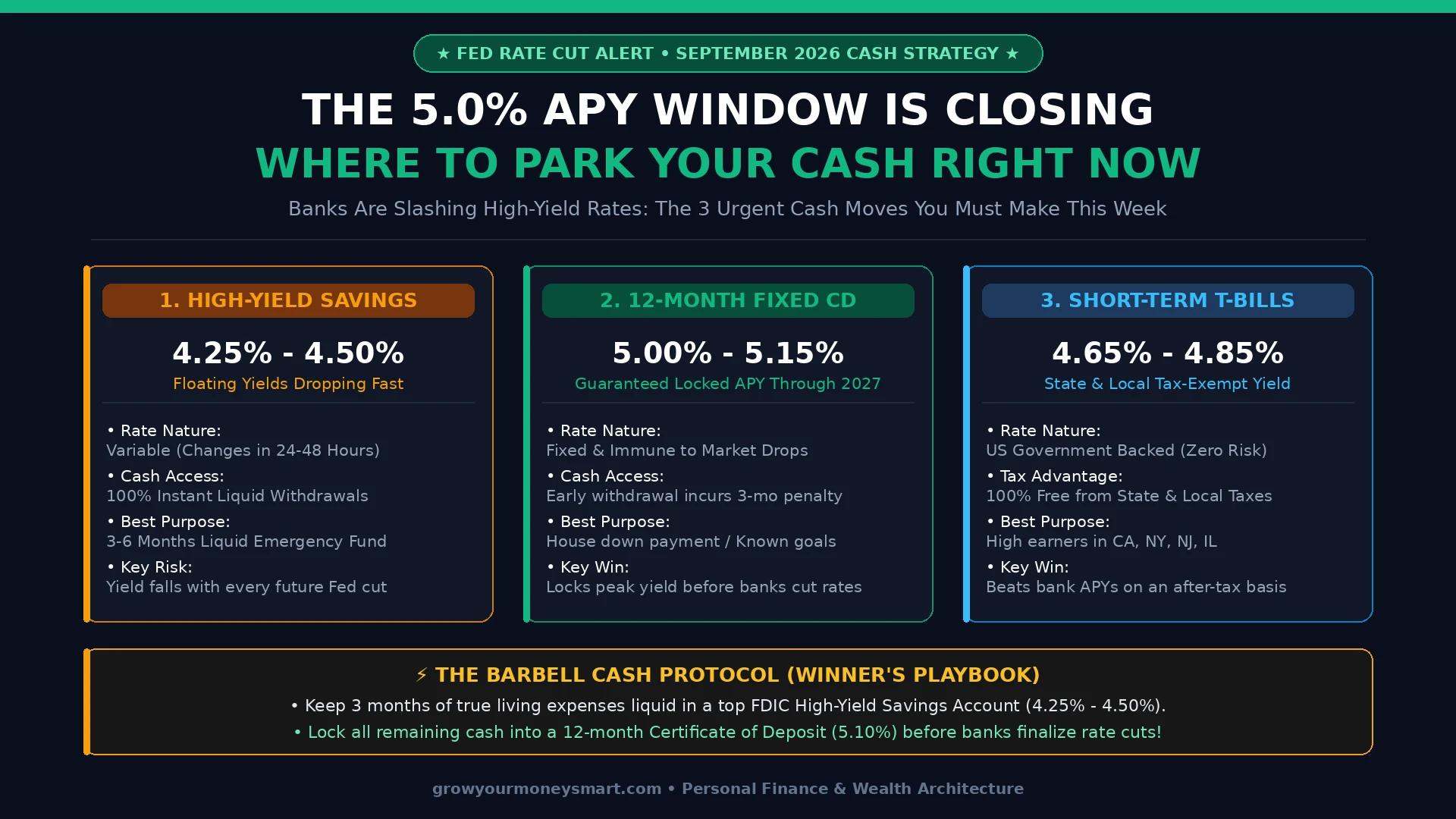
- High-Yield Savings Accounts (HYSAs): Are floating-rate instruments. When the Fed cuts rates, banks can and will lower your APY overnight without warning. Expect top tier rates to glide from 5.00% down toward 4.25% – 4.00% over the next 90 days.
- Certificates of Deposit (CDs): Offer legally binding fixed APYs. If you lock in a 12-month CD at 5.05% – 5.15% APY today, your yield is 100% guaranteed through late 2027, completely immune to further rate cuts.
- The Golden Barbell Strategy: Keep exactly 3 to 6 months of true living essentials liquid in a top high-yield savings account, and immediately sweep all surplus cash into a fixed 12-month CD or Treasury Bills before promotional rates disappear.
The True Math: What a 50 bps Fed Rate Cut Costs Your Savings
Many savers assume a 0.50% rate cut is trivial pocket change. In reality, compounding interest over a multi-year horizon transforms fractional rate changes into thousands of dollars in lost income. Let us look at the exact mathematical impact of a rate drop from 5.25% APY down to 4.25% across common cash balances:
| Cash Balance | Annual Earnings @ 5.25% APY | Annual Earnings @ 4.25% APY | Net Annual Cash Lost |
|---|---|---|---|
| $10,000 (Starter Fund) | $525.00 | $425.00 | -$100.00 / year |
| $25,000 (Emergency Reserve) | $1,312.50 | $1,062.50 | -$250.00 / year |
| $50,000 (House Down Payment) | $2,625.00 | $2,125.00 | -$500.00 / year |
| $100,000 (Pre-Retirement Cash) | $5,250.00 | $4,250.00 | -$1,000.00 / year |
If you are holding $50,000 in liquid cash for a house down payment or wedding, doing nothing over the next 12 months silently strips $500 to $1,000 of risk-free cash flow right out of your pocket. That is why understanding the mechanics of how bank rate drops propagate is essential.
Why Banks Cut Savings APYs Faster Than Credit Card Rates
Have you ever noticed that the moment the Federal Reserve hints at easing monetary policy, your online bank sends you a polite email informing you that your savings APY has dropped, yet your credit card interest rate remains stubbornly locked at 24.99%? This phenomenon is known in institutional finance as asymmetric rate passthrough.
When the Federal Funds Rate decreases, banks immediately lower their deposit rates to minimize their cost of capital. However, on consumer debt instruments—such as high-interest credit cards and revolving personal loans—banks take months to pass along reductions, preserving their net interest margin (NIM). If you are currently juggling high-interest balances, relying on Fed cuts to lower your borrowing cost is a guaranteed losing strategy. You must proactively eliminate toxic interest using aggressive mechanisms like 0% APR balance transfer cards or structured payoff plans.
The 3 Urgent Cash Moves to Execute This Week
To maximize your risk-free returns before commercial banks finalize their third-quarter rate adjustments, follow this battle-tested 3-step action roadmap:
1. Calculate Your Exact 3-to-6 Month Liquid Threshold
The biggest mistake retail investors make during rate cycles is holding too much idle cash in a savings account. Any dollar beyond your true emergency buffer sitting in a floating HYSA is experiencing yield drag. Audit your monthly essentials using our 50/30/20 monthly budget breakdown. If your core survival burn rate (housing, groceries, utilities, debt minimums) is $4,000 per month, your liquid target is strictly $12,000 to $24,000. Keep this exact figure in your primary high-yield account for instant liquidity.
2. Lock Surplus Cash Into 12-Month Certificates of Deposit (CDs)
Any funds earmarked for goals 12 to 24 months away—such as an upcoming home purchase, vehicle replacement, or tax bill—should not remain exposed to floating HYSA rates. Financial institutions like Marcus by Goldman Sachs, Barclays, and Bread Savings still have 12-month promotional CD rates above 5.00% APY on their books today. Once you open a CD, that rate is legally locked. Even if the Fed slashes interest rates another 100 basis points in early 2027, your cash continues compounding at the peak rate.
3. High Earners: Evaluate 4-Week and 8-Week US Treasury Bills
If you reside in a high-tax state such as California, New York, New Jersey, or Illinois, bank interest is subject to federal, state, and local income taxes. By contrast, US Treasury Bills (purchased directly through TreasuryDirect or via brokerage accounts like Fidelity and Vanguard) are 100% exempt from state and local income taxes. For an earner in the 32% federal bracket and 9.3% state bracket, a 4.75% T-Bill yields an effective after-tax return superior to a 5.30% traditional bank account.
Comparison Matrix: Where Should You Put Your Next $10,000?
Here is a side-by-side comparison of the three primary safe-haven cash storage vehicles in a falling rate environment:
| Feature | High-Yield Savings (HYSA) | 12-Month CD | Short-Term T-Bills |
|---|---|---|---|
| Current APY (Sept 2026) | 4.25% – 4.50% (Dropping) | 5.00% – 5.15% (Locked) | 4.65% – 4.85% (Auction Yield) |
| Interest Rate Risk | High (Banks can cut daily) | Zero (Guaranteed through maturity) | Low (Locks for 4, 13, or 26 weeks) |
| Liquidity Access | 100% Instant (No penalty) | Early withdrawal fee (3-6 mos interest) | Liquid (Can sell on secondary market) |
| Tax Treatment | Full Federal + State + Local tax | Full Federal + State + Local tax | 100% State & Local Tax Free |
| Best Strategic Use | Living emergency reserves | Down payment cash / 1-yr timeline | High-tax bracket savers |
Frequently Asked Questions (Fed Rate Cuts & Your Savings)
Will High-Yield Savings Accounts drop back to 0.50% like in 2020?
No. The macroeconomic environment in 2026 is vastly different from the zero-interest-rate policy (ZIRP) era of 2020-2021. The Federal Reserve is executing a normalization cycle, not an emergency liquidity bailout. Most Wall Street economists project the terminal Federal Funds Rate will stabilize between 3.25% and 3.75%. That means top-tier HYSAs are expected to hover between 3.50% and 4.00% over the next two years, remaining a solid wealth preserver.
Can an online bank lower my CD rate after I open it?
No. A Certificate of Deposit is a legally binding contract. Once funded, the financial institution is obligated by federal banking regulations to honor the agreed Annual Percentage Yield (APY) for the full duration of the term, regardless of whether the Federal Reserve cuts rates by 50 bps or 200 bps.
Should I invest my emergency fund in index funds if cash yields drop?
Never. An emergency fund is an insurance policy, not an investment instrument. Its primary purpose is not growth; its purpose is capital preservation and instant liquidity. If you invest your emergency reserves into the stock market to chase an extra 4% return, a sudden market downturn could force you to liquidate equities at a 25% loss to pay for an emergency car repair or medical bill. Keep your liquid emergency shield secure in an FDIC-insured account. For a comprehensive compounding breakdown of yields over 10 to 30 years, examine our definitive guide on HYSA vs stock market asset allocation.
About the Author: Jaiveer Hooda is a Personal Finance Specialist and Senior Editor at GrowYourMoneySmart.com, specializing in algorithmic cash allocation, retirement planning structures, and consumer debt elimination frameworks.

Jaiveer Hooda is the Lead Financial Researcher & Personal Finance Analyst at Grow Your Money Smart. Specializing in personal wealth optimization, index fund compounding, high-yield savings mechanics, and consumer debt elimination strategies. With a background in computer engineering, he applies mathematical modeling, cashflow simulations, and empirical risk analysis to evaluate personal finance vehicles and credit products. Every analysis is backed by verified regulatory disclosures, IRS tax schedules, and empirical APY compounding math.
Areas of Expertise: Personal Finance · High-Yield Savings Accounts (HYSA) · Index Funds & S&P 500 Compounding · Retirement Planning (401k/IRA) · Debt Optimization · Credit Card APR Mechanics.
Transparency & Editorial Policy: Editorial Standards | Report a Correction