
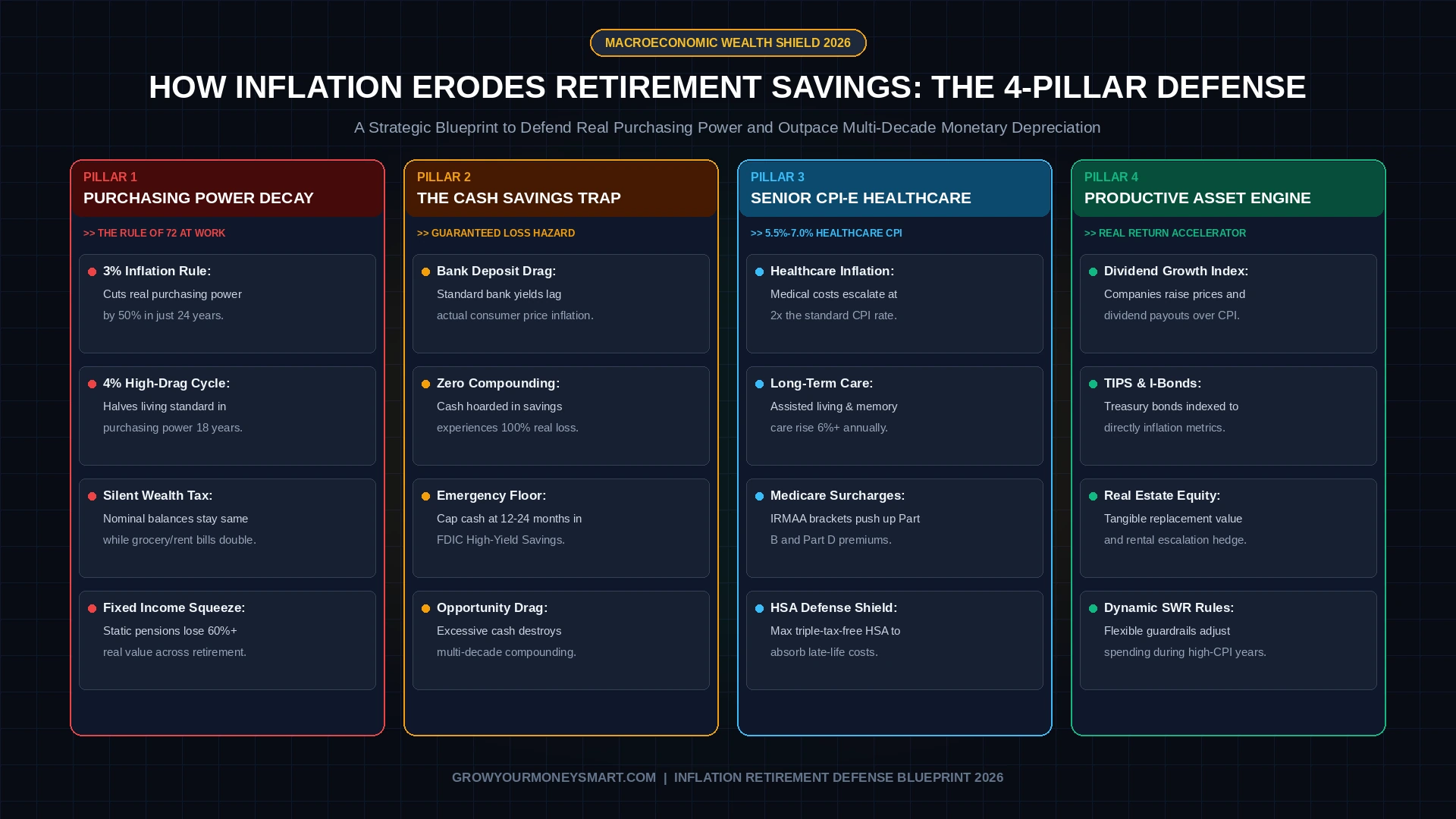
- The Silent Wealth Tax: At a standard 3.0% annual inflation rate, the real purchasing power of your money is cut in half in exactly 24 years (Rule of 72). At 4.0% inflation, it halves in just 18 years.
- The Cash Illusion: Keeping retirement funds in uninvested cash or low-yield savings guarantees a 58.8% real loss of purchasing power over a 30-year retirement timeline.
- Senior Healthcare Squeeze (CPI-E): Retirees face higher inflation than the general public because medical care, prescription drugs, and assisted living inflate at 5.5% to 7.0%+ annually.
- The Productive Asset Shield: Maintaining a 60%–80% core allocation to broad-market index equities and dividend-growth assets allows corporate pricing power to generate +4.5% to +5.5% real returns above CPI.
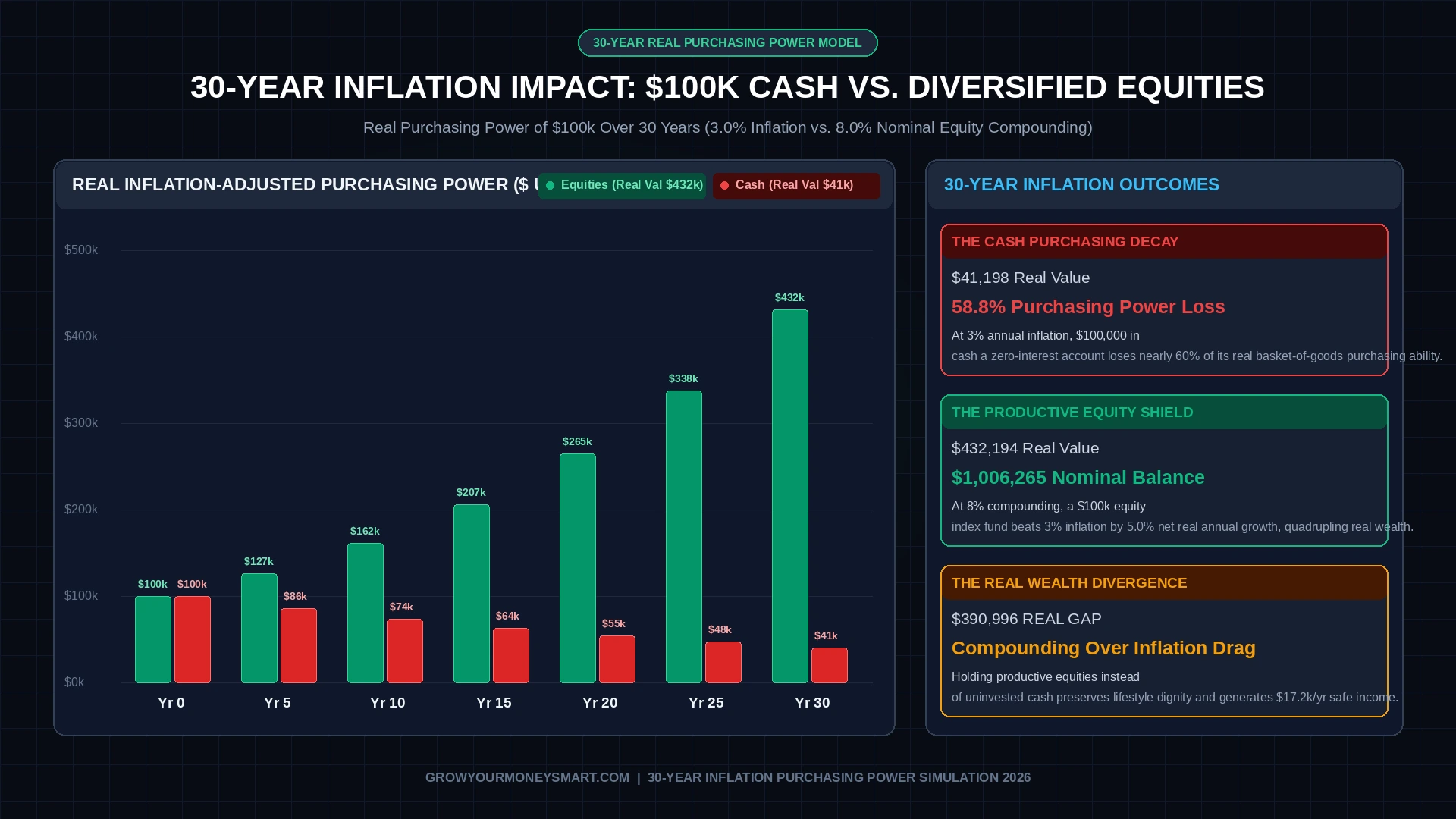
- The Multi-Decade Wealth Divergence: $100,000 in cash degrades to $41,198 in real purchasing power over 30 years, while $100,000 invested at 8% expands to $432,194 in real purchasing power ($1,006,265 nominal balance).
When investors visualize the greatest risks to their retirement security, they almost universally fixate on stock market crashes, sudden economic recessions, or volatile headline events. Yet history and actuarial mathematics prove that the most destructive threat to long-term wealth is not a sudden crash—it is the continuous, imperceptible erosion of structural inflation.
Inflation is the silent goal killer because it requires zero market volatility to destroy your living standards. Your account balance may appear completely unchanged or even grow modestly on paper, while the actual quantity of groceries, utilities, prescription medications, and healthcare services that balance can purchase steadily diminishes every single year. A retirement plan engineered around nominal account balances rather than real, inflation-adjusted purchasing power is mathematically destined for severe late-life deprivation.
In this master fiduciary guide, we unpack the mathematical mechanics of how inflation erodes retirement savings, examine why retirees face a steeper inflation curve than the working population, model 30-year real vs. nominal return simulations, and construct an unshakeable four-pillar investment defense. To evaluate your existing spending and reserve allocations, utilize our interactive Household Budget Calculator and Emergency Fund Calculator.
The Mathematics of Purchasing Power Decay: The Rule of 72 in Reverse
To understand the devastating compounding drag of inflation, investors must look at the mathematical Rule of 72 in reverse. By dividing 72 by the expected annual inflation rate, you can determine exactly how many years it will take for your purchasing power to be cut in half:
• At 2.5% Baseline Inflation: Purchasing power halves in 28.8 years.
• At 3.0% Historical Inflation: Purchasing power halves in 24.0 years.
• At 4.0% Elevated Inflation: Purchasing power halves in just 18.0 years.
• At 5.0% Stagflationary Inflation: Purchasing power is decimated by 50% in only 14.4 years.
Consider the practical reality for a 62-year-old retiring today with an annual baseline living budget of $60,000. Assuming a standard 3.0% average inflation rate over their remaining 25-year actuarial lifespan, that identical baseline lifestyle will cost $125,627 per year by age 87. If their portfolio is locked into rigid fixed-income annuities or static pension payouts with zero cost-of-living adjustments (COLA), their effective standard of living will be compressed by more than half.
The Senior Inflation Disparity: Why CPI-E Hits Retirees Harder
The headline Consumer Price Index for All Urban Consumers (CPI-U) frequently reported by financial media is heavily weighted toward transportation, technology gadgets, work apparel, and housing. However, the Bureau of Labor Statistics tracks an experimental index specifically tailored to older Americans: the Consumer Price Index for the Elderly (CPI-E).
Empirical expenditure surveys reveal that retirees allocate more than double the proportion of their annual spending to healthcare services, medical devices, prescription pharmaceuticals, and assisted residential care compared to younger workers. While manufactured consumer goods and electronics often experience deflationary cost curves, healthcare and elder-care services inflate at a relentless 5.5% to 7.0%+ annualized rate. Consequently, a retiree’s personalized inflation rate is often 1.5% to 2.5% higher than broad macroeconomic statistics suggest.
Comparative Strategy Matrix: Nominal Illusions vs. Real Inflation Defense
Examine how different asset management strategies respond across multi-decade inflation cycles:
| Asset Strategy | Nominal Return Profile | Real After-Inflation Yield | Purchasing Power Outcome Over 30 Yrs |
|---|---|---|---|
| Cash & Bank Savings | 1.0% to 3.5% Nominal | Negative (-1.0% to -2.0% Real) | Severe erosion; loses 58.8% of real buying power |
| Fixed Nominal Bonds / CDs | 3.5% to 4.5% Nominal | Near Zero (0.0% to +0.5% Real) | Stagnant; vulnerable to high-inflation shocks |
| TIPS & Series I Bonds | CPI + 1.5% to 2.2% Real | Guaranteed Positive (+1.5% to +2.2%) | Preserves 100% of purchasing power with modest real gain |
| Dividend Growth Equities | 7.5% to 9.5% Nominal | Robust (+4.5% to +6.0% Real) | Massive real wealth expansion; quadruples buying power |
| Prime Direct Real Estate / REITs | 6.5% to 8.5% Nominal | Strong (+3.5% to +5.0% Real) | High inflation defense via replacement cost & rent escalations |
Quantitative Modeling: $100,000 Cash vs. Diversified Equities Shield
To visualize how inflation separates uninvested cash from productive compounding assets, consider a controlled 30-year simulation of two separate $100,000 capital allocations subjected to a constant 3.0% annual inflation environment:
• Portfolio 1 ($100,000 Uninvested Cash): Left in zero-interest cash reserves. While the nominal dollar balance remains exactly $100,000 on bank statements, its real purchasing power collapses to $41,198 by Year 30—a total destruction of 58.8% of real living capacity.
• Portfolio 2 ($100,000 Low-Cost Equity Index): Invested in a broad-market index yielding an 8.0% nominal annualized return. Over 30 years, this capital compounds nominally to $1,006,265. After fully deducting the cumulative 3.0% inflation drag, the real purchasing power of the portfolio stands at $432,194—more than quadrupling real wealth (+332.2% real gain).
This results in an astronomical $390,996 Real Wealth Divergence created entirely by compounding productive assets above the rate of inflation. For step-by-step guidance on aligning asset allocation with retirement milestones, review our guide to the 5 Stages of Retirement Planning and Investment Time Horizon Strategies.
2025/2026 IRS Contribution Limits & Tax-Advantaged Compounding
Maximizing tax-advantaged accounts is essential to defeat inflation because taxes compound the destructive drag of rising prices. Utilize the updated statutory limits enacted under the SECURE 2.0 Act and IRS revenue procedures:
• 401(k), 403(b), & 457 Deferrals: Employee contribution limits are set at $23,500 for 2025 ($24,500 in 2026). Standard catch-up contributions for savers aged 50+ stand at $7,500 ($8,000 in 2026).
• SECURE 2.0 Super Catch-Up (Ages 60–63): Savers reaching ages 60, 61, 62, or 63 can utilize an enhanced catch-up threshold of $11,250 to accelerate inflation-beating equity accumulation.
• Mandatory High-Earner Roth Catch-Up (2026 Rule): Starting January 1, 2026, workers earning over $150,000 in prior-year FICA wages must direct catch-up contributions into after-tax Roth accounts.
• Individual Retirement Accounts (IRAs): Contribution limits are $7,000 ($7,500 in 2026) with a $1,000 catch-up allowance.
• Health Savings Accounts (HSAs): Triple-tax-advantaged limits are $4,300 for self-only and $8,550 for family coverage ($4,400 and $8,750 in 2026). Maxing an HSA builds an untouchable, tax-free buffer specifically engineered to absorb senior healthcare inflation.
Expert Video Analysis: The Money Guy Show on Inflation in Retirement
To see how professional fiduciary advisors model inflation inside comprehensive financial plans, watch this detailed analysis from Brian Preston and Bo Hanson of The Money Guy Show:
The 4-Step Inflation-Proof Retirement Blueprint
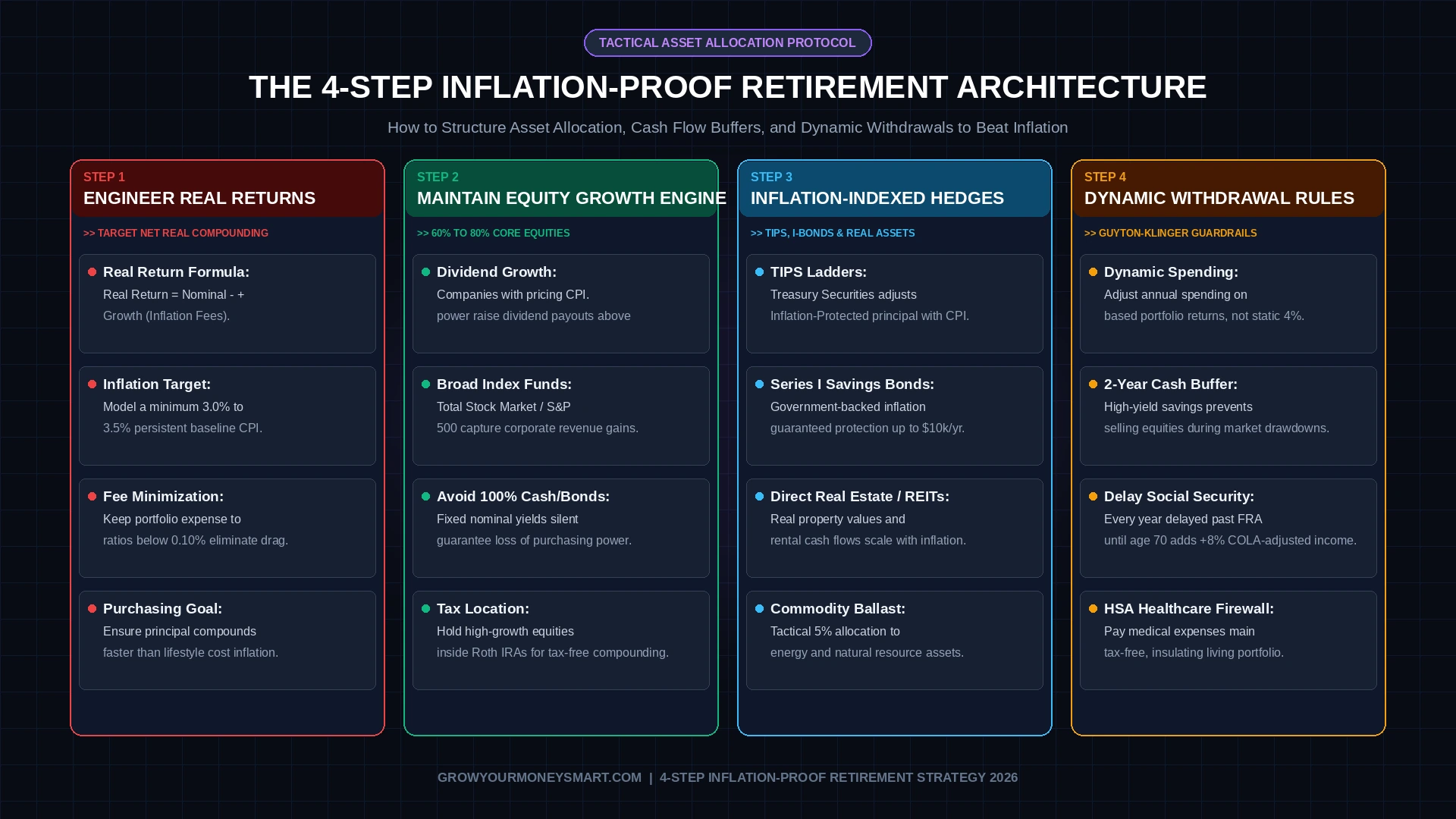
To successfully insulate your wealth from macroeconomic price surges while securing reliable lifestyle cash flow, execute this four-step tactical protocol:
Step 1: Target Positive Real Net Compounding
Establish a mandatory baseline that your portfolio must generate at least +4.0% to +5.0% real growth after subtracting inflation and investment expense ratios. Audit your expense ratios and transition high-cost actively managed mutual funds into ultra-low-cost broad index ETFs (with expense ratios under 0.08%).
Step 2: Maintain a Core 60%–80% Productive Equity Engine
Resist the emotional temptation to retreat entirely into cash or nominal bonds upon retirement. Maintaining a robust 60% to 80% allocation to diversified equities and dividend-growth companies harnesses global corporate pricing power, ensuring your income stream expands faster than CPI.
Step 3: Deploy Dedicated Inflation-Indexed Hedges
Allocate fixed-income reserves into Treasury Inflation-Protected Securities (TIPS) ladders and U.S. Series I Savings Bonds. Supplement your liquid portfolio with tangible real assets or direct real estate to capture rental income inflation escalations.
Step 4: Implement Guyton-Klinger Dynamic Spending Guardrails
Replace rigid withdrawal assumptions with dynamic spending rules: In high-inflation years accompanied by market corrections, freeze nominal withdrawal increases and draw from your 2-year cash buffer to allow your core equities time to rebound without selling shares at depressed valuations.
Behavioral Finance: Avoiding the Flight-to-Cash Trap
During macroeconomic inflation shocks, investor psychology frequently falls into the “flight-to-safety” trap. Seeing market volatility in headline news, retirees panic and liquidate diversified equity holdings to sit in bank deposits or short-term certificates of deposit.
While cash eliminates short-term nominal price volatility, it trades temporary emotional comfort for guaranteed long-term economic destruction. By locking in a negative real return, retirees inadvertently accelerate their portfolio’s depletion. If you need professional guidance to maintain emotional discipline and rebalance your portfolio, read our comprehensive analysis on DIY Investing vs. Hiring a Fee-Only Fiduciary Financial Advisor.
Actionable 10-Point Inflation Defense Checklist
Before finalizing your retirement asset allocation, verify each of the following 10 defense checkpoints:
1. Annual retirement budget stress-tested against a minimum 3.5% baseline inflation rate.
2. Senior healthcare inflation factored at 6.0% annually for late-life projection models.
3. Core equity and dividend-growth asset allocation maintained between 60% and 80%.
4. Liquid emergency cash firewall established at 12 to 24 months in an FDIC High-Yield Savings account.
5. Fixed-income holdings diversified with TIPS ladders and Series I Savings Bonds.
6. Portfolio weighted average expense ratio audited and verified below 0.10%.
7. Triple-tax-advantaged Health Savings Account (HSA) maxed out annually.
8. Social Security claiming strategy evaluated for age 70 filing to maximize COLA-adjusted checks.
9. Dynamic Guyton-Klinger withdrawal guardrails documented and instituted.
10. High-interest debt eliminated using our Debt Payoff Calculator.
Frequently Asked Questions (FAQs)
Below are clear, actionable answers to the most common questions investors ask regarding inflation defense in retirement:
Inflation acts as a silent wealth tax. Under the Rule of 72, a modest 3.0% annual inflation rate cuts your dollar’s purchasing power by 50% in 24 years. If annual inflation runs at 4.0%, purchasing power is cut in half in just 18 years, meaning everyday expenses double while fixed incomes remain stagnant.
While cash and certificates of deposit (CDs) provide nominal principal stability, they deliver negative real returns after accounting for taxes and inflation. Over a 30-year retirement, $100,000 in uninvested cash loses nearly 60% of its real purchasing value.
CPI-E (Consumer Price Index for the Elderly) measures the specific spending basket of Americans aged 62+. Because retirees spend a significantly larger percentage of their budget on healthcare, prescriptions, and long-term care—sectors inflating at 5.5% to 7.0%+ annually—retirees experience a higher effective inflation rate than younger workers.
High-quality dividend growth companies possess pricing power, allowing them to raise product prices alongside inflation and consistently increase annual dividend payouts above the CPI rate, providing an expanding passive income stream.
Treasury Inflation-Protected Securities (TIPS) and Series I Savings Bonds have their principal value directly indexed to the Consumer Price Index. When inflation rises, the underlying principal adjusts upward, guaranteeing that fixed-income allocations retain their real purchasing power.
Social Security benefits receive annual Cost-of-Living Adjustments (COLA) based on inflation. Delaying your claim past Full Retirement Age until age 70 increases your baseline monthly check by up to 24%–32%, creating a larger, government-guaranteed, inflation-indexed annuity.
Unlike rigid static withdrawal rules (such as increasing spending by CPI every year regardless of market performance), Guyton-Klinger dynamic guardrails increase withdrawals during strong market years and freeze or trim inflation adjustments following market downturns, preventing portfolio depletion.
The standard Fisher equation formula is: Real Return ≈ Nominal Annual Return – Annual Inflation Rate – Management Fees. For example, an 8.0% stock return in a 3.0% inflation environment with 0.05% fund fees yields a robust +4.95% net real annual compounding rate.
Final Expert Takeaways: Outpacing Inflation for Lifetime Security
Defeating inflation is not about predicting short-term macroeconomic cycles or making speculative market timing bets. It is about understanding the fundamental mathematical laws of compounding purchasing power. By anchoring your portfolio to productive equities, integrating TIPS and real assets, establishing liquid defensive buffers, and executing dynamic withdrawal guardrails, you ensure that your wealth expands in real purchasing power across every year of your retirement.
Take control of your financial trajectory today by auditing your expense ratios, funding your tax-advantaged buckets, and building an automated savings machine, starting with our foundational tutorial on How to Save Your First $1,000 Emergency Reserve.
Monetary policy and Consumer Price Index (CPI) trends highlight the necessity of keeping equity growth assets in your long-term portfolio. Consult the official Federal Reserve Economic Research & Monetary Policy Data for statutory guidelines and consumer protections.
📈 Inflation Defense, Sequence of Returns & Growth Engines
Combat the silent killer of purchasing power with equity compounding, inflation hedges, and safe withdrawal rules:
- Growth Engines: the Bogleheads 3-fund portfolio guide — maintaining equity market exposure to consistently outpace long-term inflation.
- Withdrawal Defense: the 4% rule safe withdrawal rate in 2026 — adjusting annual withdrawals for annual consumer price index (CPI) changes.
- Downside Timing: sequence of returns risk: protect retirement — safeguarding your portfolio against the toxic combination of inflation and bear markets.
- Cash vs Equities: HYSA vs stocks: where to put your money in 2026 — why holding excess cash guarantees long-term purchasing power erosion.
- Guaranteed Income: Social Security spousal benefits strategy — maximizing inflation-adjusted COLA payments from Social Security.

Jaiveer Hooda is the Lead Financial Researcher & Personal Finance Analyst at Grow Your Money Smart. Specializing in personal wealth optimization, index fund compounding, high-yield savings mechanics, and consumer debt elimination strategies. With a background in computer engineering, he applies mathematical modeling, cashflow simulations, and empirical risk analysis to evaluate personal finance vehicles and credit products. Every analysis is backed by verified regulatory disclosures, IRS tax schedules, and empirical APY compounding math.
Areas of Expertise: Personal Finance · High-Yield Savings Accounts (HYSA) · Index Funds & S&P 500 Compounding · Retirement Planning (401k/IRA) · Debt Optimization · Credit Card APR Mechanics.
Transparency & Editorial Policy: Editorial Standards | Report a Correction