
- The $0 Base Rule: Institutional Certified Financial Planners (CFPs) recommend engineering 100% of your retirement target assuming zero inheritance capital.
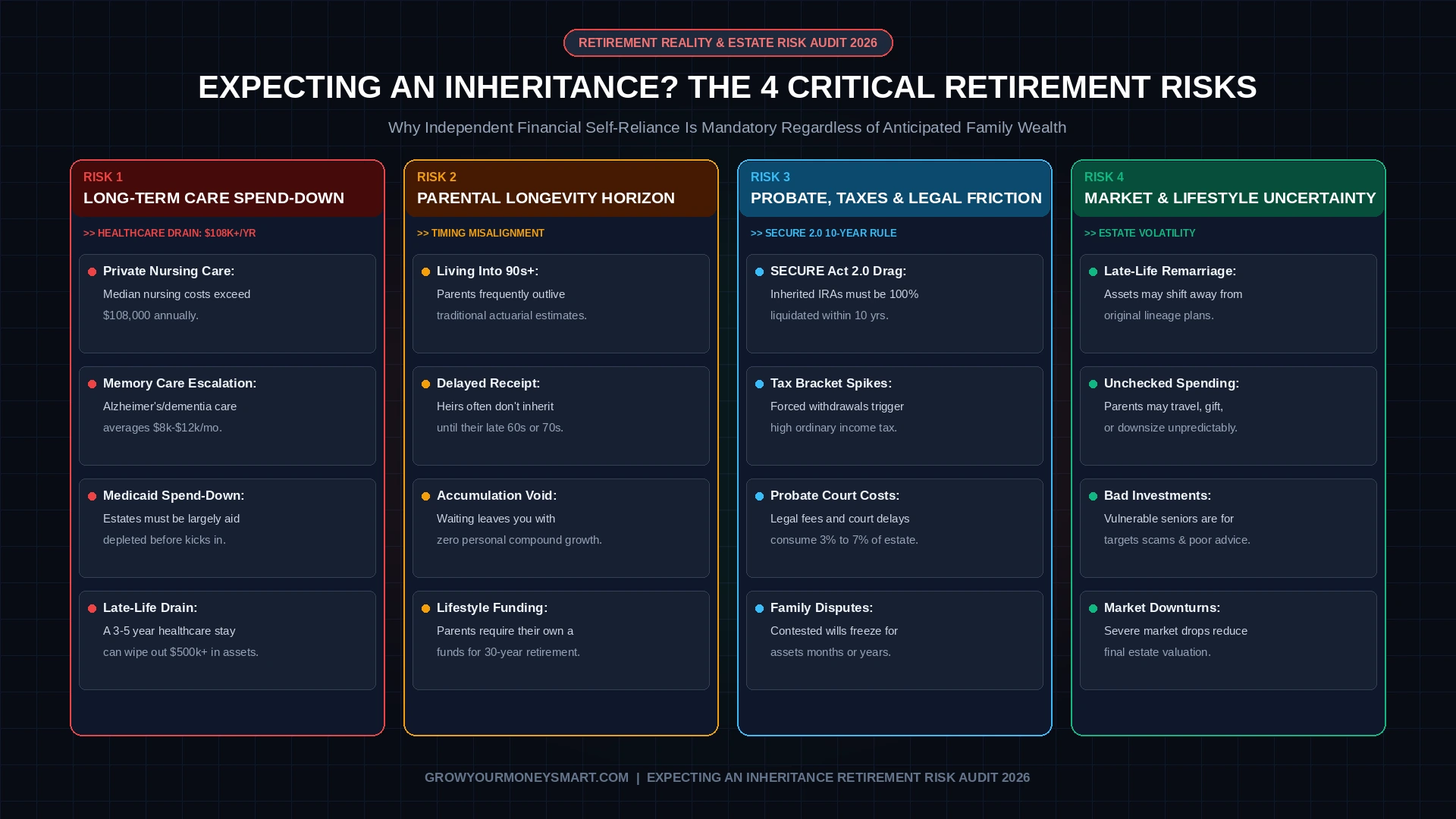
- The Long-Term Care Drain: Median private nursing home costs exceed $108,000/year (often $140k+ for memory care). A 3–5 year health event can easily consume $500,000+ of parental estate wealth.
- The Longevity Timing Gap: With parental lifespans expanding into the 90s, the average heir does not inherit until age 58 to 68—far too late to harness 30 years of compound interest.
- The SECURE 2.0 Tax Squeeze: Inherited traditional IRAs must be emptied within 10 years, potentially pushing heirs into top 32%–37% federal tax brackets during their peak earning decades.
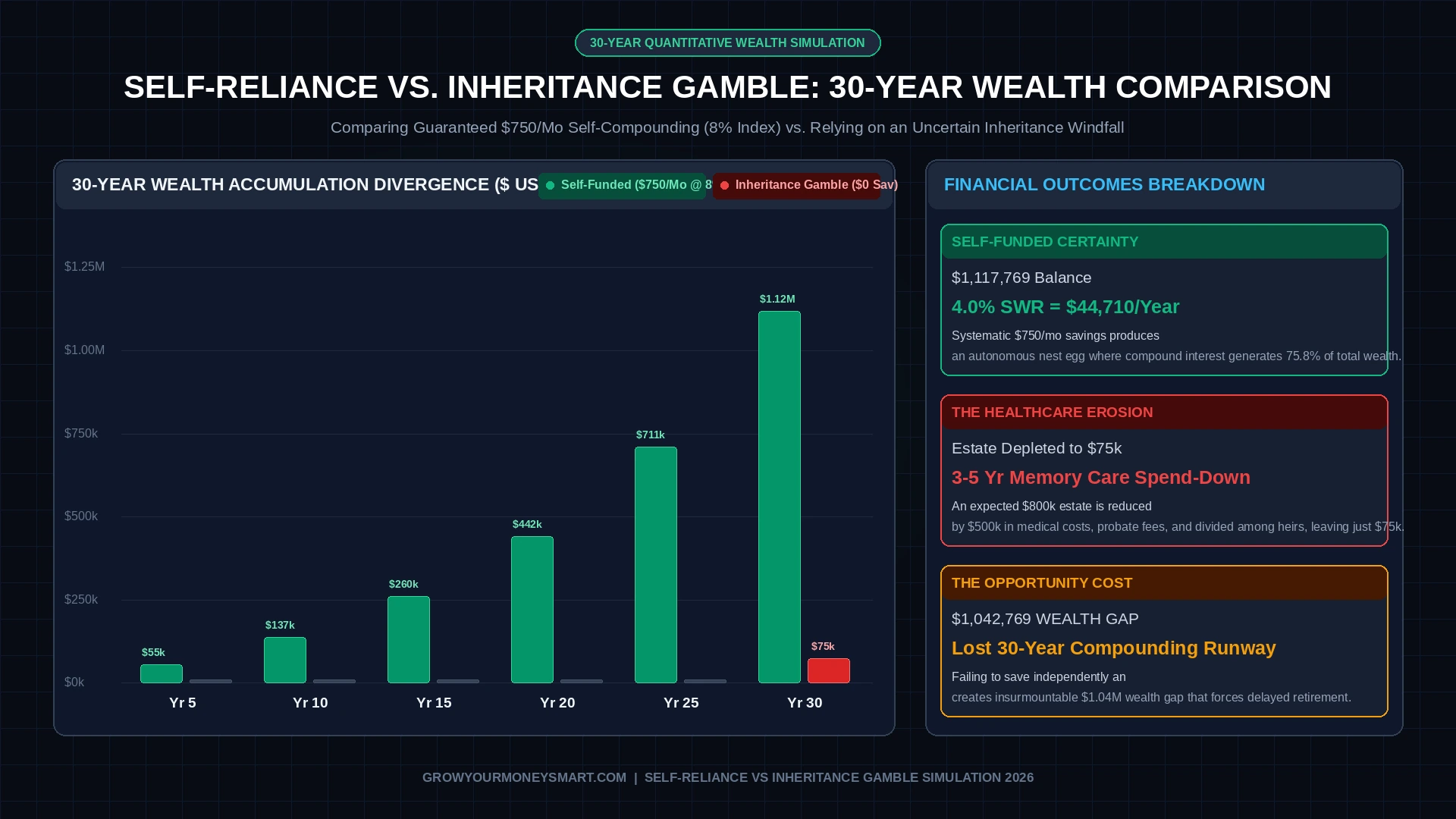
- The Multi-Million Dollar Opportunity Cost: Relying on an expected $300k windfall instead of investing $750/month results in an insurmountable $1,042,000+ personal wealth deficit over 30 years.
The financial headlines of the 2020s frequently herald the arrival of the “Great Wealth Transfer”—a historic macroeconomic phenomenon where Baby Boomers are projected to pass down an estimated $84 trillion in cumulative assets to Gen X, Millennials, and Gen Z heirs over the next two decades. For millions of hardworking professionals, this overarching narrative creates a comforting psychological safety net: the belief that an eventual family inheritance will effortlessly backstop any shortfalls in their own personal retirement savings.
However, inside fiduciary wealth management rooms, veteran advisors view counting on an inheritance as one of the single most dangerous gambles an investor can make. Empirical data reveals that over 70% of intergenerational family wealth dissipates by the end of the second generation, eroded by a combination of catastrophic late-life medical expenditures, unpredictable longevity horizons, punitive probate frictions, and legislative tax overhauls such as the SECURE 2.0 Act.
True financial independence cannot be outsourced to future estate windfalls. In this comprehensive guide, we dissect the mathematical and psychological realities of expecting an inheritance retirement planning, analyze the four hidden wealth-depletion vectors, model the 30-year opportunity cost of waiting, and provide an actionable blueprint for engineering absolute personal wealth solvency. To stress-test your existing cash flow, utilize our interactive Household Budget Calculator and Emergency Fund Calculator.
The 4 Hidden Estate Depletion Vectors: Why Expected Windfalls Evaporate
When adult children envision their parents’ estate, they typically extrapolate today’s real estate valuations and brokerage balances decades into the future. Unfortunately, this static mental model ignores the four dynamic, non-linear vectors that systematically erode family wealth before it ever reaches the next generation:
1. Long-Term Care (LTC) & Memory Care Spend-Downs
According to the U.S. Department of Health and Human Services, approximately 70% of individuals turning age 65 will require some form of long-term care support during their remaining lifetime. In 2026, the national median cost for a private room in a skilled nursing facility exceeds $108,000 per year, with top-tier memory care facilities in metropolitan regions commanding between $10,000 and $15,000 per month ($120,000–$180,000 annually). Because Medicare does not cover custodial nursing care, aging parents are forced into a private-pay spend-down model. A prolonged 4-year cognitive or physical decline can effortlessly consume $500,000 to $750,000 of liquid equity.
2. The Parental Longevity Horizon & Timing Mismatch
Medical breakthroughs and cardiovascular therapies have pushed median life expectancies into the late 80s and 90s. If your parents live to age 92 when you are 65, their capital must actively sustain their own living expenses, property taxes, assisted living costs, and inflationary healthcare needs for more than three decades. More critically, an inheritance received at age 62 or 67 arrives too late to compound. You cannot retroactively utilize compounding interest during your 30s, 40s, and 50s.
3. The SECURE 2.0 10-Year Inherited IRA Tax Squeeze
Prior to the passage of the original SECURE Act, beneficiaries could “stretch” distributions from an inherited traditional IRA across their entire actuarial lifetime, minimizing annual tax friction. Under current IRS regulations, non-spouse designated beneficiaries must completely liquidate an inherited IRA within 10 calendar years. If you inherit a $500,000 traditional IRA during your peak earning years (e.g., in your early 50s), taking $50,000+ in annual required withdrawals stacked on top of your existing salary will catapult your household into top marginal federal (32%–37%) and state income tax brackets, losing 40%+ of the account balance to taxes.
4. Estate Probate Friction, Legal Costs & Unplanned Restructuring
Dying without an airtight Revocable Living Trust forces an estate into public probate court. Probate attorney fees, executor compensation, appraisal costs, and statutory court filings typically siphon 3% to 7% of gross estate value before a single dollar is disbursed. Furthermore, late-life remarriages, updated wills, blended family litigation, or predatory financial scams targeting cognitively vulnerable seniors can abruptly divert expected lineage transfers.
Head-to-Head Architecture: Self-Funded Independence vs. Inheritance Reliance
The divergence between engineering your own autonomous retirement machine versus relying on family estate capital is mathematically and behaviorally stark. Examine the comparative structural matrix below:
| Core Strategic Dimension | Autonomous Self-Funded Plan | Inheritance Reliance Gamble | Optimal Integrated Wealth Path |
|---|---|---|---|
| Retirement Plan Foundation | 100% self-funded via systematic savings | Dependent on parental estate surplus | Self-funded base; windfall treated as pure bonus |
| Compounding Runway | 30–40 years of uninterrupted market gains | Zero compounding during peak accumulation | Full multi-decade compounding velocity |
| Healthcare Inflation Defense | Dedicated HSA & liquid cash firewalls | Vulnerable to parental LTC spend-down | Independent HSA + Parental hybrid LTC planning |
| Tax Location Control | Optimized 3-Bucket (Roth, Pre-tax, Taxable) | Forced 10-year inherited IRA tax spikes | Strategic Roth conversions & step-up basis |
| Family Psychological Dynamics | Complete financial sovereignty & zero guilt | Subconscious anxiety & estate entitlement | Transparent legacy & living trust governance |
| Retirement Timing Certainty | Predictable target retirement date (e.g., 55–62) | Completely unpredictable (waiting for demise) | Guaranteed baseline with potential early exit |
30-Year Compounding Simulation: The $1.04M Cost of Relying on an Inheritance
To quantify the devastating opportunity cost of postponing personal retirement savings in anticipation of family wealth, consider a rigorous mathematical simulation comparing two professionals, both starting at age 30:
• Investor A (Autonomous Compounder): Commits to investing $750 per month ($9,000/year) into a low-cost, broad-market index portfolio (such as total stock market and S&P 500 funds) inside tax-advantaged accounts yielding a historical nominal 8.0% annualized compound return.
• Investor B (Inheritance Anticipator): Invests $0 per month, assuming an expected $800,000 family estate will fully fund their eventual retirement at age 60.
By age 60 (Year 30), Investor A has accumulated a verified portfolio balance of $1,117,769 from a total out-of-pocket investment of only $270,000. Pure compound interest accounts for $847,769 (75.8%) of their total nest egg. Under a conservative 4.0% Safe Withdrawal Rate, Investor A enjoys an autonomous, lifetime passive income stream of $44,710 per year ($3,725/month) without touching principal.
Now consider Investor B’s reality at year 30: Their surviving parent lived to age 88 and required 4 years of specialized memory care costing $500,000. The remaining $300,000 estate incurred $25,000 in probate and administrative costs and was split equally with a sibling, leaving Investor B with a net inheritance of just $75,000. Investor B now faces a catastrophic $1,042,769 wealth deficit at age 60 with zero compounding runway remaining to recover. For advanced retirement timeline modeling, review our comprehensive roadmap to the 5 Stages of Retirement Planning.
2025/2026 IRS Regulations & SECURE 2.0 Legislation Updates
Executing an airtight retirement plan requires aligning your savings architecture with current statutory IRS thresholds and SECURE 2.0 legislative mandates:
• Workplace Elective Deferrals: 401(k), 403(b), and 457 elective contribution limits stand at $23,500 for 2025 ($24,500 in 2026), with standard catch-up contributions for savers aged 50+ at $7,500 ($8,000 in 2026).
• SECURE 2.0 Super Catch-Up (Ages 60–63): Workers aged 60 to 63 can deploy an elevated catch-up maximum of $11,250, providing an intensive compounding booster immediately prior to retirement.
• Mandatory High-Earner Roth Catch-Up (2026 Mandate): Beginning January 1, 2026, employees earning over $150,000 in prior-year FICA wages must direct all catch-up contributions exclusively into after-tax Roth accounts.
• IRAs & Health Savings Accounts: Individual Retirement Account limits are $7,000 ($7,500 in 2026). Triple-tax-advantaged HSA limits are $4,300 for self-only and $8,550 for family coverage ($4,400 and $8,750 in 2026), creating an untouchable healthcare buffer for late-life medical costs.
• Inherited IRA RMD Rules: In 2024 and 2025, the IRS finalized regulations clarifying that if the deceased parent had already reached their Required Beginning Date (RBD) for RMDs (currently age 73, shifting to age 75 for those born in 1960 or later), non-spouse beneficiaries must take annual RMDs in years 1 through 9, in addition to fully distributing the account by year 10.
Expert Video Analysis: The Money Guy Show on Inheritance Planning
To deepen your understanding of why expecting an inheritance should never alter your core investment trajectory, watch this essential breakdown from financial advisors Brian Preston and Bo Hanson of The Money Guy Show:
The 4-Step Inheritance Retirement Blueprint: Building Total Financial Sovereignty
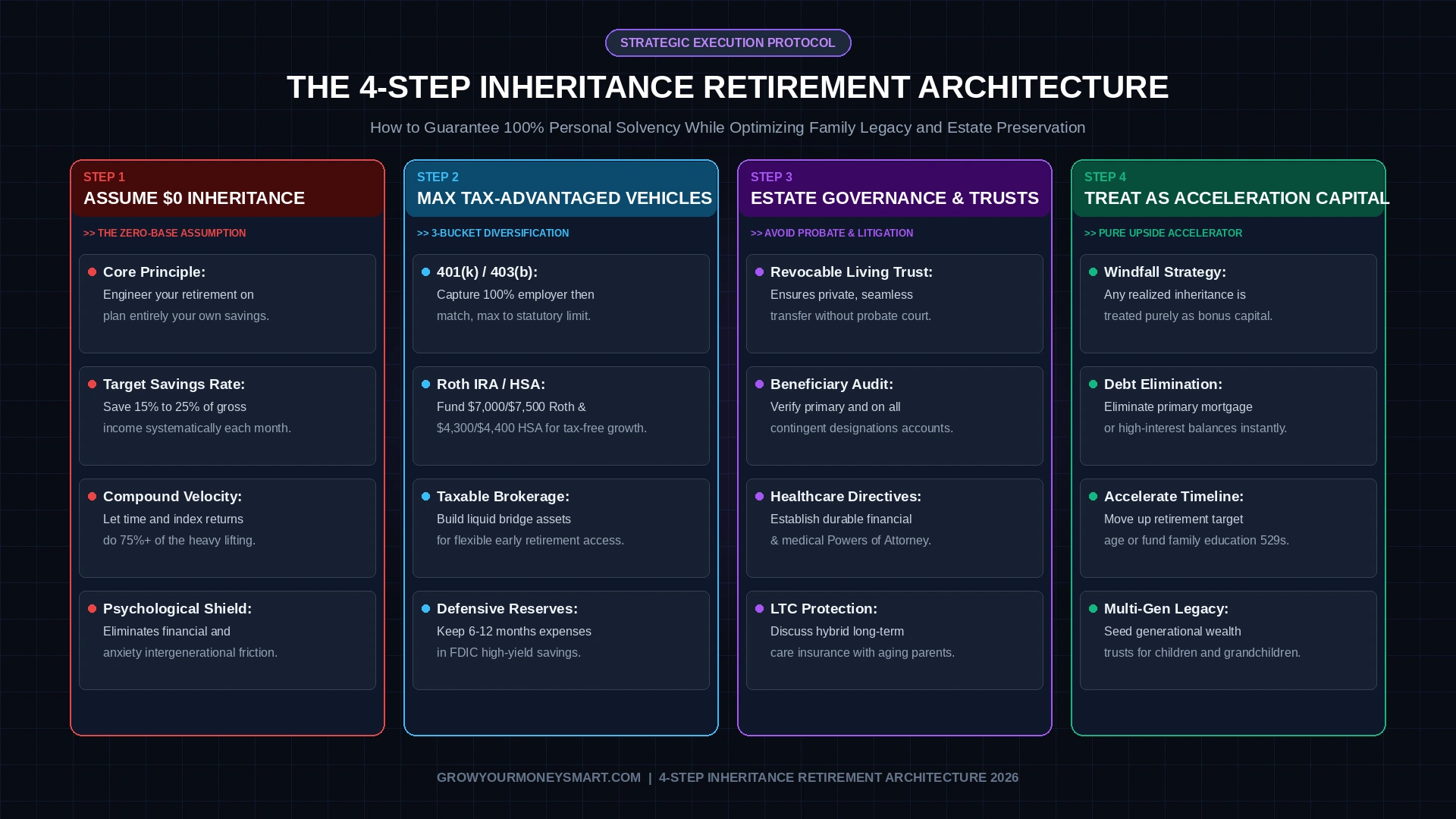
To successfully insulate your financial future from estate uncertainty while maximizing intergenerational wealth transfer efficiency, execute this structured four-step implementation protocol:
Step 1: Adopt the $0 Inheritance Baseline Protocol
Build your complete retirement accumulation and decumulation model under the strict mathematical constraint that you will receive exactly $0 from family estates. Calculate your baseline retirement number (e.g., 25x your annual non-discretionary expenses) and establish an automated monthly savings rate between 15% and 25% of gross income. Learn how your investment horizon shapes asset allocation in our guide to Investment Time Horizon Strategies.
Step 2: Maximize the 3-Bucket Tax-Advantaged Waterfall
Channel capital systematically through an optimized tax location hierarchy: First, capture 100% of employer 401(k) matching dollars; second, max out Health Savings Accounts (HSAs); third, fully fund Roth IRAs via direct contributions or Backdoor Roth conversions; and fourth, allocate surplus cash to broad-market taxable brokerage index funds to serve as a liquid pre-59½ bridge.
Step 3: Facilitate Proactive Family Estate Governance
Initiate compassionate, structured family conversations with aging parents. Verify that critical estate documents are established and funded: a Revocable Living Trust to bypass probate, updated Transfer-on-Death (TOD/POD) beneficiary designations, and durable Financial and Medical Powers of Attorney. Discuss whether hybrid life/long-term care insurance policies are appropriate to ring-fence parental medical risks.
Step 4: Deploy Realized Inheritances Purely as Acceleration Capital
If and when an inheritance materializes, do not use it to cover basic lifestyle overhead. Instead, treat it exclusively as an acceleration catalyst: pay off remaining mortgage debt, eliminate liabilities with our Debt Payoff Calculator, fund 529 education accounts for children, or accelerate your target retirement date by 3 to 5 years.
Behavioral Finance: Eliminating Psychological Traps & Entitlement
Relying on an expected inheritance introduces toxic behavioral dynamics into family relationships. When adult children view parental assets as “their future money,” subconscious resentment often brews whenever aging parents spend money on travel, hobbies, home modifications, or necessary assisted living care. This entitlement mindset damages parent-child bonds and creates profound emotional anxiety.
Conversely, achieving complete financial self-reliance liberates both generations. When you know your own retirement is 100% funded and secure, you can genuinely encourage your parents to spend, enjoy, and allocate their wealth toward the highest quality healthcare, comfort, and philanthropic desires without anxiety. If you are debating whether to manage this transition independently or seek professional guidance, review our in-depth analysis on DIY Investing vs. Hiring a Fiduciary Financial Advisor.
Actionable 10-Point Pre-Execution Checklist
Before modifying your retirement savings rate or estate strategy, ensure you have completed each of the following 10 verification checkpoints:
1. Retirement target calculated assuming exactly $0 in expected inheritance.
2. Monthly automated savings rate established between 15% and 25% of gross earnings.
3. Employer 401(k) matching dollars captured in full (100% instant return).
4. Health Savings Account (HSA) maxed out annually for triple-tax-free medical defense.
5. Roth IRA or Backdoor Roth IRA contribution limits fully utilized ($7,000/$7,500).
6. Liquid emergency cash buffer confirmed at 6 to 12 months in an FDIC high-yield account.
7. Portfolio weighted average expense ratio audited and maintained below 0.10%.
8. Primary and contingent beneficiary designations audited across all banking/investment portals.
9. Parents’ Revocable Living Trust, Durable POA, and Healthcare Directives confirmed active.
10. Mandatory 6-month cooling-off protocol established for any future windfall receipts.
Frequently Asked Questions (FAQs)
Below are clear, actionable answers to the most critical questions investors ask regarding inheritance expectations and retirement planning:
Certified Financial Planners universally advise setting your retirement plan target assuming a $0 inheritance. Because healthcare costs, longevity, taxes, and late-life spending are unpredictable, treating an inheritance as a guaranteed asset risks severe multi-hundred-thousand-dollar retirement shortfalls.
Private nursing home rooms average over $108,000 annually, while specialized memory care often exceeds $10,000 to $14,000 per month. A typical 3- to 5-year chronic health or cognitive decline event can easily consume $400,000 to $700,000+ of liquid estate assets before Medicaid qualifications apply.
Under current IRS regulations resulting from the SECURE Act and SECURE 2.0, non-spouse designated beneficiaries must completely liquidate inherited traditional and Roth IRAs by December 31st of the 10th year following the original owner’s death, often forcing heirs into peak income tax brackets.
With modern life expectancies extending well into the late 80s and 90s, the average age of inheritance receipt in the United States is between 58 and 68 years old. Relying on an inheritance deprives you of 30 to 40 prime years of compound interest growth.
Families should implement a comprehensive estate governance plan, including a Revocable Living Trust to bypass public probate court, regularly audited beneficiary designations (TOD/POD), and updated durable financial and medical Powers of Attorney.
First, establish a mandatory 6-month emotional cooling-off period and park the funds in an FDIC-insured high-yield cash vehicle. Then, consult a fee-only fiduciary advisor and CPA to evaluate tax liabilities, eliminate high-interest debt, fund tax-sheltered accounts, and pay down mortgage principal.
Cash, life insurance proceeds, and real estate (which receives a step-up in cost basis) generally pass income-tax-free at the federal level. However, inherited traditional 401(k)s and traditional IRAs are taxed as 100% ordinary income upon withdrawal.
Building your own fully funded retirement eliminates the subconscious psychological pressure and entitlement regarding aging parents’ spending choices. It allows parents to spend their hard-earned wealth on their own care and lifestyle without guilt or family friction.
Final Expert Takeaways: The Path to Enduring Financial Freedom
Mastering Expecting an Inheritance? Why You Still Absolutely Need Retirement Planning is ultimately a commitment to personal responsibility and mathematical reality over hopeful speculation. Inheritances are gifts, not guarantees. By engineering your personal wealth architecture to stand entirely on its own feet through systematic compounding, disciplined asset location, and robust defensive cash buffers, you eliminate financial anxiety and protect your family lineage.
If a legacy transfer reaches you in the future, it will serve as pure acceleration fuel—allowing you to retire earlier, expand philanthropic giving, or seed generational wealth for your children. If medical or longevity expenses consume the estate, your lifestyle and dignity remain completely secure. Start building your independent compounding engine today, beginning with our step-by-step tutorial on How to Save Your First $1,000 Emergency Fund.
Inherited retirement accounts, spousal roll-overs, and distribution timelines are subject to the 10-year rule under the SECURE Act. Consult the official Internal Revenue Service (IRS) Retirement Plan Beneficiary Rules for statutory guidelines and consumer protections.
⚖️ Generational Transfers, Estate Protections & Self-Reliance
Navigate family wealth transfers wisely and avoid probate complications with these estate planning guides:
- Transfer Traps: beneficiary designation vs will: costly traps — preventing costly inheritance disputes, probate taxation, and accidental disinheritance.
- Trust Protection: will vs living trust: what you need for retirement — why revocable trusts provide seamless, private generational asset passing.
- Core Legal Paperwork: 4 essential legal documents for retirement planning — securing vital medical directives, wills, and financial powers of attorney.
- Self-Reliant Wealth: 5 stages of retirement planning lifecycle — building independent personal wealth so an uncertain inheritance is never a dependency.

Jaiveer Hooda is the Lead Financial Researcher & Personal Finance Analyst at Grow Your Money Smart. Specializing in personal wealth optimization, index fund compounding, high-yield savings mechanics, and consumer debt elimination strategies. With a background in computer engineering, he applies mathematical modeling, cashflow simulations, and empirical risk analysis to evaluate personal finance vehicles and credit products. Every analysis is backed by verified regulatory disclosures, IRS tax schedules, and empirical APY compounding math.
Areas of Expertise: Personal Finance · High-Yield Savings Accounts (HYSA) · Index Funds & S&P 500 Compounding · Retirement Planning (401k/IRA) · Debt Optimization · Credit Card APR Mechanics.
Transparency & Editorial Policy: Editorial Standards | Report a Correction