
Household expenditure surveys prove that post-career expenses naturally decline in active spending categories, challenging arbitrary savings targets. Consult the official Federal Reserve Board Report on the Economic Well-Being of U.S. Households for statutory guidelines and consumer protections.
Demystify retirement nest egg requirements with empirical withdrawal math and spending benchmarks:
- Withdrawal Realities: the 4% rule safe withdrawal rate explained — calculate your true target number based on actual annual living expenses.
- Age 60 Projections: how much do you really need to retire at 60? — realistic expense models debunking sensational multi-million dollar media headlines.
- Frugal FIRE Models: Lean FIRE vs Fat FIRE spending benchmarks — discovering how intentional spending cuts your required nest egg in half.
- Guaranteed Floor: Social Security spousal benefits strategy — factoring in guaranteed inflation-adjusted federal retirement income.
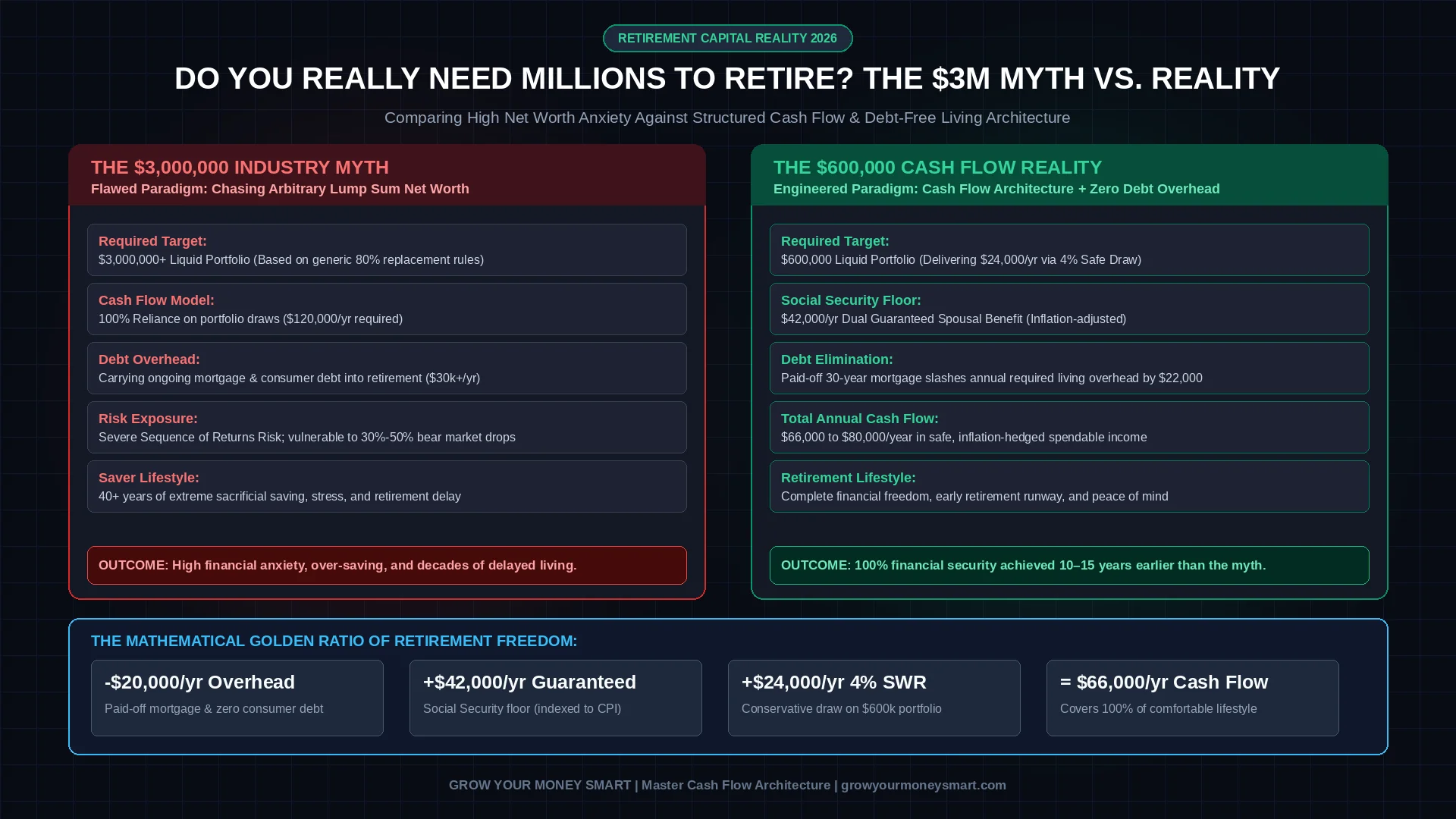
- The $3M Myth Debunked: Conventional media benchmarks push multi-million dollar nest eggs based on flawed 80% income-replacement models that ignore structural expense drops in retirement.
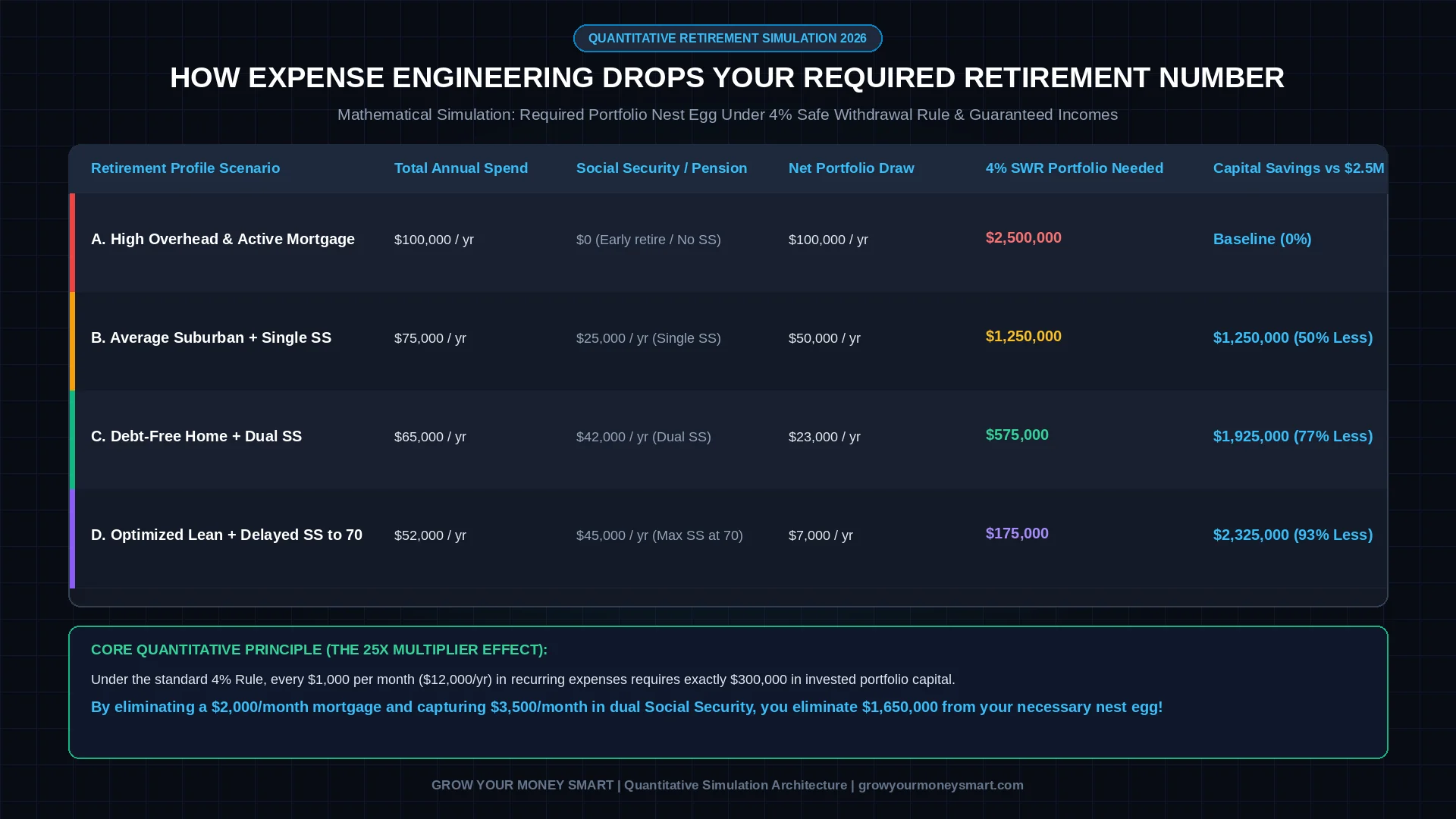
- Expense Engineering is King: Under the 4% Rule, every $1,000/month ($12,000/year) in recurring fixed overhead requires $300,000 in invested capital. Paying off a $1,800/month mortgage eliminates over $540,000 from your required nest egg.
- The $600,000 Cash Flow Reality: Pairing a paid-off home with a dual Social Security floor ($42,000/yr) and a 4% safe draw on $600k ($24,000/yr) delivers $66,000 to $80,000 per year in inflation-hedged, debt-free spendable income.
- Sequence Risk Defense: Maintaining a 2-year cash liquidity firewall ($30k–$50k) protects a modest portfolio from forced selling during market drawdowns, ensuring multi-decade longevity.
Achieving genuine, enduring financial freedom and stepping away from the 9-to-5 grind does not require winning the lottery or amassing an intimidating multi-million-dollar portfolio. If you have ever felt overwhelmed by financial media headlines declaring that “Americans now need $2.5 Million to retire comfortably,” you are not alone. The financial planning industry has long profited from stoking net worth anxiety, pushing complex accumulation metrics while obscuring the mathematical reality of retirement cash flow.
In modern personal finance, the critical question is not “How big is your lump sum balance?” but rather “How efficiently does your cash flow cover your baseline living expenses?” When you decouple your retirement target from arbitrary rules of thumb and engineer your baseline overhead, you discover that a modest, well-structured portfolio can easily support a vibrant, stress-free lifestyle. For precision diagnostics on your personal debt and spending trajectory, utilize our interactive Debt Payoff Calculator and Household Budget Calculator.
The Anatomic Failure of the 80% Income Replacement Rule (evaluated through institutional salary multiples for retirement by age)
For decades, traditional financial planners have relied on a blunt heuristic: the 80% Income Replacement Rule. This model posits that if you earn $100,000 per year prior to retirement, you must engineer an income stream of $80,000 annually throughout your retirement years. To generate $80,000 exclusively from an investment portfolio under the classic 4% Safe Withdrawal Rule, an investor would theoretically need an eye-watering $2,000,000 nest egg ($80,000 × 25).
However, this conventional model fails under rigorous financial scrutiny because it ignores the dramatic economic shifts that take place the moment you leave the workforce:
• Elimination of Payroll (FICA) Taxes: Working professionals surrender 7.65% of gross earnings to Social Security (6.2%) and Medicare (1.45%) taxes. In retirement, investment withdrawals and retirement distributions are completely exempt from FICA taxes.
• Halting Active Retirement Contributions: Dedicated savers routinely allocate 15% to 25% of their gross earnings toward 401(k)s, IRAs, and HSAs. Once retired, you transition from capital accumulation to distribution, immediately freeing up that portion of your cash flow.
• Elimination of Work-Related Friction Costs: Commuting fuel, toll charges, professional wardrobes, dining out during workdays, and union/association dues vanish upon retirement, slashing living costs by another 5% to 10%.
• Primary Housing Debt Paid Off: For disciplined homeowners who pay off their 30-year mortgages prior to retirement, the single largest expense category—principal and interest payments—is completely eliminated.
When you account for these structural reductions, the vast majority of retirees maintain an identical or enhanced standard of living on just 50% to 60% of their pre-retirement gross income. To evaluate how your timeline impacts risk exposure, explore our comprehensive guide on Investment Time Horizons.
Head-to-Head Comparison: The $3M Industry Myth vs. The $600k Reality
The table below contrasts the flawed assumptions of the conventional wealth industry against the engineered, debt-free cash flow architecture:
| Strategic Metric | The $3,000,000 Industry Myth | The $600,000 Cash Flow Reality | Practical Financial Impact |
|---|---|---|---|
| Core Philosophy | Lump-Sum Net Worth Maximization | Expense Engineering & Cash Flow Flow | Shifts focus from vanity metrics to spendable liquidity |
| Housing Overhead | Carrying $2,000+/mo mortgage into retirement | 100% Paid-off primary home ($0 debt) | Saves $24,000/yr in non-discretionary baseline spending |
| Social Security Integration | Treated as negligible or claimed early at 62 | Optimized dual spousal filing ($42,000/yr floor) | Guarantees 50%–65% of baseline survival budget |
| Portfolio Draw Needed | $120,000/yr (100% portfolio reliance) | $24,000/yr (4% SWR on $600,000 portfolio) | Reduces required invested capital by 80% ($2.4M saved) |
| Sequence of Returns Risk | Extreme; forced selling during 30% drawdowns | Shielded by 2-year cash liquidity buffer | Prevents permanent capital impairment in bear markets |
| Saver Timeline | 40+ years of extreme savings & delayed living | Achievable in 15–25 years of disciplined investing | Unlocks 10–15 years of early retirement freedom |
The 25x Multiplier Effect: Why Every $1,000/Mo Debt Demands $300,000
To master retirement economics, you must understand the mathematical mechanics of William Bengen’s classic 4% Safe Withdrawal Rule. The inverse of 4% (1 ÷ 0.04) is 25. This means that for every single dollar of annual income you require from your portfolio, you must accumulate $25 in invested liquid assets.
Consider the compounding leverage this creates across your balance sheet:
• A $1,000/Month Fixed Expense: Equals $12,000 annually. Under the 25x multiplier ($12,000 × 25), this single expense requires $300,000 in dedicated portfolio capital.
• A $2,000/Month Mortgage Payment: Equals $24,000 annually. Carrying this mortgage into retirement demands $600,000 in invested portfolio capital solely to service the bank’s interest and principal.
• A $500/Month Car Payment: Equals $6,000 annually. Carrying auto financing requires $150,000 in invested capital.
When you aggressively eliminate liabilities before your retirement date—such as utilizing strategies from our guide on How to Pay Off a 30-Year Mortgage in 15 Years—you are effectively giving yourself a $500,000 to $750,000 retirement portfolio discount! You do not need to earn or save that extra half-million dollars because the underlying expense no longer exists.
Social Security: Your Inflation-Indexed Defined Benefit Anchor
The second pillar that completely dismantles the “Millions Needed” myth is the power of the Social Security Administration (SSA) defined benefit floor. While financial pessimists frequently dismiss Social Security, the program remains backed by federal statutory taxing authority and provides a feature that private market portfolios cannot match: guaranteed, lifetime, inflation-indexed annuities with zero sequence of returns risk.
Consider a married couple reaching Full Retirement Age (FRA, age 67 for those born in 1960 or later):
• Primary Earner Benefit: $2,400 per month ($28,800/year).
• Spousal Benefit: $1,300 per month ($15,600/year).
• Combined Guaranteed Annual Income: $44,400 per year ($3,700/month).
To replicate $44,400 in guaranteed, inflation-indexed annual cash flow using a 4% withdrawal rate from a private portfolio, an investor would need to amass $1,110,000 in cash and equities ($44,400 × 25). By claiming Social Security strategically—and delaying the primary earner’s benefit to age 70 for an extra 24% to 32% permanent bump in delayed retirement credits—your guaranteed floor expands even further, absorbing nearly 100% of your baseline non-discretionary survival budget.
Expert Video Walkthrough: Debunking the Retirement Target with Math
To see these numbers modeled visually across dynamic market conditions, watch this comprehensive educational breakdown by retirement specialist Humphrey Yang on “FINANCIAL ADVISOR Explains: Retirement Plans for Beginners (401k, IRA, Roth 401k/IRA, 403b)”:
The 4-Pillar Action Roadmap to Retiring Comfortably Without Millions
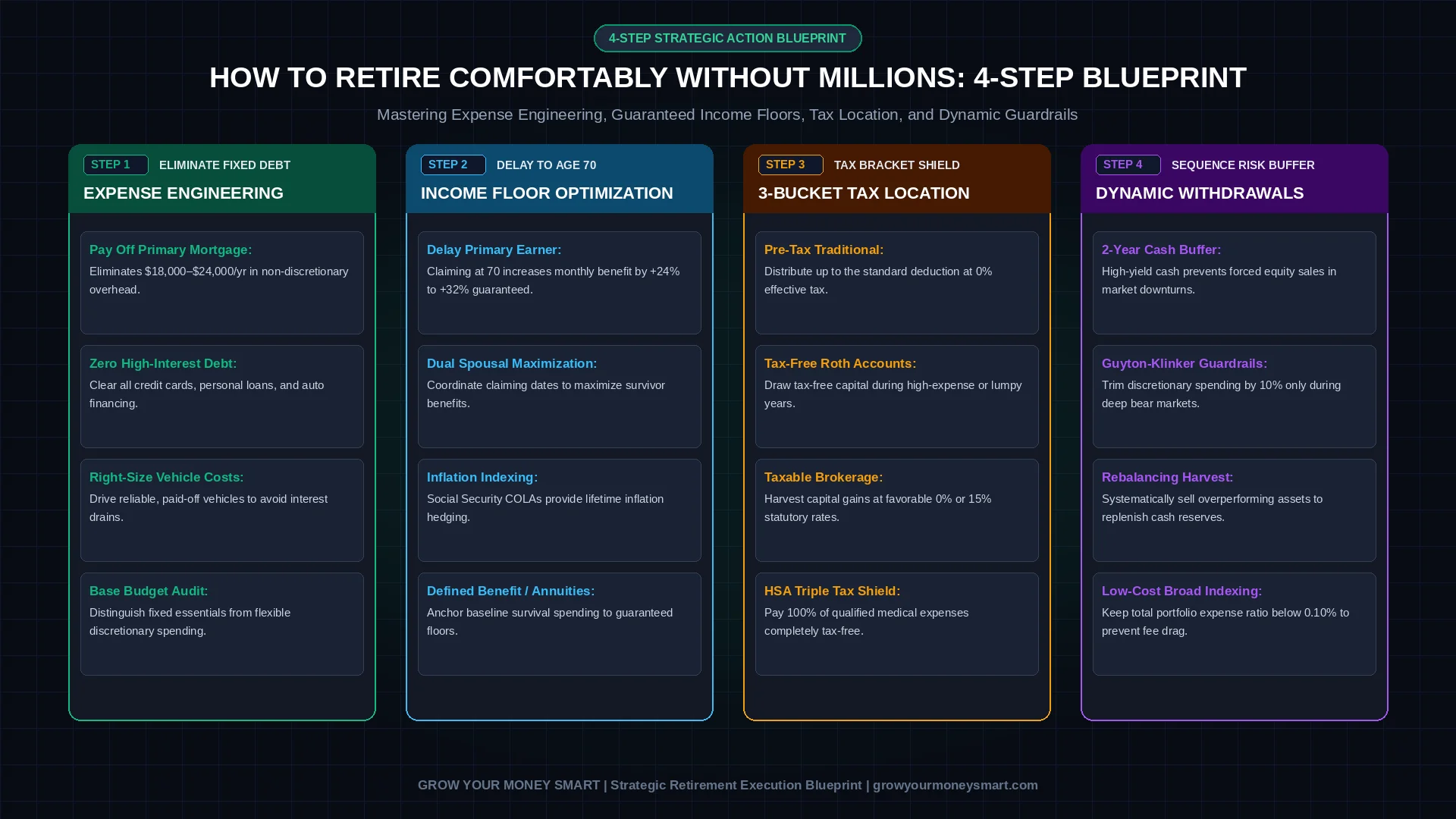
To construct a resilient retirement architecture on a sensible, achievable nest egg, execute these four actionable strategic pillars:
Pillar 1: Execute Aggressive Expense Engineering
Prior to your retirement date, conduct a forensic cash flow audit. Eliminate all revolving consumer debts, auto loans, and personal credit lines. Establish a payoff glidepath for your primary residence so you enter retirement with 100% home equity. Eliminating $2,000/month in debt service is mathematically equivalent to accumulating $600,000 in your investment account. Structure your baseline cash flow using our strategies for Budgeting and Cash Flow Allocation.
Pillar 2: Maximize Your Guaranteed Social Security Floor
Avoid the common trap of reflexively filing for Social Security at age 62, which imposes a permanent 30% reduction on your monthly benefit. If possible, bridge the gap between age 62 and your Full Retirement Age (or age 70) using modest cash reserves or part-time consulting income. Every year you delay claiming past FRA until age 70 locks in a guaranteed, government-backed 8% annual real increase in your baseline benefit.
Pillar 3: Deploy a 3-Bucket Tax Location Strategy
Do not leave your retirement assets solely in pre-tax 401(k) accounts, where every withdrawal is taxed as ordinary income and may trigger higher Medicare Part B/D (IRMAA) premiums. Diversify across three tax buckets:
1. Pre-Tax Traditional Accounts: Withdraw up to the standard deduction at a 0% effective federal tax rate.
2. Tax-Free Roth Accounts: Fund lumpy expenses (vacations, home maintenance, vehicle upgrades) tax-free without spiking your marginal bracket.
3. Triple-Tax-Advantaged HSAs: Cover 100% of out-of-pocket medical bills completely tax-free. Progress through each wealth milestone by exploring our 5 Stages of Retirement Planning.
Pillar 4: Establish Dynamic Withdrawal Guardrails & Cash Buffer
Never rely on a rigid withdrawal schedule. Implement Guyton-Klinker dynamic guardrails paired with a 2-year cash liquidity buffer ($30,000 to $50,000 in an FDIC-insured high-yield savings account). When equity markets experience sharp cyclical corrections, draw your living expenses from the cash buffer. This single tactical rule eliminates sequence of returns risk and allows your equity growth engine to recover uninterrupted. Protect your baseline liquidity with our Emergency Fund Calculator.
2025/2026 Statutory Contribution Limits & SECURE 2.0 Accelerators
Building your $500,000 to $600,000 nest egg is faster than ever when leveraging updated IRS contribution limits and SECURE 2.0 legislation:
• Workplace 401(k), 403(b), & 457 Plans: Elective deferral limits are set at $23,500 for 2025 ($24,500 in 2026). Standard catch-up contributions for individuals aged 50+ remain at $7,500 ($8,000 in 2026).
• SECURE 2.0 “Super Catch-Up” (Ages 60–63): Savers aged 60, 61, 62, or 63 qualify for an elevated catch-up threshold of $11,250, providing an accelerated 4-year compounding sprint before retirement.
• Individual Retirement Accounts (IRAs): Annual contribution limits stand at $7,000 ($7,500 in 2026) with an extra $1,000 catch-up for age 50+.
• Health Savings Accounts (HSAs): Annual limits are $4,300 for individual and $8,550 for family coverage ($4,400 and $8,750 respectively in 2026), plus an additional $1,000 catch-up at age 55+.
• 529 College Plan to Roth IRA Rollover: Up to $35,000 in unused 529 funds can be rolled penalty-free into a beneficiary’s Roth IRA after 15 years of account seasoning.
Frequently Asked Questions (FAQs)
Below are clear, mathematically grounded answers to the most common questions savers ask about debunking the multi-million dollar retirement myth:
No. The conventional $2M to $3M benchmark is built on outdated 80% income-replacement assumptions and assumes retirees carry heavy debt. When you eliminate your primary mortgage and integrate guaranteed Social Security income, a $500,000 to $600,000 portfolio generates $66,000 to $80,000 per year in safe, debt-free spendable cash flow.
Under the 4% Safe Withdrawal Rule (the 25x multiplier), every $1,000 per month ($12,000 per year) in fixed living expenses requires $300,000 in invested portfolio capital. Eliminating an average $1,800/month mortgage payment removes over $540,000 from the total nest egg you need to accumulate.
Social Security acts as an inflation-adjusted, government-guaranteed defined benefit pension. An average married couple receiving a combined $42,000 annually from Social Security covers the vast majority of non-discretionary living costs, reducing the burden on their liquid portfolio to just $15,000–$25,000 per year.
The 80% replacement rule assumes your expenses stay identical in retirement. In reality, retirees stop paying 7.65% FICA payroll taxes, stop saving 15%–20% of their income for retirement, and frequently eliminate work-related commuting and housing debts, typically requiring only 50%–60% of pre-retirement gross earnings.
Under the proven 4% Safe Withdrawal Rule with dynamic guardrails, a $600,000 balanced portfolio safely produces $24,000 in annual distributions ($2,000 per month), adjusted upward each year for inflation, with near-zero historical failure risk across 30-year retirement windows.
Establish a 2-year cash and short-term Treasury buffer ($30,000 to $50,000) in a High-Yield Savings Account. During market corrections or bear markets, draw living expenses directly from the cash firewall rather than selling depressed equities at a loss.
For 2025/2026, employee 401(k) limits are $23,500 ($24,500 in 2026) with standard catch-ups of $7,500 ($8,000 in 2026). Furthermore, the SECURE 2.0 ‘Super Catch-Up’ allows workers aged 60–63 to contribute an extra $11,250 annually, creating an accelerated final compounding runway.
By holding assets across Pre-Tax (Traditional 401k/IRA), Tax-Free (Roth IRA/HSA), and Taxable Brokerage accounts, retirees can pull pre-tax dollars up to the standard deduction at a 0% effective rate, draw Roth funds for lumpy expenses, and keep overall taxable income in the lowest 0%–12% federal tax brackets.
Final Verdict: Redefining Financial Independence on Your Terms
Retirement freedom is not a trophy reserved for multi-millionaires. It is an engineered financial architecture built upon low fixed overhead, reliable guaranteed income floors, tax-smart account structuring, and disciplined asset allocation. By shifting your focus away from arbitrary seven-figure milestones and toward sustainable net cash flow, you take back control of your financial destiny—allowing you to retire comfortably, securely, and years ahead of schedule.

Jaiveer Hooda is the Lead Financial Researcher & Personal Finance Analyst at Grow Your Money Smart. Specializing in personal wealth optimization, index fund compounding, high-yield savings mechanics, and consumer debt elimination strategies. With a background in computer engineering, he applies mathematical modeling, cashflow simulations, and empirical risk analysis to evaluate personal finance vehicles and credit products. Every analysis is backed by verified regulatory disclosures, IRS tax schedules, and empirical APY compounding math.
Areas of Expertise: Personal Finance · High-Yield Savings Accounts (HYSA) · Index Funds & S&P 500 Compounding · Retirement Planning (401k/IRA) · Debt Optimization · Credit Card APR Mechanics.
Transparency & Editorial Policy: Editorial Standards | Report a Correction