
Leaving the workforce prior to Medicare eligibility at age 65 requires bridging healthcare coverage and calculating early distribution rules. Consult the official Social Security Administration (SSA) Retirement Planning Guidelines for statutory guidelines and consumer protections.
Validate your early exit numbers and healthcare bridges with these companion retirement analyses:
- Withdrawal Framework: the 4% rule safe withdrawal rate explained — calculating your portfolio multiplier to ensure your nest egg lasts 30 to 40 years.
- Core Lifecycle Plan: 5 stages of retirement planning lifecycle — audit your progression through late-career accumulation and early distribution.
- Pre-Medicare Coverage: healthcare costs: the elephant in retirement planning — budgeting for private health insurance premiums from age 60 until Medicare at 65.
- Early Exit Archetypes: types of FIRE: Lean FIRE vs Fat FIRE vs Barista FIRE — matching your annual spending targets to modern financial independence models.
- Market Timing Risk: sequence of returns risk: protect retirement — insulating early withdrawals with cash buffers and bond tents.
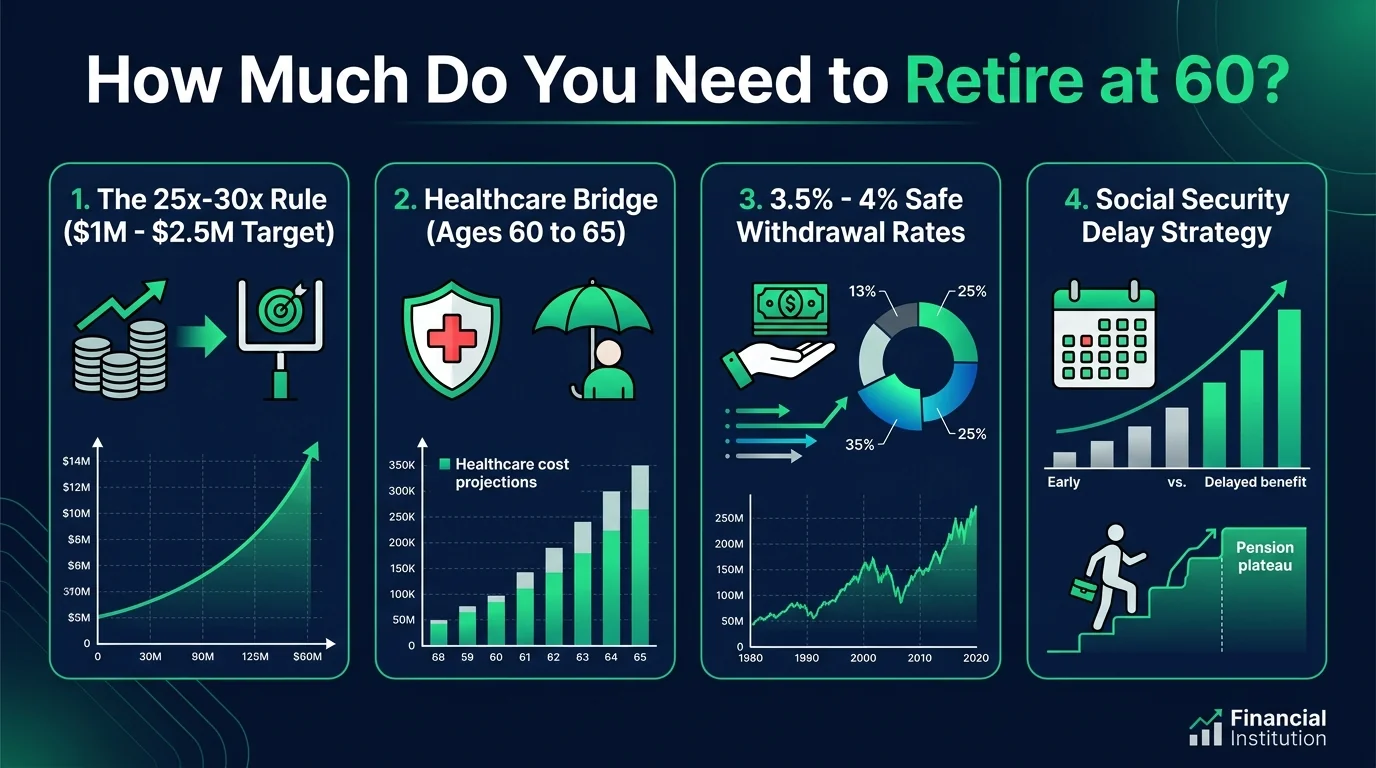
- The Core Target: Retiring at age 60 generally requires a nest egg between $1.0 million and $2.5 million, calculated as 25x to 30x your expected annual post-retirement expenses.
- Safe Withdrawal Rate: Because a retirement at 60 must span 30 to 35+ years, adopting a dynamic 3.5% to 3.75% withdrawal rate offers far greater portfolio longevity than the rigid 4% rule.
- The 5-Year Healthcare Bridge: You must self-fund health coverage between ages 60 and 65 before Medicare begins, which typically costs $8,000 to $18,000 annually per individual without subsidies.
- Tax-Efficient Withdrawal Order: Withdraw from taxable brokerage accounts first, pre-tax 401(k)/IRAs second, and tax-free Roth accounts last to keep your taxable income optimized for ACA health insurance subsidies.
- Social Security Strategy: Bridging expenses from your portfolio between ages 60 and 67 or 70 permanently boosts your guaranteed lifetime Social Security payout by up to 77% compared to claiming at age 62.
Retiring at age 60 is the quintessential milestone of modern financial independence. Stepping away from full-time employment five to seven years ahead of traditional retirement age gives you the health, energy, and freedom to pursue personal passions, travel, and spend priceless time with family. However, an early exit from the workforce fundamentally alters the financial arithmetic of retirement planning.
When you retire at 60, you face three distinct mathematical hurdles (see our milestone guide on how much to save by age 30, 40, 50, and 60): your investment portfolio must sustain cash flow for 30 to 35+ years, you must bridge a 5-year gap before Medicare coverage begins at age 65, and you must navigate the critical timing of Social Security benefits. In this comprehensive master guide, we break down exact dollar figures, withdrawal formulas, spending benchmarks, tax optimization blueprints, and real-world simulations to answer definitively: how much do you need to retire at 60?
How Much Money Do You Need to Retire at 60? The Core Formulas
Determining your retirement number does not rely on arbitrary guesswork or salary averages. Instead, it is governed by two foundational financial models: the Expense Multiplier Rule (25x–30x) and the Safe Withdrawal Rate (SWR). Understanding how these models interact across your investment time horizon is the first step toward securing lasting financial freedom.
1. The 25x to 30x Annual Spending Rule
The standard retirement rule of thumb states that you should amass 25 times your annual living expenses. This is based on the famous Trinity Study, which evaluated 30-year historical retirement horizons. However, because retiring at 60 often demands a 35-year portfolio lifespan, seasoned wealth advisors recommend applying a 28x to 30x multiplier for added downside protection.
To calculate your target corpus, calculate your projected annual spending (net of any guaranteed pension or annuity income) and multiply by your chosen factor:
Required Nest Egg = (Desired Annual Expenses − Guaranteed Annual Pension) × 28.5
2. The 3.5% to 4.0% Safe Withdrawal Rate at Age 60
The 4% rule allows you to withdraw 4% of your starting portfolio balance in year one, adjusting that dollar amount upward for inflation in every subsequent year. While a 4.0% withdrawal rate yields a 95% historical success rate over 30 years, reducing your initial withdrawal rate to 3.5% or 3.75% boosts portfolio survival probability to over 98% across 35 to 40 years, drastically lowering sequence-of-returns risk during early market downturns.
Retirement Savings Needed at Age 60: Spending Benchmark Matrix
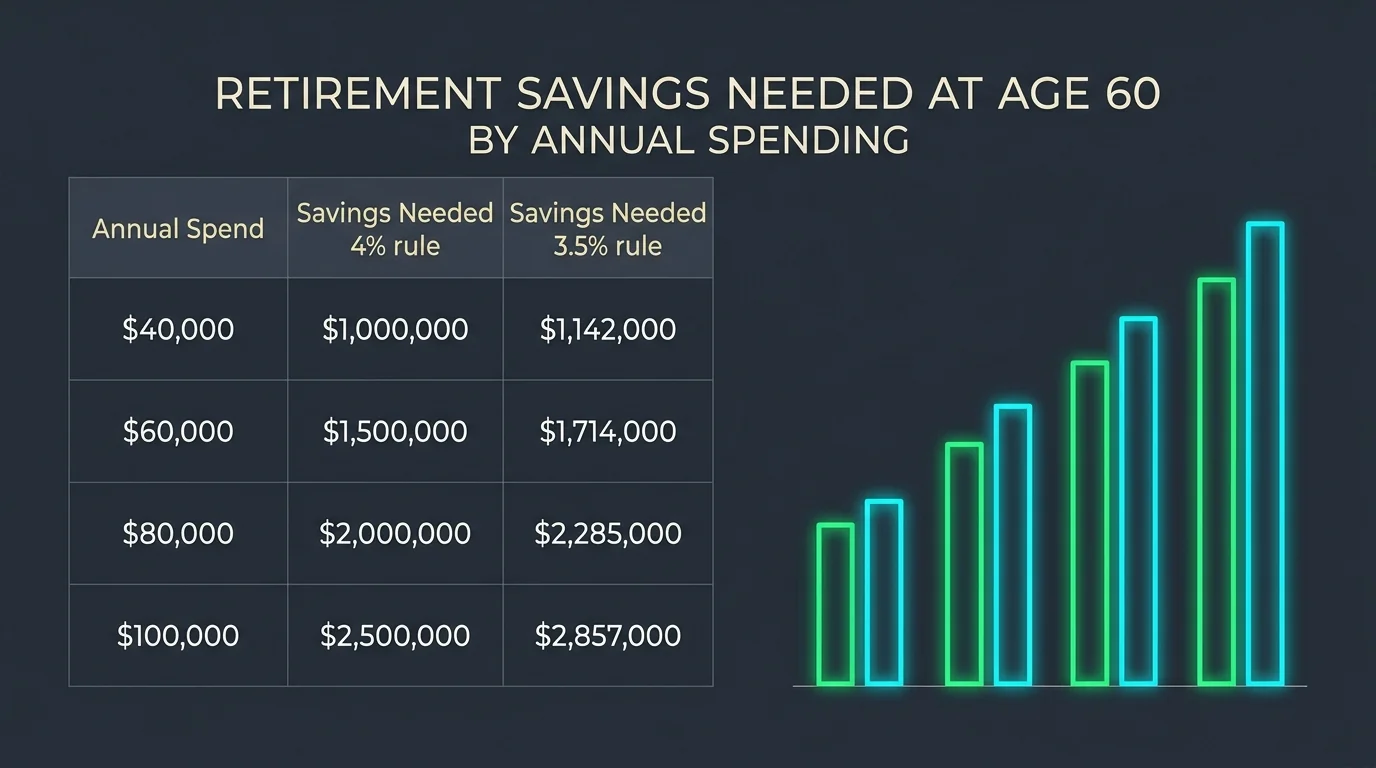
Your exact savings requirement depends primarily on your annual cash outflow. Below is a detailed breakdown comparing the portfolio sizes required across different annual lifestyle budgets, comparing traditional 4% withdrawals against conservative 3.5% early-retirement withdrawal rates:
| Desired Annual Spending | Estimated Monthly Budget | Savings Needed (4.0% SWR / 25x) | Savings Needed (3.5% SWR / 28.6x) | Recommended Lifestyle Fit |
|---|---|---|---|---|
| $40,000 / year | $3,333 / mo | $1,000,000 | $1,142,857 | Frugal / Lean FIRE / Paid-off home in low-cost region |
| $60,000 / year | $5,000 / mo | $1,500,000 | $1,714,285 | Moderate comfortable living / Occasional travel / Debt-free |
| $80,000 / year | $6,667 / mo | $2,000,000 | $2,285,714 | Upper-middle lifestyle / Frequent travel / Comprehensive healthcare |
| $100,000 / year | $8,333 / mo | $2,500,000 | $2,857,142 | Affluent retirement / High-cost metro / Extensive hobbies & leisure |
| $120,000 / year | $10,000 / mo | $3,000,000 | $3,428,571 | Luxury lifestyle / Multi-property / Full private coverage & gifting |
To accurately assess where your current household expenses fall, utilize our free interactive budgets calculator or read our tactical breakdown on how to budget living expenses effectively.
Retiring at 60 vs. 65 vs. 67: Head-to-Head Comparison Matrix
Retiring at 60 requires greater financial discipline than waiting until standard retirement ages because you forego peak earning years while expanding the drawdown phase. Here is how key structural variables compare across retirement ages:
| Planning Factor | Retiring at Age 60 | Retiring at Age 65 | Retiring at Age 67 (Full FRA) |
|---|---|---|---|
| Expected Retirement Span | 30 to 38+ Years | 25 to 30 Years | 20 to 25 Years |
| Medicare Availability | 5-Year Gap (Ages 60–65) | Immediate Eligibility | Immediate Eligibility |
| Recommended SWR | 3.25% – 3.75% | 4.0% – 4.25% | 4.25% – 4.75% |
| Social Security Status | 2-Year wait to age 62 (reduced) or bridge to 67/70 | Eligible with ~13% permanent reduction vs FRA | 100% Full Unreduced Benefit |
| Salary Savings Target | 8x to 10x Current Salary | 8x to 9x Current Salary | 7x to 8x Current Salary |
| Sequence Risk Sensitivity | Very High (First 5–7 years) | Moderate | Low to Moderate |
The 5 Critical Pillars of a Successful Age-60 Retirement Plan
Building a robust retirement foundation at 60 requires coordinating multiple moving parts across the stages of the retirement plan lifecycle. Focus on executing these five non-negotiable pillars:
Pillar 1: Solving the 5-Year Healthcare Bridge (Ages 60 to 65)
The single greatest out-of-pocket surprise for people retiring at 60 is health insurance. Since Medicare begins at 65, you must bridge a 5-year gap. For a couple aged 60, unsubsidized private health insurance premiums can easily exceed $1,500 to $2,200 per month ($18,000 to $26,000 annually). Strategies to solve this include:
- Affordable Care Act (ACA) Premium Tax Credits: By strategically controlling your Modified Adjusted Gross Income (MAGI) through taxable brokerage withdrawals or Roth conversions, you can qualify for significant health insurance premium subsidies on Healthcare.gov.
- COBRA Continuation Coverage: COBRA allows you to retain your employer plan for up to 18 months post-retirement, providing seamless continuity while you evaluate marketplace options.
- Health Savings Account (HSA) Distributions: Utilizing accumulated HSA funds allows you to pay qualified out-of-pocket medical expenses, deductibles, and co-pays completely tax-free.
Pillar 2: Tax-Smart Asset Location and Drawdown Sequencing
The sequence in which you pull money from your accounts can add 5 to 8 years of longevity to your nest egg. Follow the optimal 3-tier drawdown sequence:
- Taxable Brokerage Accounts First: Sell appreciated assets with favorable long-term capital gains tax rates (0% or 15%), which keeps your taxable income low and maximizes healthcare subsidies.
- Tax-Deferred Accounts (Traditional IRA / 401k) Second: Withdraw just enough from pre-tax accounts to fill up the standard deduction and lowest marginal tax brackets (10% and 12%).
- Roth IRAs / Roth 401(k)s Last: Allow your tax-free compounding engine to grow untouched as long as possible, reserving it for large lump-sum expenses, travel, or estate planning.
Pillar 3: The Social Security Optimization Equation
Although you can technically begin claiming Social Security benefits at age 62, doing so locks in a permanent 30% reduction in your monthly benefit compared to your Full Retirement Age of 67. If you delay claiming until age 70, your benefit increases by 8% per year via delayed retirement credits.
For individuals retiring at 60, using portfolio assets as a bridge between ages 60 and 67 or 70 serves as the most powerful, inflation-indexed annuity available on the market.
Pillar 4: Sequence-of-Returns Risk & Cash Buffer Strategy
Sequence-of-returns risk refers to the danger of experiencing a severe stock market downturn in the first 3 to 5 years of retirement while actively selling shares for living expenses. To insulate your portfolio from market crashes, establish a 24- to 36-month cash reserve in high-yield savings accounts or short-term Treasury bills. Explore our emergency fund calculator to model your liquidity reserves.
Pillar 5: Eliminating High-Interest & Mortgage Debt
Fixed debt payments inflate your required annual withdrawal number. Eliminating high-interest consumer debt and evaluating mortgage payoff before age 60 dramatically lowers baseline living expenses, allowing a smaller portfolio to deliver total financial security. Check our debt payoff calculator and guide on debt management strategies for accelerating payoff milestones.
Expert Video Breakdown: Early Retirement Numbers & Portfolio Survival
To see how financial advisors stress-test portfolio longevity, asset allocation, and early retirement expense multipliers, watch this deep dive from The Money Guy Show:
Step-by-Step Action Blueprint: How to Prepare for Retirement at 60
If you are within 5 to 10 years of reaching age 60, follow this structured, chronological implementation roadmap:
- Conduct a Forensic Expense Audit: Track 12 months of actual household expenses. Categorize spending into essential needs (housing, food, healthcare, utilities) and discretionary wants (travel, hobbies, dining).
- Calculate Your Exact Gap Number: Subtract guaranteed income sources (pensions, real estate net cash flow) from your annual expenses. Multiply the net shortfall by 28.5 to identify your target savings goal.
- Build a 3-Year Liquidity Moat: Transition 2 to 3 years worth of essential living expenses into liquid, capital-preserving instruments (HYSA, money market funds, short-duration CDs) to protect against early bear markets.
- Model Healthcare & ACA Subsidies: Run preliminary health plan estimates on Healthcare.gov based on projected taxable retirement distributions to confirm your annual health budget.
- Consult a Fee-Only Certified Financial Planner (CFP): Stress-test your plan with Monte Carlo simulations to ensure your asset allocation and withdrawal rates withstand historical worst-case market scenarios. Learn more about choosing the right advisory path in our guide on DIY investing vs hiring a financial advisor.
⚡ Age 60 Early Retirement Preparation Frameworks
Ensure a smooth transition into early retirement at 60 with these critical planning blueprints:
- Pre-Medicare Healthcare Gap: Explore our guide on healthcare costs and bridge insurance before Medicare at 65 covering ACA exchange subsidies and HSA bridge strategies.
- Managing Longevity Risk: Explore our guide on planning for extended retirement longevity to protect your portfolio over potential 35+ year withdrawal horizons.
- Early Social Security Traps: Explore our guide on Social Security early retirement age reductions and how delaying claims to full retirement age increases guaranteed income.
- Phased Work Alternatives: Explore our guide on flexible work and semi-retirement options at 60 to test-drive retirement without abrupt income loss.
Frequently Asked Questions (FAQs)
Here are clear, authoritative answers to the most common questions on retiring at age 60:
To retire comfortably at age 60, most households require between $1.2 million and $2.5 million, depending on annual living expenses. Financial planners recommend targeting 25x to 30x your expected annual retirement spending, which sustains an annual safe withdrawal rate of 3.5% to 4.0% across a 30- to 35-year retirement horizon.
Yes, you can retire at 60 with $1 million if your annual living expenses are between $35,000 and $40,000 (reflecting a 3.5% to 4% withdrawal rate). If you have a paid-off mortgage, lower regional living costs, or a future Social Security benefit starting at 62 or 67, a $1M portfolio can comfortably support your retirement.
Because Medicare begins at age 65, retiring at 60 creates a 5-year healthcare bridge. The most cost-effective solution is enrolling in an Affordable Care Act (ACA) Marketplace plan. By managing your taxable distributions to keep your Modified AGI modest, you can qualify for substantial premium tax credits that significantly lower monthly insurance costs.
While the traditional 4% Bengen rule was designed for a 30-year retirement, retiring at 60 extends your planning horizon to 35+ years. Many wealth advisors recommend a conservative starting withdrawal rate of 3.25% to 3.75%, utilizing dynamic spending rules to adjust withdrawals during prolonged market contractions.
Claiming Social Security at 62 results in a permanent 30% reduction in your monthly benefit compared to your Full Retirement Age (FRA) of 67. If your investment portfolio and cash reserves can fund your living expenses until age 67 or 70, delaying Social Security increases your guaranteed lifetime payout by up to 8% per year.
Yes. The IRS 10% early withdrawal penalty expires once you reach age 59½ for both traditional and Roth IRAs as well as employer 401(k) plans. Standard income taxes still apply to distributions from pre-tax accounts, while qualified Roth distributions are completely tax-free.
Standard retirement benchmarks recommend having 8x your gross annual salary saved by age 60. For individuals planning to fully retire at 60 rather than working until 65 or 67, aiming for 8x to 10x salary provides an essential buffer against inflation and sequence-of-returns risk.
A recommended asset allocation for retiring at 60 is typically 50% to 60% equities and 40% to 50% fixed income/cash. Retaining 50%+ in diversified global equities ensures the growth needed to beat inflation over a 35-year horizon, while bonds and cash protect immediate cash flow needs.

Jaiveer Hooda is the Lead Financial Researcher & Personal Finance Analyst at Grow Your Money Smart. Specializing in personal wealth optimization, index fund compounding, high-yield savings mechanics, and consumer debt elimination strategies. With a background in computer engineering, he applies mathematical modeling, cashflow simulations, and empirical risk analysis to evaluate personal finance vehicles and credit products. Every analysis is backed by verified regulatory disclosures, IRS tax schedules, and empirical APY compounding math.
Areas of Expertise: Personal Finance · High-Yield Savings Accounts (HYSA) · Index Funds & S&P 500 Compounding · Retirement Planning (401k/IRA) · Debt Optimization · Credit Card APR Mechanics.
Transparency & Editorial Policy: Editorial Standards | Report a Correction