
Between Debt Avalanche vs Snowball, the Debt Avalanche method always saves more money and mathematically pays off debt faster. By targeting the highest-APR balances first, Avalanche eliminates compounding interest drag, saving an average of $1,200 to $3,500+ on typical consumer debts and finishing 2 to 5 months sooner. Conversely, the Debt Snowball method tackles the smallest balance first, delivering faster psychological victories to build early emotional momentum.
- The Math Winner: The Debt Avalanche is mathematically superior in 100% of scenarios, maximizing interest savings and achieving zero-debt status in the shortest possible time.
- The Behavioral Winner: The Debt Snowball wins on psychological adherence, helping borrowers who feel overwhelmed by eliminating accounts quickly.
- The Cost of Psychology: Choosing Snowball over Avalanche costs borrowers between $500 and $3,000+ in unnecessary interest—the “behavioral tax” of prioritizing small balances over high interest rates.
- The 2026 Rate Factor: With credit card interest rates averaging 24.7% APR per Federal Reserve data, the Avalanche math advantage has widened significantly.
- The Hybrid Solution: Knock out one small balance (<$1,500) in under 60 days for instant dopamine, then immediately pivot all extra cash into the highest-APR debt.
When you are drowning in multiple monthly loan payments, choosing the right debt elimination framework is the single most important financial decision you will make. Two strategies dominate personal finance: the Debt Avalanche (mathematical optimization) and the Debt Snowball (behavioral psychology). While both methods require paying minimums on all obligations while funneling extra cash to a single priority debt, the order in which you attack your balances changes everything.
In this comprehensive guide, we dissect the exact avalanche vs snowball math across a real-world $25,000 debt portfolio, analyze which debt method saves more cash, and provide actionable steps to break free from debt years ahead of schedule. To model your own liabilities in real-time, test our interactive Debt Payoff Calculator alongside our Credit Card Minimum Payment Calculator.
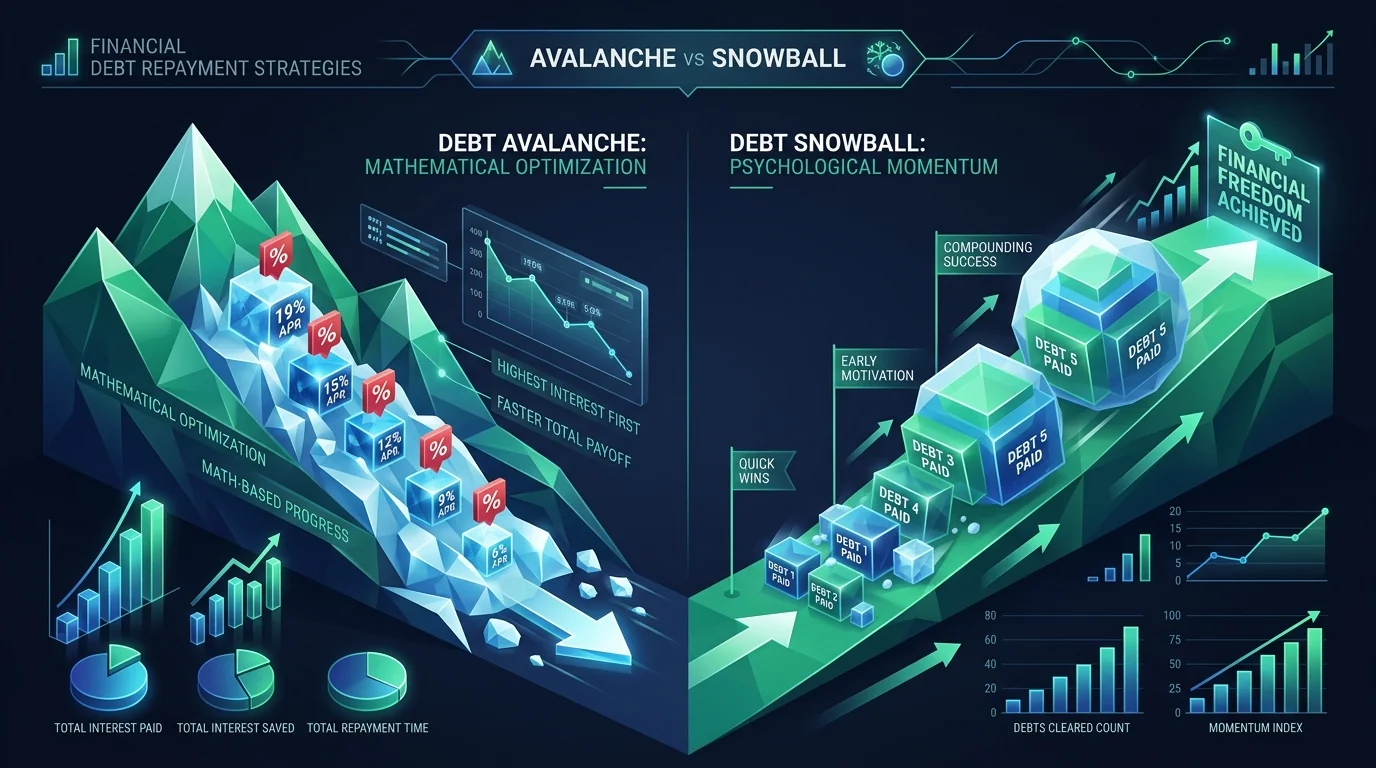
Avalanche vs Snowball: How Each Debt Payoff Method Works
Both frameworks follow the exact same foundational operational rule: you pay the required monthly minimums on every single debt to protect your credit score from 30-day delinquency marks. Every spare dollar above the minimums is then concentrated on one single target debt. The core divergence lies entirely in how you select that target:
- The Debt Avalanche Method (Highest Interest Rate First): You rank your debts strictly in descending order of Annual Percentage Rate (APR). The account with the highest interest rate receives 100% of your extra cash flow. Once that high-rate liability is eliminated, its minimum payment plus your extra cash rolls directly into the next highest APR debt.
- The Debt Snowball Method (Smallest Balance First): Popularized by radio host Dave Ramsey, you rank debts strictly in ascending order of balance size, completely ignoring interest rates. The smallest debt receives all extra funds until paid in full, giving you a fast quick win. You then roll that liberated cash into the second smallest debt, creating an expanding snowball of cash flow.
Avalanche vs Snowball Math: $25,000 Real-World Showdown
To see the exact quantitative difference between both strategies, let us model an empirical scenario representing a typical American household carrying $25,000 in total consumer debt:
- Debt 1 (High-Interest Credit Card): $6,000 balance at 26.99% APR (Minimum payment: $180/month)
- Debt 2 (Personal Consolidation Loan): $8,000 balance at 15.49% APR (Minimum payment: $220/month)
- Debt 3 (Auto Loan): $8,500 balance at 7.25% APR (Minimum payment: $240/month)
- Debt 4 (Medical Collection Bill): $2,500 balance at 0.00% APR (Minimum payment: $60/month)
Total Monthly Baseline Minimums: $700.00/month.
Accelerated Payoff Budget: The borrower commits an additional $500.00/month, bringing total monthly debt repayment cash flow to $1,200.00/month.
Here is how the mathematical outcomes compare side-by-side:
The Math Verdict: The Debt Avalanche saves an extra $1,240.00 in pure cash compared to the Debt Snowball and reaches zero debt 2 full months faster. Over a larger debt portfolio (such as $50,000 to $80,000 in student loans and credit cards), the Avalanche interest advantage frequently exceeds $3,500 to $6,000.
Which Debt Method Saves More Money? (The Interest Gap Reality)
When asking which debt method saves more, the answer is always mathematically unequivocal: the Debt Avalanche saves more money in every single scenario where interest rates differ. The reason stems from the fundamental math of compound debt amortization:
- Compound Interest Compounding Against You: Every day you leave a $6,000 balance accruing interest at 26.99% APR, it generates roughly $4.44 per day in pure finance charges. In contrast, leaving the $2,500 0% medical bill sitting generates $0 in interest. Attacking the 0% medical bill first while the 26.99% card accumulates interest is effectively burning $135+ every single month in unnecessary interest fees.
- When the Savings Difference Is Massive: The wider the APR spread between your highest and lowest debts, the more money Avalanche saves. In 2026, with store credit cards charging upwards of 28% to 32% APR while personal loans and auto loans sit at 7% to 12%, allowing high-rate debt to linger can cost thousands.
- When the Savings Difference Is Small: If your debts all carry similar interest rates (for instance, three student loans at 5.5%, 6.0%, and 6.5%), the math difference between Snowball and Avalanche is negligible (often less than $75). In that specific situation, using the Snowball for psychological speed carries virtually no financial penalty.
Psychology vs. Pure Math: Why Do Many Choose the Snowball?
If the Avalanche mathematically saves more money and pays off debt faster, why do financial advisors and researchers frequently recommend the Debt Snowball? The answer lies in behavioral finance:
A landmark study published in the Journal of Marketing Research and corroborated by Northwestern University’s Kellogg School of Management discovered that borrowers who used the Debt Snowball were significantly more likely to eliminate their entire debt load than those attempting the Avalanche. The researchers concluded that:
- The Power of Quick Wins: Paying off an entire account—even a tiny $800 medical bill—creates an immediate dopamine rush and a tangible sense of progress.
- Cognitive Bill Reduction: Eliminating accounts reduces monthly bill clutter. Managing 2 monthly statements instead of 5 lowers cognitive fatigue, making borrowers far less likely to abandon their debt payoff plan.
- The Avalanche Motivation Trap: If your highest-APR balance is also your largest debt (e.g., $15,000 at 24% APR), you might make payments for 14 straight months without crossing a single account off your list, causing many borrowers to experience debt fatigue and give up.
The Hybrid Velocity Strategy: The Best of Both Worlds
You do not have to choose strictly between cold mathematical efficiency and warm psychological motivation. At Grow Your Money Smart, we recommend the Hybrid Velocity Method:
Phase 1 (The 60-Day Quick Win): Scan your liabilities for any small nuisance debt under $1,500 (such as a lingering retail store card or medical copay). Attack it ruthlessly with the Snowball method to eliminate the bill in 30 to 60 days, giving yourself immediate behavioral proof that your plan works.
Phase 2 (The Pure Avalanche Pivot): With your quick win secured and one monthly payment eliminated, immediately pivot all remaining cash flow to the Debt Avalanche. Rank remaining balances by APR and wipe out high-interest cards first to save thousands in compounding interest.
5 Actionable Steps to Accelerate Your Debt Elimination Today
- 1. Transfer Balances to 0% APR: Before choosing Avalanche or Snowball, freeze interest accrual entirely by transferring toxic credit card debt to a card from our vetted list of Best 0% APR Balance Transfer Cards. Pausing interest for 15 to 21 months supercharges both methods.
- 2. Prioritize Multiple Debts Surgically: If you are juggling credit cards, car loans, and student debt, follow our comprehensive framework on How to Prioritize Multiple Debts to identify toxic versus benign liabilities.
- 3. Execute on a Tight Budget: If money is tight, follow our step-by-step blueprint to Pay Off Debt Living Paycheck to Paycheck or discover how to wipe out $10,000 in Debt in 1 Year.
- 4. Maintain a Lean Emergency Buffer: Never throw 100% of your available liquidity at debt while leaving $0 in savings. Even a modest $1,000 to $2,000 reserve prevents you from swiping a credit card when your car breaks down. Read our decision matrix on Pay Off Debt vs. Save Emergency Fund.
- 5. Evaluate Consolidation vs. Settlement: If your monthly minimums exceed 40% of your gross income, standard payoff methods may take too long. Compare structured options in Debt Consolidation vs. Balance Transfer and understand when to consider professional relief in Debt Settlement vs. Bankruptcy.
Expert Video Breakdown: Snowball vs. Avalanche Method
To visualize the compound interest mathematics and behavioral differences between the Debt Snowball and Debt Avalanche methods, watch Fortunly’s comprehensive video breakdown below:
Frequently Asked Questions (FAQs)
The Debt Avalanche prioritizes liabilities by interest rate (highest APR first) to minimize total interest costs. The Debt Snowball prioritizes liabilities by balance size (smallest balance first) to create fast psychological victories.
The Debt Avalanche method always saves more money. By eliminating the highest-interest debts first, it stops compound interest from accumulating, typically saving borrowers $1,200 to $3,500+ on average consumer debt balances.
Mathematically, the Debt Avalanche pays off all debt faster in total months because less of your monthly payment is diverted to interest charges. However, the Snowball method pays off the first individual account faster.
No. Both Avalanche and Snowball require paying on-time minimums across all accounts, protecting your payment history. Over time, aggressively paying down high-utilization credit cards under the Avalanche actually improves credit scores faster.
Researchers at Northwestern University found that closing accounts quickly gives borrowers a sense of self-efficacy and psychological motivation, making them less likely to abandon their debt payoff plan before completion.
The Hybrid method knocks out one small balance (<$1,500) first for a fast psychological win, and then immediately pivots all remaining cash flow into the pure Debt Avalanche method to maximize interest savings.
Yes. You should build a lean starter emergency fund ($1,000 to $2,000) before aggressively accelerating debt payoff. This prevents unexpected vehicle or medical emergencies from forcing you back into credit card debt.
Transferring high-interest balances to a 0% APR card drops that debt to the bottom of the Avalanche priority list (since APR is 0%), allowing you to redirect cash flow to the next highest interest loan while paying zero finance charges.

Jaiveer Hooda is the Lead Financial Researcher & Personal Finance Analyst at Grow Your Money Smart. Specializing in personal wealth optimization, index fund compounding, high-yield savings mechanics, and consumer debt elimination strategies. With a background in computer engineering, he applies mathematical modeling, cashflow simulations, and empirical risk analysis to evaluate personal finance vehicles and credit products. Every analysis is backed by verified regulatory disclosures, IRS tax schedules, and empirical APY compounding math.
Areas of Expertise: Personal Finance · High-Yield Savings Accounts (HYSA) · Index Funds & S&P 500 Compounding · Retirement Planning (401k/IRA) · Debt Optimization · Credit Card APR Mechanics.
Transparency & Editorial Policy: Editorial Standards | Report a Correction