
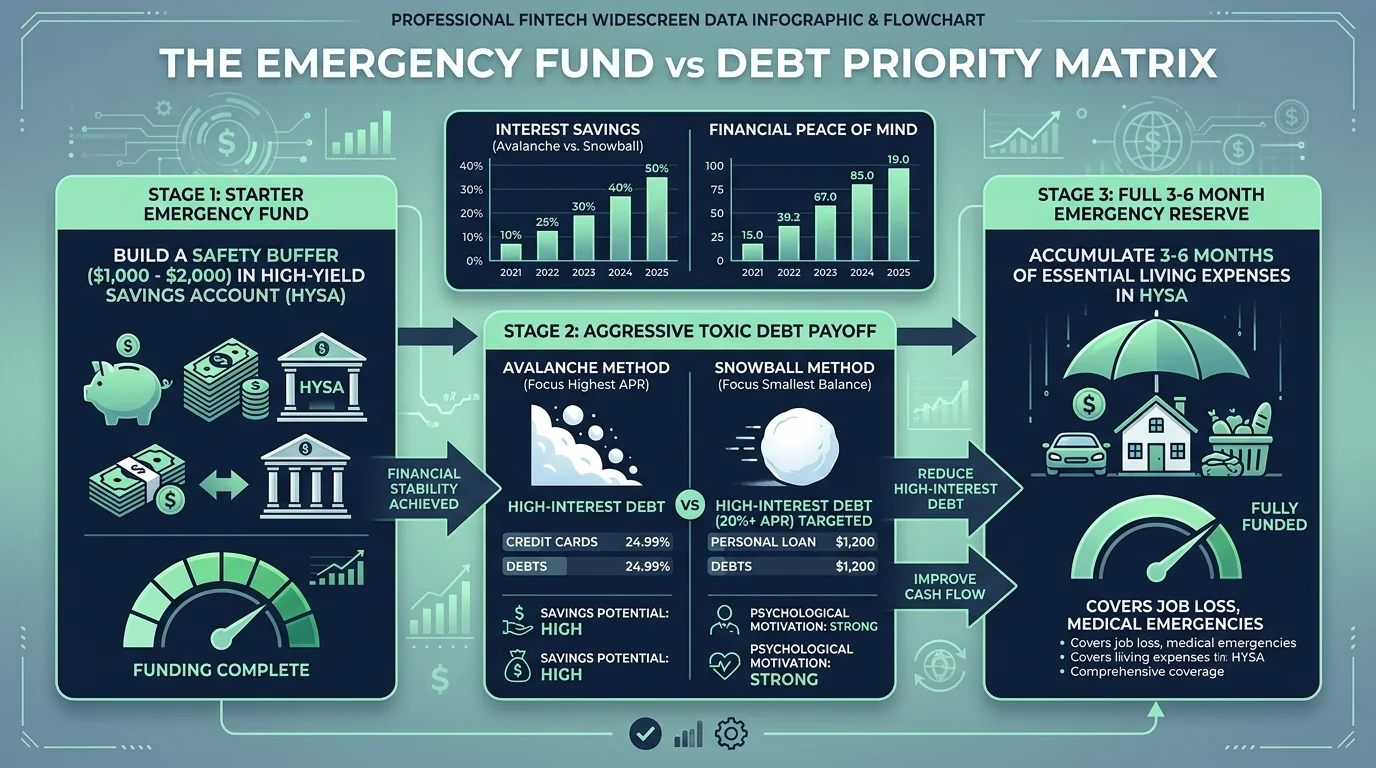
- The Golden Rule: Never choose 100% debt payoff or 100% savings in isolation. The optimal path is a staged hybrid framework that stops the cycle of borrowing before attacking debt balances.
- Stage 1 Starter Buffer ($1,000–$2,000): Without an initial cash reserve in a starter emergency fund, the next minor car repair or medical bill will immediately force you back onto high-interest credit cards.
- The 7%–8% APR Threshold: Any debt with an interest rate above 8% (especially 20%–29% credit card APRs) represents a guaranteed, risk-free negative return. Mathematically, aggressive debt payoff beats savings after your starter fund is locked in.
- Protect Cash Flow First: Once toxic debts are eliminated, rapidly scale your liquid reserves to 3–6 months of essential living expenses using an emergency fund calculator.
- Calculate Your Numbers: Model your exact payoff timeline with our interactive debt payoff calculator to see your interest savings in real time.
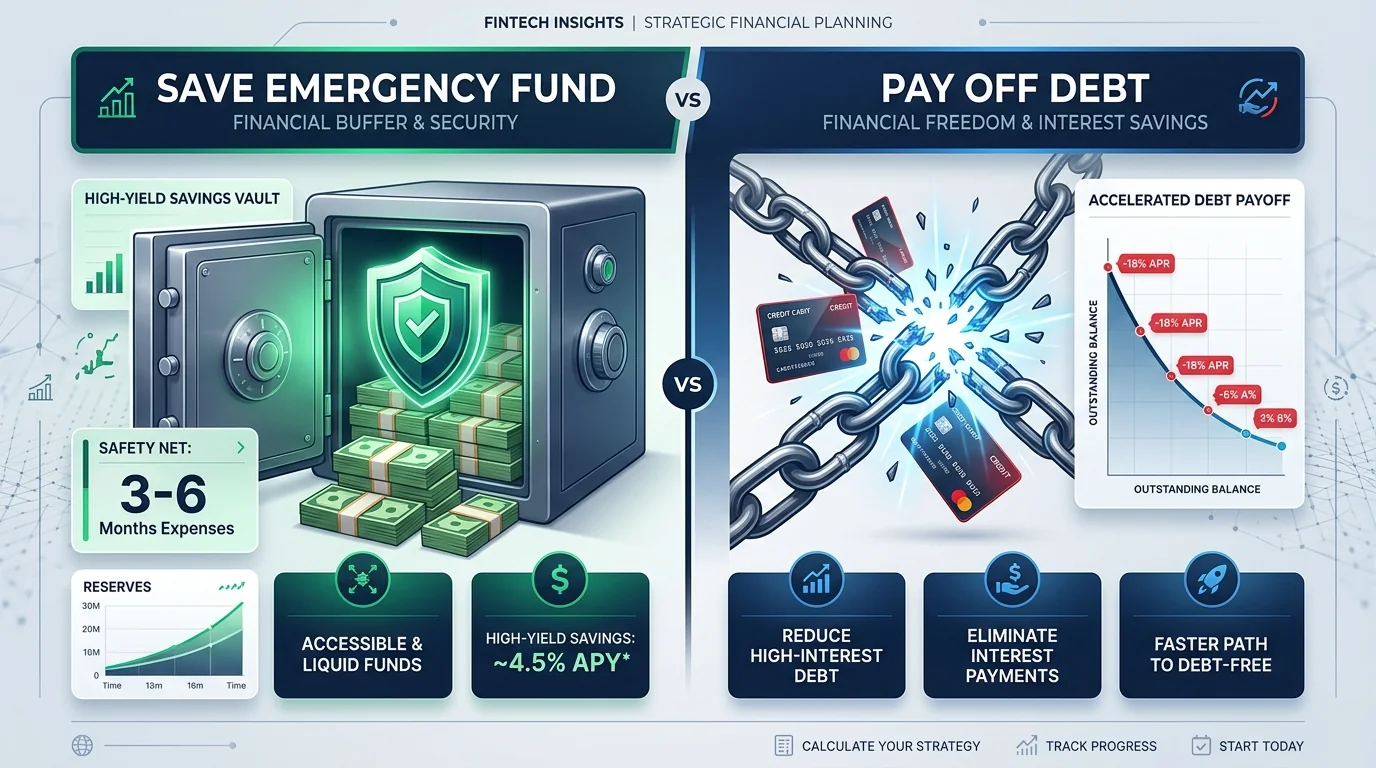
The Great Financial Dilemma: Math vs. Human Psychology
One of the most fiercely debated questions in personal finance is straightforward on the surface but complex in execution: should you pay off debt first or build an emergency fund?
If you ask a pure mathematical spreadsheet, the answer seems obvious: when credit cards charge 24% to 29% APR and a top High-Yield Savings Account (HYSA) yields 4.50% APY, every dollar placed into savings instead of debt costs you a net 20%+ in lost purchasing power each year. Mathematically, carrying debt while hoarding cash appears irrational.
However, personal finance does not operate in a frictionless vacuum. Life happens outside of spreadsheets. When you have $0 in emergency savings and direct 100% of your disposable income toward debt repayment, a sudden $800 tire blowout or dental bill immediately creates an emergency. With empty bank accounts, you are forced to swipe the very credit card you were trying to eliminate, destroying your psychological momentum and trapping you in an endless debt-and-borrow cycle.
In this comprehensive 2026 guide, we break down the definitive, E-E-A-T verified framework used by Certified Financial Planners (CFPs) to solve the pay off debt vs save emergency fund puzzle. You will discover how to calculate your exact interest trade-offs, how to establish a bulletproof safety net, and how to execute a staged cash flow hierarchy that delivers both financial security and rapid debt freedom.
Head-to-Head Comparison: Pay Off Debt vs. Save Emergency Fund
To understand where your next available dollar should go, examine how debt repayment and emergency cash reserves compare across the six vital financial dimensions:
| Decision Factor | Prioritizing Debt Payoff | Prioritizing Emergency Fund | The 2026 Hybrid Strategy |
|---|---|---|---|
| Guaranteed Return (ROI) | Equal to the debt’s APR (e.g., 24.99% guaranteed return). | Equal to the HYSA yield (~4.0% to 4.5% APY before tax). | Maximizes net ROI while eliminating emergency vulnerability. |
| Liquidity & Cash Buffer | Zero liquidity; money sent to lenders cannot be retrieved in a cash crunch. | 100% liquid cash available instantly in a FDIC-insured HYSA. | Maintains a $1,000–$2,000 starter buffer before aggressive payoff. |
| Risk of Recidivism | High: An unexpected bill forces immediate re-borrowing on credit cards. | Moderate: High interest continues compounding, increasing total debt. | Minimal: Starter cash absorbs shocks; debt decreases systematically. |
| Psychological Stress | High anxiety from zero cash buffer until the last dollar of debt is paid. | Anxiety from watching high-interest debt balances stagnate or grow. | High confidence; provides immediate peace of mind and measurable debt progress. |
| Monthly Cash Flow Relief | Permanently eliminates mandatory monthly minimum payments. | Preserves cash on hand but leaves monthly debt obligations intact. | Accelerates cash flow liberation by sequentially crushing monthly minimums. |
| Recommended Focus | High-interest consumer debt (>8% APR) after starter fund. | Baseline survival reserve before anything else. | Standard Best Practice: Staged Financial Hierarchy. |
The Core Concept: Understanding the Cost of Borrowing vs. Cost of Zero Liquidity
To master your money, you must distinguish between two competing risks: Interest Drag and Liquidity Shock.
1. Interest Drag: The Compounding Wealth Destroyer
Interest on revolving consumer credit cards compounds daily. If you carry a $10,000 balance at 24% APR, you are paying roughly $2,400 per year ($200 per month) purely in interest fees to financial institutions. If you only pay the minimum balance, it can take over 20 years and more than $14,000 in total interest to clear that debt. Exploring proven debt management strategies is critical to ending this chronic cash drain.
2. Liquidity Shock: Why Going $0 in Savings Is Dangerous
Many aggressive debt-slayers make the fatal mistake of emptying their checking and savings accounts to put every single penny against their loan balances. However, credit card companies frequently slash credit limits or close accounts during macroeconomic downturns. If an unexpected emergency occurs—such as a layoff, a medical deductible, or a critical home repair—credit cards may not even be accessible. Liquid cash is your only true financial insurance policy.
This is why structured financial planning relies on balancing debt-free living vs. strategic leverage to construct an unbreakable financial foundation.
Mathematical Simulation: Comparing 4 Real-World Scenarios
To demonstrate the tangible financial impact of each strategy, let us simulate a real-world scenario with realistic parameters:
- Total High-Interest Debt: $10,000 on credit cards at 24.0% APR ($250 minimum monthly payment).
- Monthly Disposable Surplus: $500 extra cash flow available above living essentials.
- High-Yield Savings Rate: 4.50% APY compounded monthly.
- Emergency Shock Event: A $1,200 sudden emergency occurs at Month 6.
| Strategy Simulation | Monthly Allocation ($500 Extra) | Time to Debt Freedom | Total Interest Paid | Emergency Shock Outcome (Month 6) | Final Financial Health at Month 24 |
|---|---|---|---|---|---|
| Scenario A: 100% Debt First ($0 Savings) | $500 to Debt, $0 to Savings | 17 Months | $1,780 | Relapse: No cash available. Forced to charge $1,200 to credit card, adding 3 months to payoff. | Debt cleared, but only $3,500 in savings. High psychological burnout. |
| Scenario B: 100% Savings First ($0 Extra to Debt) | $0 to Debt (Pay Min $250), $500 to Savings | 48+ Months | $4,650+ | Covered: $1,200 paid with cash from $3,000 accumulated savings. | $8,200 in savings, but still burdened with $6,400+ in high-interest debt. |
| Scenario C: 3-Stage Hybrid (Recommended) | Months 1–3: $500 to Savings ($1,500 buffer) Months 4–19: $500 to Debt Payoff | 19 Months | $1,940 | Fully Absorbed: Emergency paid with $1,200 cash buffer. Debt plan continues uninterrupted. | Optimal: 100% Debt-Free + $4,200 in emergency cash reserves. Zero relapse. |
| Scenario D: 50/50 Split Method | $250 to Debt, $250 to Savings every month | 26 Months | $2,710 | Partially Absorbed: $1,200 cash available, but slow debt reduction costs $770 extra in interest. | Debt-Free at Month 26 with $4,800 savings, but paid significantly more interest. |
The Clear Takeaway: Scenario C (The 3-Stage Hybrid Strategy) provides the highest net financial resilience. By taking just 3 months to build an initial $1,500 cash buffer, you protect yourself against emergency relapses while paying only an extra $160 in interest compared to the risky “zero savings” approach. You can verify your own custom numbers with our budget calculator.
Expert Authority Video: The Financial Order of Operations
Watch this authoritative masterclass from Certified Financial Planners at The Money Guy Show explaining exactly how to prioritize building an emergency fund vs. paying off debt according to your financial order of operations:
The 5-Step Actionable Blueprint: How to Execute in 2026
Follow this sequential 5-step roadmap to eliminate toxic debt while building long-term financial security:
Step 1: Establish Your $1,000–$2,000 “Ironclad Shock Absorber”
Before throwing extra cash at loan balances, deposit $1,000 to $2,000 (or one full month of baseline living expenses if your income is volatile) into a dedicated High-Yield Savings Account. Keep this account at a separate bank from your primary checking account to eliminate impulse spending while maintaining immediate electronic transfer access.
Step 2: Capture 100% of Employer 401(k) Matching
If your employer provides a 401(k) company match (e.g., 50% or 100% up to 5% of salary), always contribute enough to claim the full match before accelerating debt payoff. An employer match represents an immediate, guaranteed 50% to 100% return on investment, which mathematically surpasses even high-interest credit card rates. Aligning this with your investment time horizon ensures you never leave free retirement money behind.
Step 3: Eliminate High-Interest Toxic Debt (>8% APR)
With your starter emergency fund in place and employer match secured, funnel 100% of remaining surplus cash into eliminating toxic debts. Choose one of two proven execution methods:
- The Debt Avalanche (Mathematically Optimal): List all debts in descending order of interest rate. Pay minimums on all accounts and aggressively attack the balance with the highest APR first (e.g., 28% APR store card). This saves the maximum total dollars in interest fees.
- The Debt Snowball (Psychological Momentum): List all debts from smallest balance to largest balance, regardless of interest rate. Pay minimums on all and crush the smallest balance first (e.g., $450 medical bill). The quick psychological victories build powerful motivation.
Step 4: Scale to a Full 3 to 6-Month Emergency Reserve
Once all high-interest consumer debts are paid off, redirect the substantial cash flow previously consumed by debt payments directly into your High-Yield Savings Account. Build this reserve until it covers 3 to 6 months of essential living expenses (housing, utilities, food, insurance, and minimum transportation). If you are a single-income household, freelancer, or work in a volatile industry, aim for 6 to 9 months of expenses. Follow our comprehensive emergency fund and HYSA master guide for complete account architecture, FDIC rules, and sizing models.
Step 5: Transition to Long-Term Wealth & Low-Interest Debt
With an ironclad emergency reserve and zero high-interest debt, evaluate your remaining low-interest obligations (such as fixed mortgages under 4% or low-rate student loans). Because long-term broad-market index funds historically compound at 8%–10% annually, you can comfortably balance low-interest debt payments with aggressive tax-advantaged investing in Roth IRAs, HSAs, and index funds. If you need personalized guidance on tax planning or asset allocation, evaluate DIY investing vs hiring a financial advisor.
Frequently Asked Questions (FAQs)
Here are expert answers to the most common search questions regarding debt payoff versus emergency savings:
Yes. You should build a starter emergency fund of $1,000 to $2,000 before aggressively attacking credit card debt. Without this liquid buffer, any unexpected life expense (car repair, medical copay) will force you to swipe high-interest credit cards, restarting the debt cycle and erasing your psychological progress.
As a general rule, any debt with an interest rate above 7% to 8% APR is considered high-interest “toxic debt” that should be aggressively eliminated before building a full 6-month emergency reserve. Debts with rates below 4% to 5% (such as low-rate fixed mortgages) can be paid on standard schedules while investing and saving simultaneously.
You should only use part of your emergency savings to pay off debt if it leaves you with a minimum $1,000 to $2,000 safety net. Never completely drain your liquid reserves to $0 to pay off debt, as this leaves you entirely vulnerable to job loss or sudden emergencies.
Keep your emergency fund in a dedicated, FDIC-insured High-Yield Savings Account (HYSA). Look for an account offering competitive APY rates (typically 4.0% to 4.5%+) with zero monthly maintenance fees and fast electronic transfer capabilities.
A 50/50 split can work well psychologically for risk-averse individuals, but it is mathematically less efficient than the 3-stage hybrid approach. By splitting funds 50/50 when carrying 24% APR credit card debt, you prolong high-interest compounding and pay hundreds of dollars more in unnecessary interest fees.
Never stop 401(k) contributions below the employer match threshold. An employer match provides an instant 50% to 100% guaranteed return. However, once you have captured the full match, pause any unmatched voluntary retirement contributions until you have built your starter fund and crushed high-interest debt.
Once high-interest debt is eliminated, aim for 3 to 6 months of essential living expenses (housing, food, utilities, medical, transportation). Dual-income stable households can lean toward 3 months, while single-income earners, freelancers, and commission-based workers should target 6 months.
The Debt Avalanche (paying highest interest rate first) saves the most money mathematically. The Debt Snowball (paying smallest balance first) provides faster emotional wins. Choose the method you can stick with consistently; consistency matters more than pure mathematical optimization.
Consumer protection benchmarks recommend holding a starter cash reserve before aggressively deploying all free cash flow toward unsecured debts. Consult the official Consumer Financial Protection Bureau (CFPB) Debt and Credit Management for statutory guidelines and consumer protections.
🛡️ Strategic Cash Reserves & Debt Elimination Roadmaps
Balance cash preservation and interest savings with these companion personal finance guides and calculators:
- Reserve Sizing: emergency fund savings calculator — calculate your custom 3 to 6-month baseline survival reserve.
- Cash Yield Optimization: high-yield savings accounts (HYSA) vs stock market investing — where to park emergency cash for maximum guaranteed yield with zero market volatility.
- Aggressive Payoff: paying off high-interest credit card debt fast — step-by-step blueprint to wipe out $20,000 in revolving debt.
- Emergency Duration: 3 months vs 6 months emergency fund calculation — tailoring safety buffers to single income vs dual income families.
- Core Framework: zero-based budgeting vs 50/30/20 rule comparison — balancing essential living costs, savings, and accelerated debt repayments.

Jaiveer Hooda is the Lead Financial Researcher & Personal Finance Analyst at Grow Your Money Smart. Specializing in personal wealth optimization, index fund compounding, high-yield savings mechanics, and consumer debt elimination strategies. With a background in computer engineering, he applies mathematical modeling, cashflow simulations, and empirical risk analysis to evaluate personal finance vehicles and credit products. Every analysis is backed by verified regulatory disclosures, IRS tax schedules, and empirical APY compounding math.
Areas of Expertise: Personal Finance · High-Yield Savings Accounts (HYSA) · Index Funds & S&P 500 Compounding · Retirement Planning (401k/IRA) · Debt Optimization · Credit Card APR Mechanics.
Transparency & Editorial Policy: Editorial Standards | Report a Correction