
A Money Market Account (MMA) is an FDIC-insured bank deposit account that blends high savings yields with checking account features like debit cards and check-writing privileges. A High-Yield Savings Account (HYSA) focuses strictly on maximizing APY with pure digital transfers and zero checking frills. Both offer identical $250,000 FDIC protection and variable rates. Choose an MMA if you need direct payment access to your emergency cash; choose an HYSA if you prioritize higher pure interest without checking temptation.
- Spending Access: MMAs provide physical debit cards and paper check-writing; most HYSAs only permit electronic ACH transfers.
- Safety & Insurance: Both bank MMAs and HYSAs are 100% FDIC-insured up to $250,000 per depositor (see our tactical guide on how to safely insure $1M+ with FDIC limits).
- Critical Distinction: A Money Market Account (MMA) is an FDIC-insured bank deposit; a Money Market Mutual Fund is an uninsured brokerage investment.
- Yield Comparison: Top-tier HYSAs consistently edge out MMAs by 0.15% to 0.40% in Annual Percentage Yield due to lower administrative overhead.
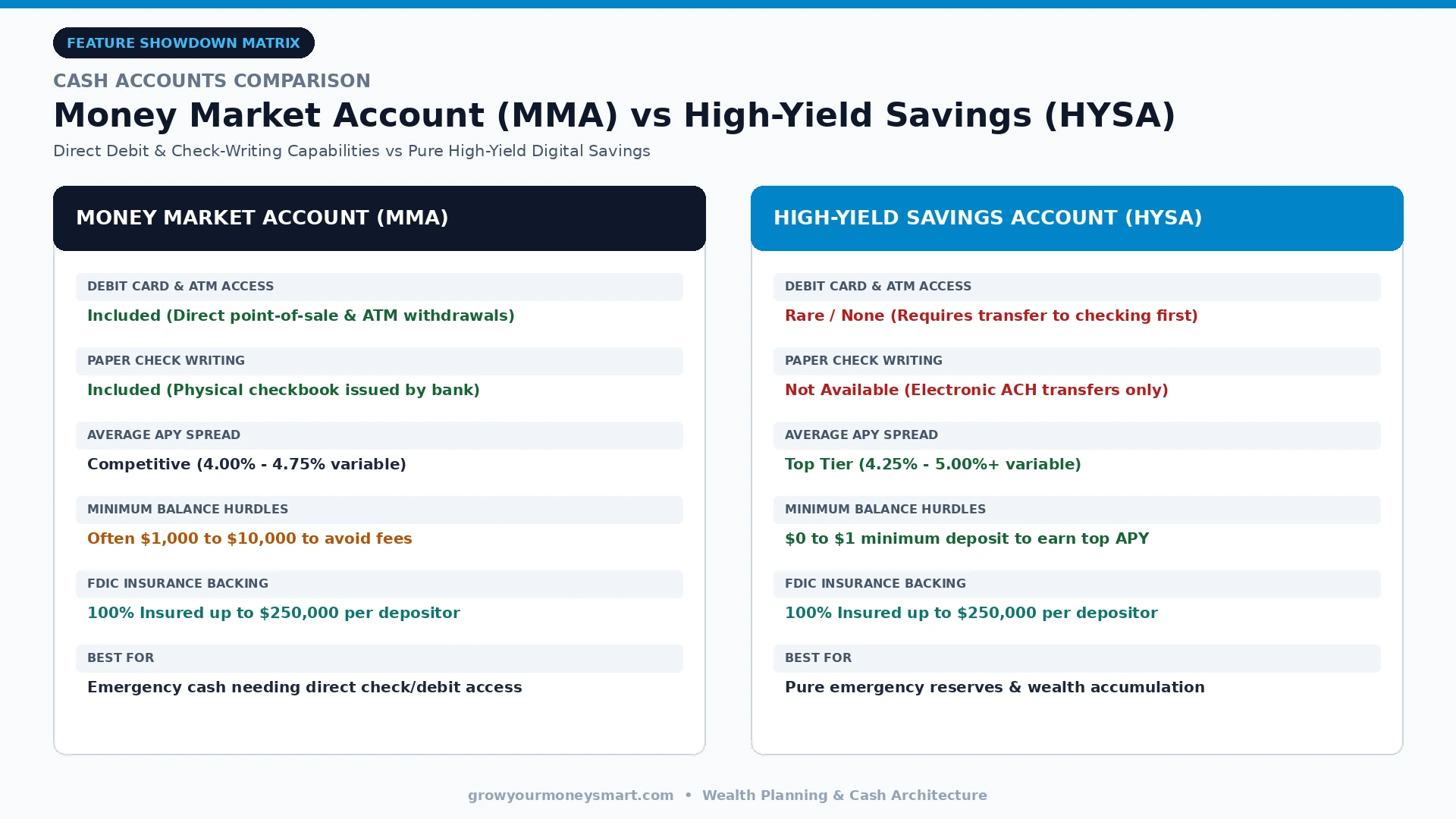
When searching for a safe home to grow cash reserves, consumers frequently stumble upon two competing terms: Money Market Accounts (MMAs) and High-Yield Savings Accounts (HYSAs). Because both accounts offer competitive Annual Percentage Yields (APYs) that crush traditional brick-and-mortar savings accounts, many savers assume they are interchangeable.
However, fundamental differences in transaction access, minimum balance hurdles, and spending mechanics dictate which vehicle fits your financial workflow. In this guide, we break down how both accounts work, dissect the critical difference between bank MMAs and brokerage money market funds, and help you select the ideal account for your cash.
What Is a Money Market Account (MMA)?
A Money Market Account (MMA)—not to be confused with a money market mutual fund—is an interest-bearing bank deposit account that acts as a hybrid between a checking account and a savings account. Banks pool customer deposits to invest in short-term, low-risk debt securities (such as U.S. Treasury bills and certificates of deposit) and pass the yield along to depositors.
The standout feature of an MMA is spending convenience. Unlike traditional savings vehicles, most MMAs issue a debit card and paper checks, allowing you to pay large unexpected bills directly from your cash reserves without waiting 2 to 3 business days for an external bank transfer to clear.
What Is a High-Yield Savings Account (HYSA)?
A High-Yield Savings Account (HYSA) is an online savings account engineered for pure cash growth. Digital banks operate without the overhead of physical branch networks, allowing them to pay APYs ranging from 4.00% to 5.00%+.
HYSAs are deliberately decoupled from everyday spending tools. You typically cannot swipe a debit card at a store or write a physical check against your HYSA balance. To access funds, you initiate an ACH transfer to your primary checking account. For many savers, this slight friction is an intentional psychological feature that prevents impulse spending of emergency reserves.
Core Comparison Matrix: MMA vs HYSA
Here is how Money Market Accounts and High-Yield Savings Accounts compare across critical banking criteria:
| Feature Dimension | Money Market Account (MMA) | High-Yield Savings Account (HYSA) |
|---|---|---|
| Average Top APY Range | 4.00% – 4.75% variable | 4.25% – 5.00%+ variable |
| Debit Card Access | Yes (ATM swipes & POS purchases) | Rare (Electronic ACH only) |
| Paper Check Writing | Yes (Checkbook issued) | No |
| Minimum Deposit / Balance | Often $1,000 to $10,000 to earn top APY | Usually $0 to $1 |
| Federal Insurance | FDIC / NCUA up to $250,000 | FDIC / NCUA up to $250,000 |
| Best Role In Portfolio | Emergency cash where check/debit is vital | Dedicated emergency fund & wealth runway |
Crucial Warning: Money Market Account vs Money Market Mutual Fund
One of the most dangerous points of confusion in retail finance is the distinction between a Money Market Account and a Money Market Mutual Fund:
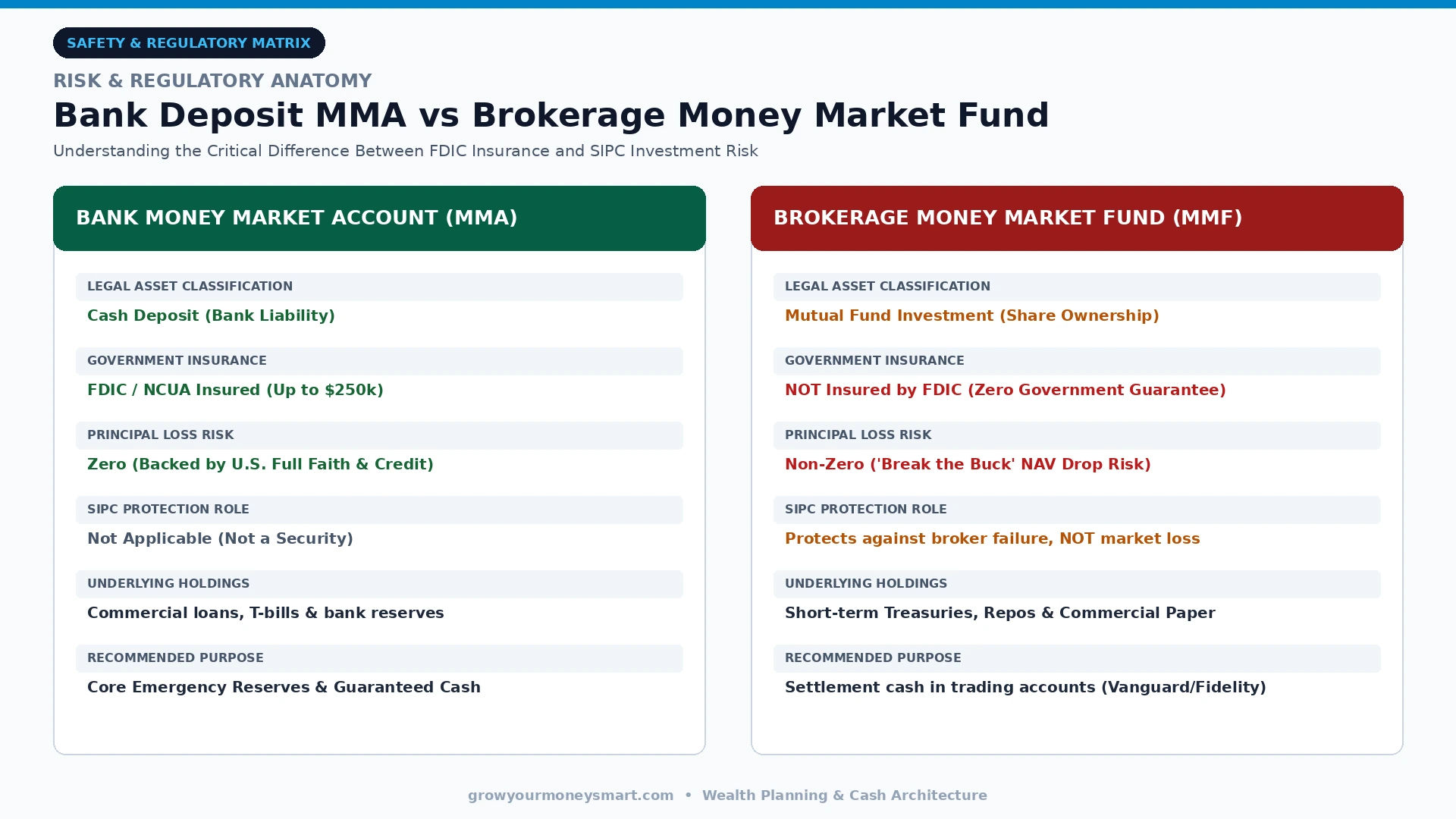
- Money Market Account (MMA): A bank deposit product. It is 100% FDIC insured up to $250,000 per depositor. You cannot lose principal, regardless of economic conditions.
- Money Market Mutual Fund (MMF): An investment fund offered by brokerage firms (like Vanguard, Fidelity, or Charles Schwab). While MMFs invest in ultra-safe short-term government debt, they are NOT insured by the FDIC. They carry SIPC protection (which protects against brokerage insolvency, not investment losses) and technically carry a non-zero risk of “breaking the buck” (falling below a $1.00 net asset value).
For your baseline cash reserves, always verify that your account is held at an FDIC-insured institution. Explore our master blueprint on building a bulletproof emergency fund to avoid common liquidity traps.
Regulation D: Understanding Transaction Limits in 2026
Historically, federal regulations strictly limited “convenient” withdrawals from savings and money market accounts to six per month under Federal Reserve Regulation D. In April 2020, the Federal Reserve permanently amended Regulation D, removing the mandatory federal restriction.
However, individual banks retain the legal right to impose their own withdrawal limits. Many brick-and-mortar banks still charge $10 to $15 “excess withdrawal fees” if you exceed six monthly transactions, while modern online banks have eliminated these caps entirely. When comparing MMAs, always inspect the fine print to confirm whether check and debit transactions are truly unlimited.
Frequently Asked Questions: MMA vs HYSA
Which Account Should You Choose in 2026?
If your primary objective is maximizing pure interest growth and maintaining a psychological wall between your savings and everyday spending impulses, an HYSA is the superior vehicle. Review our updated guide to the best high-yield savings accounts to compare current market rates. However, if you want guaranteed fixed yields without floating rate risk, compare an HYSA against a structured CD ladder strategy.
If you anticipate needing to write checks for contractors, property taxes, or medical deductibles directly from savings, choose an MMA. Calculate your required baseline liquidity with our interactive emergency fund calculator before allocating capital.

Jaiveer Hooda is the Lead Financial Researcher & Personal Finance Analyst at Grow Your Money Smart. Specializing in personal wealth optimization, index fund compounding, high-yield savings mechanics, and consumer debt elimination strategies. With a background in computer engineering, he applies mathematical modeling, cashflow simulations, and empirical risk analysis to evaluate personal finance vehicles and credit products. Every analysis is backed by verified regulatory disclosures, IRS tax schedules, and empirical APY compounding math.
Areas of Expertise: Personal Finance · High-Yield Savings Accounts (HYSA) · Index Funds & S&P 500 Compounding · Retirement Planning (401k/IRA) · Debt Optimization · Credit Card APR Mechanics.
Transparency & Editorial Policy: Editorial Standards | Report a Correction