
A Certificate of Deposit (CD) ladder locks in fixed APY yields (typically 4.25%–4.75%) across staggered maturities, shielding your interest from Federal Reserve rate cuts in exchange for early withdrawal penalties. A High-Yield Savings Account (HYSA) offers 100% daily liquidity with zero penalties, but features variable APYs that drop immediately when benchmark rates decline. For emergency funds, prioritize an HYSA; for planned cash needs beyond 6 to 12 months, a CD ladder guarantees higher cumulative income.
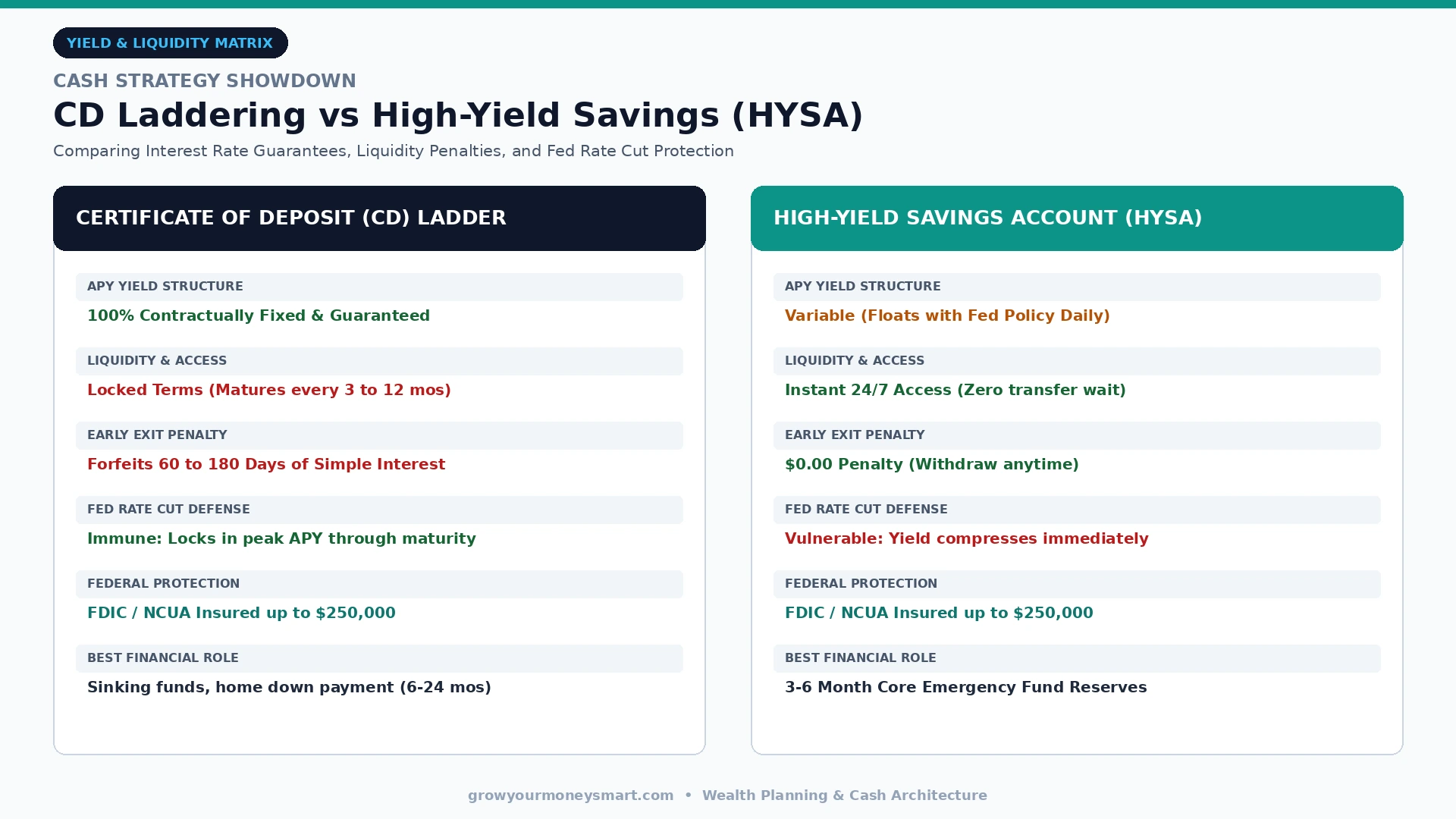
- Interest Rate Guarantee: CDs provide contractually guaranteed fixed yields; HYSA rates are variable and adjust at the bank’s discretion.
- Liquidity & Access: HYSA funds are accessible 24/7 without fees; breaking a CD early forfeits 60 to 180 days of earned interest.
- Fed Rate Cut Shield: In a declining interest rate environment, CD ladders lock in today’s peak yields for up to 1 to 5 years.
- The Smart Hybrid Strategy: Keep 3 to 6 months of baseline living expenses liquid in a top-tier HYSA, and deploy excess sinking funds into a rolling 4-rung CD ladder.
As the Federal Reserve recalibrates monetary policy, cash savers face a critical fork in the road: Should you leave your cash in a liquid High-Yield Savings Account, or lock it into a structured CD ladder?
While parking cash in traditional big-bank checking accounts yielding an insulting 0.01% is financial negligence, choosing between a CD ladder and an HYSA requires balancing two competing forces: yield certainty versus liquidity. In this comprehensive guide, we dissect the mathematical trade-offs, break down real-world dollar return scenarios, and demonstrate how to build an automated rolling cash architecture in 2026.
What Is a CD Ladder and How Does It Work?
A Certificate of Deposit (CD) ladder is an automated cash management strategy where you divide a lump sum of capital across multiple CDs with staggered maturity dates (e.g., 3 months, 6 months, 9 months, and 12 months). Instead of locking all your capital into a single long-term CD where funds remain trapped, a portion of your money matures at predictable, regular intervals.
When the shortest-term CD matures, you have two options: harvest the cash and earned interest for planned expenses, or roll the principal into a new 12-month CD at the top of the ladder. Once the system is established, you earn long-term CD yields while enjoying quarterly liquidity.
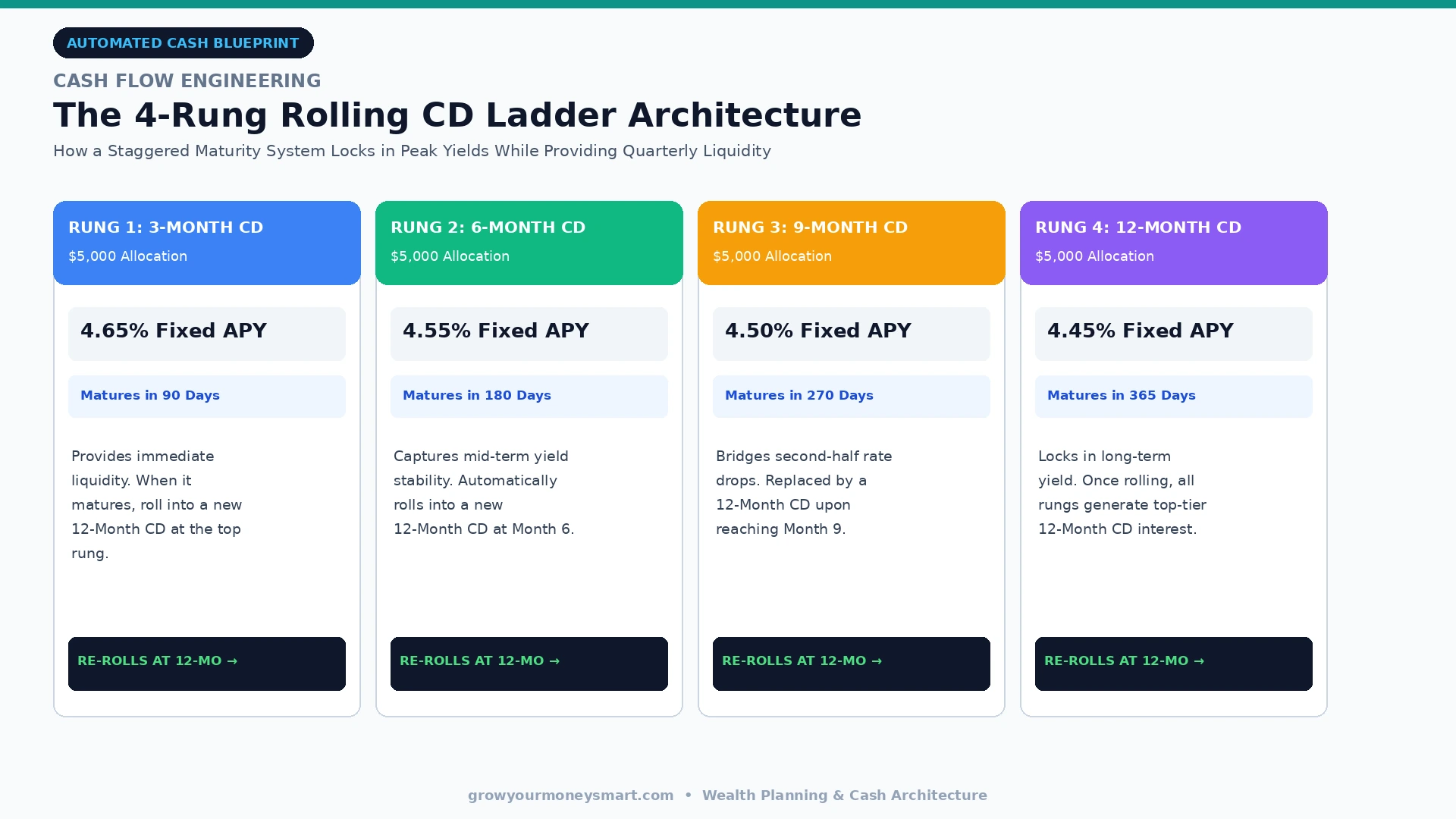
Consider the classic 4-rung architecture illustrated above with a $20,000 cash balance:
- Rung 1: 3-Month CD ($5,000 @ 4.65% APY): Matures in 90 days, providing near-term liquidity buffer. Upon maturity, it is re-invested into a new 12-month CD.
- Rung 2: 6-Month CD ($5,000 @ 4.55% APY): Matures in 180 days, re-rolling into a 12-month CD at Month 6.
- Rung 3: 9-Month CD ($5,000 @ 4.50% APY): Matures in 270 days, re-rolling into a 12-month CD at Month 9.
- Rung 4: 12-Month CD ($5,000 @ 4.45% APY): Matures in 365 days, re-rolling at the one-year mark.
After one full year of cycle rotations, 100% of your capital is invested in top-tier 12-month CDs earning maximum yield, yet 25% of your total balance unlocks every single quarter.
What Is a High-Yield Savings Account (HYSA)?
A High-Yield Savings Account (HYSA) is an FDIC-insured deposit account offered primarily by online fintechs and chartered digital banks that pays 10 to 12 times the national savings average. Unlike CDs, an HYSA imposes no maturity schedules or locked terms: you can deposit and withdraw money at any time without paying penalties.
However, the fundamental characteristic of an HYSA is that its Annual Percentage Yield (APY) is variable. When the Federal Reserve adjusts the Federal Funds Rate, commercial banks instantly reprice their HYSA yields downward. To learn more about navigating rate cycles, explore our tactical guide on Fed rate cuts and cash strategy.
Head-to-Head Comparison: CD Ladder vs HYSA
To determine where your capital belongs, compare the fundamental mechanics of both vehicles across six critical dimensions:
| Feature Dimension | Structured CD Ladder | High-Yield Savings Account (HYSA) |
|---|---|---|
| Interest Rate Certainty | 100% Guaranteed & Fixed | Variable (Fluctuates with Fed policy) |
| Liquidity & Withdrawal Speed | Staggered (Available only on maturity dates) | Instant / Daily (24/7 ACH & transfers) |
| Early Withdrawal Penalties | Yes (Forfeits 60–180 days of interest) | $0 (Zero penalty ever) |
| Federal Insurance Coverage | FDIC / NCUA insured up to $250,000 | FDIC / NCUA insured up to $250,000 |
| Reinvestment Risk | Moderate (Matures when rates may be lower) | High (Immediate yield compression during rate cuts) |
| Optimal Financial Role | Sinking funds, home down payments (6–24 mos) | Emergency fund reserves, monthly buffer |
Bank CDs vs Brokered CDs: An Advanced Yield Tactic
When constructing a CD ladder, savers must distinguish between Bank CDs and Brokered CDs:
- Traditional Bank CDs: Purchased directly through a commercial bank or credit union. If you need your funds before maturity, you pay a penalty based on simple interest (e.g., 90 days of interest forfeited). Your principal remains intact.
- Brokered CDs: Purchased through a brokerage firm (such as Fidelity, Charles Schwab, or Vanguard). Brokered CDs offer access to hundreds of banks across the nation on a single platform. However, they do not permit early withdrawal penalties. If you need to exit early, you must sell your CD on the secondary market. If market interest rates have risen since you purchased, you may receive less than face value for your CD.
For individuals seeking predictable, stress-free liquidity, direct online bank CDs (offered by institutions like Ally Bank, Marcus by Goldman Sachs, and Capital One) are generally preferable for household emergency and sinking fund ladders.
Mathematical Simulation: What Happens When the Fed Cuts Rates?
To understand why CD ladders outperform in falling rate environments, let us simulate a real-world monetary scenario. Assume you have $25,000 in cash at the start of the year, earning a starting APY of 4.75%. During the year, the Federal Reserve executes three 25-basis-point rate cuts, reducing benchmark yields by a cumulative 0.75%.
- Strategy A (100% HYSA): Your account starts at 4.75%, but drops to 4.50% after month 3, 4.25% after month 6, and 4.00% after month 9. Your effective weighted annual APY drops to 4.25%, yielding approximately $1,062.50 in annual interest.
- Strategy B (4-Rung CD Ladder): You lock in 4.75% across 3, 6, 9, and 12-month CDs on Day 1. Even though market rates plummet across the year, your locked-in rungs continue generating the full 4.75% until their contractual maturity. Your effective annual return remains 4.60%, yielding $1,150.00.
In this scenario, the CD ladder captures an extra $87.50 in pure profit on a modest $25,000 balance—without taking a single dollar of stock market risk. If cash balances scale to $100,000, that yield protection equals hundreds of dollars in guaranteed income. You can test your target reserve needs using our interactive emergency fund calculator.
The Hybrid Strategy: The Optimal Cash Architecture
Sophisticated savers do not treat this decision as an “either/or” dilemma. Instead, they deploy the Two-Tier Hybrid Cash Architecture:
Tier 1: Core Emergency Liquidity (HYSA): Maintain 3 to 6 months of absolute nondiscretionary living expenses (rent, mortgage, food, utilities, debt minimums) in an HYSA. Check our comprehensive emergency fund & HYSA master guide to ensure your liquid cash remains completely insulated from lockup periods. For savers who require check-writing capabilities or debit access for irregular bills alongside top APYs, compare an HYSA against a liquid Money Market Account (MMA).
Tier 2: Tactical Sinking Funds (CD Ladder): Allocate capital earmarked for known future obligations occurring in 6 to 36 months—such as annual property taxes, planned vehicle purchases, or wedding budgets—into a rolling CD ladder. This locks in premium yields without risking premature liquidation penalties.
If you have an investment horizon beyond 3 to 5 years, cash equivalents will inevitably lose purchasing power to inflation. In that case, compare cash yields against long-term equity growth in our detailed analysis of HYSA vs stock market investing.
Frequently Asked Questions: CD Ladder vs HYSA
Final Decision Checklist: Which Should You Choose Today?
Choose an HYSA if your primary objective is emergency safety, flexible monthly cash flow, or funding unplanned expenses within the next 6 months. Browse our vetted rankings of the best high-yield savings accounts to find zero-fee accounts with top-tier rates.
Choose a CD Ladder if you have a lump sum of earmarked cash that you will not touch for 6 to 36 months, and your priority is locking in current yields to protect against central bank rate cuts.

Jaiveer Hooda is the Lead Financial Researcher & Personal Finance Analyst at Grow Your Money Smart. Specializing in personal wealth optimization, index fund compounding, high-yield savings mechanics, and consumer debt elimination strategies. With a background in computer engineering, he applies mathematical modeling, cashflow simulations, and empirical risk analysis to evaluate personal finance vehicles and credit products. Every analysis is backed by verified regulatory disclosures, IRS tax schedules, and empirical APY compounding math.
Areas of Expertise: Personal Finance · High-Yield Savings Accounts (HYSA) · Index Funds & S&P 500 Compounding · Retirement Planning (401k/IRA) · Debt Optimization · Credit Card APR Mechanics.
Transparency & Editorial Policy: Editorial Standards | Report a Correction