
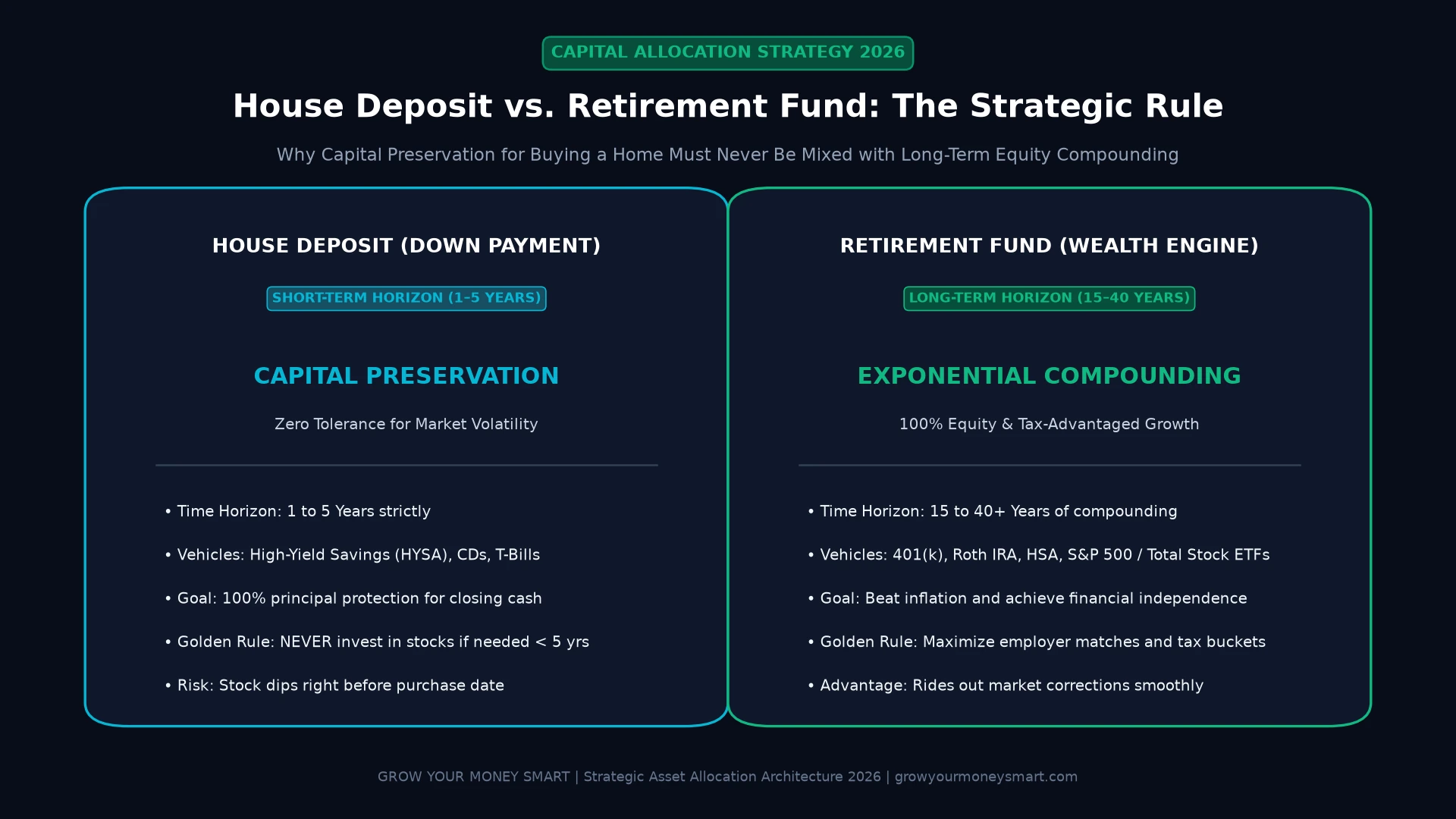
- The Horizon Divide: House deposit money is short-term (1–5 years) requiring 100% capital preservation (HYSA, CDs, T-Bills). Retirement funds are long-term (15–40 years) requiring 100% equity compounding (401k, Roth IRA, ETFs).
- The Cardinal Rule: NEVER invest your home down payment in stocks or crypto. A sudden 20% correction right before closing can destroy your purchase timeline.
- Preserve the 401(k) Match: Never pause retirement contributions below your company match threshold—it is an instant, guaranteed 100% return.
- The Compounding Math: $100,000 in an S&P 500 index fund compounds to $684,847 over 25 years vs $266,583 in primary home equity, proving the massive opportunity cost of becoming ‘house poor.’
One of the most intense financial dilemmas faced by ambitious professionals is the tug-of-war between two massive life milestones: buying a home and building a multi-million-dollar retirement fund. Should you pour every spare dollar into an illiquid down payment to escape renting, or should you maximize your 401(k) and Roth IRA to capture exponential compound interest?
The answer lies in understanding that these two financial goals require fundamentally opposite savings and investment strategies. Confusing the two can lead to catastrophic consequences: either having your down payment slashed by a sudden stock market correction, or missing out on hundreds of thousands of dollars in lost retirement compounding. For customized calculations on your budget and debt payoff timelines, explore our interactive Household Budget Calculator and Debt Payoff Calculator.
The Fundamental Clash: Time Horizon & Risk Tolerance
In quantitative asset management, the appropriate investment vehicle is dictated entirely by one variable: time horizon. Mixing up short-term capital with long-term capital is the single most common mistake retail investors make.
The House Deposit Framework (Short-Term Capital Preservation)
When saving for a down payment needed within 1 to 5 years, your risk tolerance must be zero. If you place your down payment in equities and the market drops 25% six months before closing, your home purchase is paralyzed. Short-term funds must reside in FDIC-insured High-Yield Savings Accounts (HYSA), Certificates of Deposit (CDs), or Treasury Bills yielding fixed returns.
The Retirement Fund Framework (Long-Term Compounding Engine)
When investing for retirement 20 to 40 years away, short-term market volatility is completely irrelevant. In fact, market corrections are beneficial because recurring automatic contributions buy more shares at discounted prices. Retirement capital must be deployed aggressively into broad-market index funds (S&P 500, Total US Market, International) inside tax-advantaged accounts. Understand how your timeline dictates risk in our guide on Investment Time Horizons.
| Strategic Feature | House Deposit (Down Payment) | Retirement Fund (401k / Roth IRA) |
|---|---|---|
| Target Horizon | 1 to 5 Years (Immediate to Medium) | 15 to 40+ Years (Multi-Decade) |
| Risk Tolerance | Zero Tolerance (Capital Preservation) | High Equity Volatility Acceptance |
| Optimal Storage | HYSA, Short-Term CDs, T-Bills, MMFs | 401(k), Roth IRA, HSA, S&P 500 ETFs |
| Liquidity Level | 100% Cash Liquid for Closing | Illiquid until Age 59½ (Tax-Locked) |
| Inflation Hedge | Low (Relies on Yield Rates) | Exceptional (Equity Growth > Inflation) |
| Tax Advantage | Taxable Interest Income | Pre-Tax Deferral or 100% Tax-Free Roth |
The 25-Year Wealth Math: Stocks vs. Primary Home Equity
Many homebuyers justify over-extending their down payments by claiming, “A primary home is my biggest investment.” However, financial history and empirical data from Nobel Laureate Robert Shiller demonstrate that residential real estate has historically appreciated at approximately 3.5% to 4.5% nominally—barely beating inflation once property taxes, insurance, mortgage interest, and maintenance are deducted.
Consider a quantitative 25-year simulation tracking a single $100,000 capital allocation:
• Scenario A (Broad Stock Index at 8.0% CAGR): $100,000 invested in a low-cost total stock index fund compounds to $684,847. The entire balance is 100% liquid, yields dividends, and requires zero maintenance or property tax payments.
• Scenario B (Primary Home Equity at 4.0% Net Appreciation): $100,000 locked in home equity grows to $266,583. Accessing this money requires selling the home (incurring 6% agent commissions) or taking a high-interest HELOC.
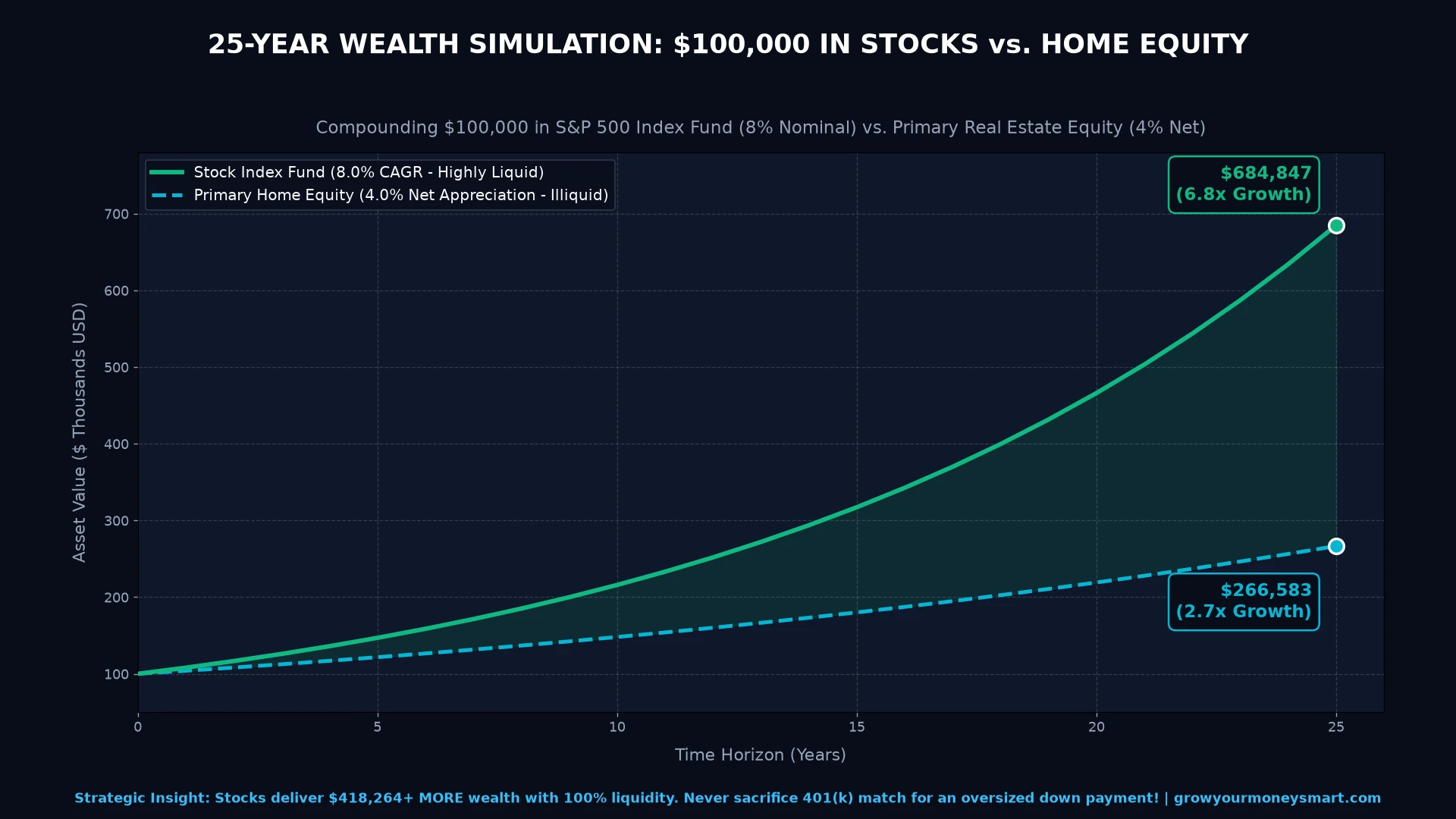
As the visual model confirms, the equity compounding in stocks generates $418,264+ in excess wealth over 25 years. This proves why starving your retirement fund to put down an unnecessary 30% or 40% on a house carries an enormous hidden opportunity cost. Progress through every stage of wealth building with our 5 Stages of Retirement Planning.
Expert Video Walkthrough: Mortgages vs. Stock Market Compounding
To examine the mathematical trade-offs between mortgage equity and stock market investing with real portfolio models, watch this detailed walkthrough by personal finance educator Humphrey Yang:
The “House Poor” Trap & Hidden Ownership Frictions
Becoming “house poor” occurs when buyers allocate all their liquid cash to down payment and closing costs, leaving them with zero cash buffer and forcing them to suspend retirement contributions. Essential ownership frictions include:
1. The 1% Maintenance Rule: A $450,000 home requires approximately $4,500 annually in routine maintenance, appliance replacements, and roof repairs.
2. Property Taxes & Insurance Inflation: Unlike fixed-rate mortgage principal and interest, local property taxes and homeowners insurance premiums rise continuously with inflation.
3. HOA Fees & Special Assessments: Unpredictable assessments for building maintenance can drain cash reserves unexpectedly.
4. Illiquidity Risk: Home equity cannot be spent at the grocery store during a job loss without taking high-interest debt.
The Dual-Track Savings Blueprint: How to Fund Both Goals
You do not have to choose strictly between buying a home and retiring wealthy. Execute this 5-step dual-track strategy:
Step 1: Capture 100% of Your Employer 401(k) Match First
Never compromise on your employer match. It is an immediate 100% return that instantly doubles your money.
Step 2: Maintain a 3-to-6 Month Emergency Cash Fortress
Before funneling capital into a down payment fund, lock away 3 to 6 months of living expenses in an untouchable HYSA. Calculate your target emergency reserve with our Emergency Fund Calculator.
Step 3: Establish a Dedicated “Down Payment HYSA”
Open a separate high-yield savings account or Treasury Bill ladder specifically labeled “House Fund.” Automate monthly transfers so down payment savings are never comingled with daily spending.
Step 4: Target a Reasonable 10% to 15% Down Payment
Do not delay your life for years waiting to save a 20% down payment if home prices are rising rapidly. Putting 10% down while maintaining retirement momentum is mathematically superior to putting 20% down with zero liquid reserves.
Step 5: Allocate Windfalls Using the 50/50 Rule
Direct annual bonuses, tax refunds, and salary raises 50% toward the house down payment and 50% toward Roth IRA or index fund investing.
Frequently Asked Questions (FAQs)
Below are clear, expert answers to the most common questions regarding down payment savings versus retirement funds:
Because they operate on completely different time horizons and risk profiles. A house deposit is a short-term goal (1 to 5 years) requiring 100% capital preservation in liquid instruments like HYSAs and CDs. In contrast, a retirement fund has a multi-decade horizon (15 to 40 years) designed to absorb short-term equity market volatility in exchange for exponential compound growth.
Never pause contributions below your employer 401(k) match threshold. Stopping your match is turning down an immediate 100% guaranteed return. Once the employer match is secured, you can temporarily redirect additional discretionary savings toward your down payment fund for 12 to 24 months.
If buying within 1 to 3 years, keep 100% of your funds in FDIC-insured High-Yield Savings Accounts (HYSAs), short-term Certificates of Deposit (CDs), or Treasury Bills (T-Bills). Never invest down payment money in equities or cryptocurrency, where a sudden 20% market correction could delay your home purchase by years.
With a Roth IRA, you can withdraw your original contributions penalty-and-tax-free at any time, plus up to $10,000 of earnings penalty-free under the IRS First-Time Homebuyer exception (if account is 5+ years old). However, raiding retirement funds destroys decades of tax-free compound growth and should only be considered as a last resort.
Historically, no. Broad stock market indices (S&P 500) have returned 8% to 10% annualized, while residential real estate has averaged 3.5% to 4.5% before factoring in property taxes, insurance, interest, and maintenance. Stocks offer complete liquidity, whereas home equity is illiquid and inaccessible without selling or borrowing.
Putting 20% down avoids Private Mortgage Insurance (PMI) and lowers monthly payments. However, putting 5% to 10% down allows you to keep an emergency cash buffer and continue compounding wealth in retirement accounts, rather than becoming ‘house poor’ with all your net worth trapped in illiquid brick-and-mortar.
Adopt the ‘Dual-Track Savings Framework’: 1. Automate 10% to 15% of income into 401(k)/Roth IRA. 2. Direct surplus savings into a dedicated HYSA labeled ‘Down Payment Fund.’ 3. Allocate annual bonuses or windfalls 50/50 between the two goals.
Property taxes (1-2.5% annually), homeowners insurance, HOA fees, mortgage interest, and the 1% annual maintenance rule (e.g., $4,000/yr on a $400k home) create an ongoing cash drag that does not compound your wealth.
⚡ Homeownership & Wealth Accumulation Guides
Balance real estate dreams with long-term compound growth using these strategic resources:
- Down Payment Blueprint: Explore our guide on saving for a house down payment fast featuring realistic timelines and high-yield cash holding rules.
- Automation Engine: Explore our guide on automated monthly savings transfers to effortlessly build your deposit without manual banking transfers.
- Mortgage Restructuring: Explore our guide on mortgage recast vs refinance comparison to evaluate whether to lower payments or reset your loan term.
Final Expert Takeaways
Navigating House Deposit vs. Retirement Fund savings is not an all-or-nothing contest. By strictly separating your short-term liquid capital preservation vehicles from your long-term equity compounding machines, capturing employer retirement matches, and avoiding the “house poor” trap, you achieve the ultimate financial prize: owning your dream home while remaining on track for complete multi-million-dollar retirement freedom.
IRS guidelines permit penalty-free IRA distributions up to $10,000 for qualified first-time homebuyers under statutory conditions. Consult the official Internal Revenue Service (IRS) Early Retirement Distributions and Exceptions for statutory guidelines and consumer protections.
🏠 Housing vs Retirement Wealth Compounding Strategies
Resolve the tension between buying a home and maximizing compound retirement growth with these companion analyses:
- Down Payment Tactics: how to save for a house down payment fast — proven tactics to accumulate deposit cash without sacrificing financial health.
- Lifecycle Framework: 5 stages of retirement planning lifecycle — balance early home acquisition with long-term nest egg accumulation.
- Account Maximization: how to max out 401(k) and Roth IRA simultaneously — capture every employer match before locking liquid cash into property.
- Asset Allocation Math: HYSA vs stocks: where to put your money in 2026 — evaluating short-term cash yields vs long-term stock market returns.
- Safe Withdrawal Benchmark: the 4% rule safe withdrawal rate explained — understand how real estate net worth affects your ultimate retirement income.

Jaiveer Hooda is the Lead Financial Researcher & Personal Finance Analyst at Grow Your Money Smart. Specializing in personal wealth optimization, index fund compounding, high-yield savings mechanics, and consumer debt elimination strategies. With a background in computer engineering, he applies mathematical modeling, cashflow simulations, and empirical risk analysis to evaluate personal finance vehicles and credit products. Every analysis is backed by verified regulatory disclosures, IRS tax schedules, and empirical APY compounding math.
Areas of Expertise: Personal Finance · High-Yield Savings Accounts (HYSA) · Index Funds & S&P 500 Compounding · Retirement Planning (401k/IRA) · Debt Optimization · Credit Card APR Mechanics.
Transparency & Editorial Policy: Editorial Standards | Report a Correction