
Between Treasury Bills (T-Bills) and a High-Yield Savings Account (HYSA), the best choice depends on your state tax bracket, your investment timeline, and impending Federal Reserve interest rate moves (and how they compare to cash alternatives like money market accounts vs HYSA):
- Choose Treasury Bills if you live in a moderate-to-high income tax state (California, New York, New Jersey, Massachusetts), because T-Bills are 100% exempt from state and local income taxes under federal statute 31 U.S.C. § 3124. They also lock in your yield for 4 to 52 weeks, protecting your cash against upcoming Federal Reserve rate cuts.
- Choose an HYSA if you require immediate liquidity for daily cash flow or an emergency reserve (0 to 30 days). High-yield savings accounts provide instant ACH transfers, debit access, and $250,000 in FDIC insurance with zero purchase minimums.
Rule of thumb: Keep 1 to 2 months of living expenses in an HYSA for daily peace of mind, and park remaining short-term reserves (3 to 12 months) in rolling T-Bills to shield yields from state taxes and rate cuts.
As the Federal Reserve navigates monetary policy and interest rate shifts, cash savers face an urgent question: where should you park your cash? Calculate your exact baseline cushion with our free emergency fund calculator before deciding between risk-free Treasury debt or liquid bank accounts.
For the past few years, moving idle checking cash into a high-yield savings account was a no-brainer. But with rate cuts on the horizon, variable APYs are vulnerable to falling overnight. Meanwhile, US Treasury Bills (T-Bills) offer a powerful alternative: fixed yields backed by the full faith and credit of the US government and an IRS-recognized exemption from state and local income taxes.
In this guide, we break down the mathematical differences, tax calculations, liquidity constraints, and step-by-step strategies so you can determine exactly whether T-Bills, an HYSA, or a combination of both will earn you more money.
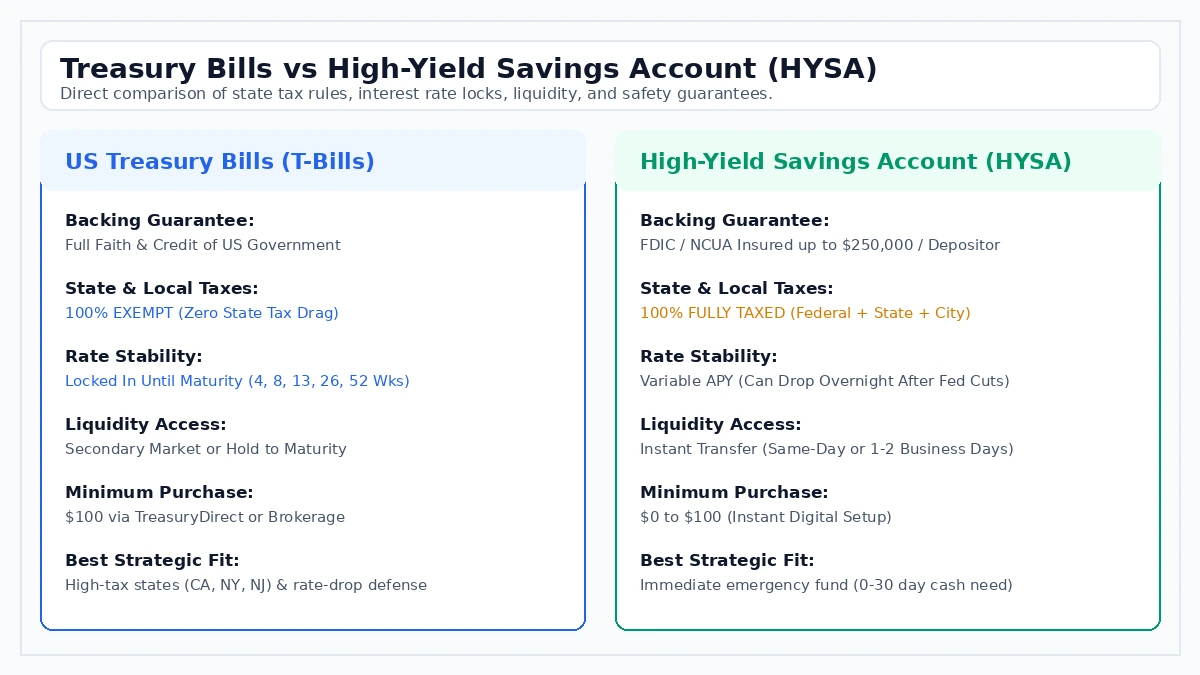
Head-to-Head Comparison: Treasury Bills vs HYSA
To understand which instrument suits your personal financial setup, compare their fundamental attributes side by side:
| Feature / Attribute | Treasury Bills (T-Bills) | High-Yield Savings Account (HYSA) |
|---|---|---|
| Safety Guarantee | Backed by the Full Faith & Credit of the US Government | FDIC or NCUA insured up to $250,000 per depositor (see our guide on how to insure $1 million+ safely) |
| State & Local Tax Treatment | 100% Tax-Exempt (IRS 31 U.S.C. § 3124) | Fully Taxable (Federal + State + Local) |
| Rate Type & Stability | Fixed discount yield locked until maturity (4 to 52 wks) | Variable APY (Can drop at the bank’s discretion) |
| Liquidity Access | Hold to maturity or sell on secondary market (brokerage) | Instant withdrawals via ACH, transfer, or ATM debit |
| Minimum Purchase | $100 increments (TreasuryDirect or Fidelity / Schwab / Vanguard) | $0 to $100 depending on the online bank |
| Compound Schedule | Sold at discount, pays face value at maturity | Compounded daily or monthly and credited monthly |
The State Tax Exemption Advantage (The Math Breakdown)
The single greatest financial advantage of US Treasury Bills over a high-yield savings account is their immunity from state and local income taxes. Under federal law, interest earned on US government obligations is exempt from state-level income taxation.
When you earn interest in an HYSA, that income is treated as ordinary interest and taxed by both the IRS and your state revenue department. If you reside in a state with high income taxes—such as California (up to 13.3%), New York (up to 10.9% plus NYC local tax), New Jersey (up to 10.75%), or Oregon (up to 9.9%)—state taxes create a severe “tax drag” on your HYSA returns.
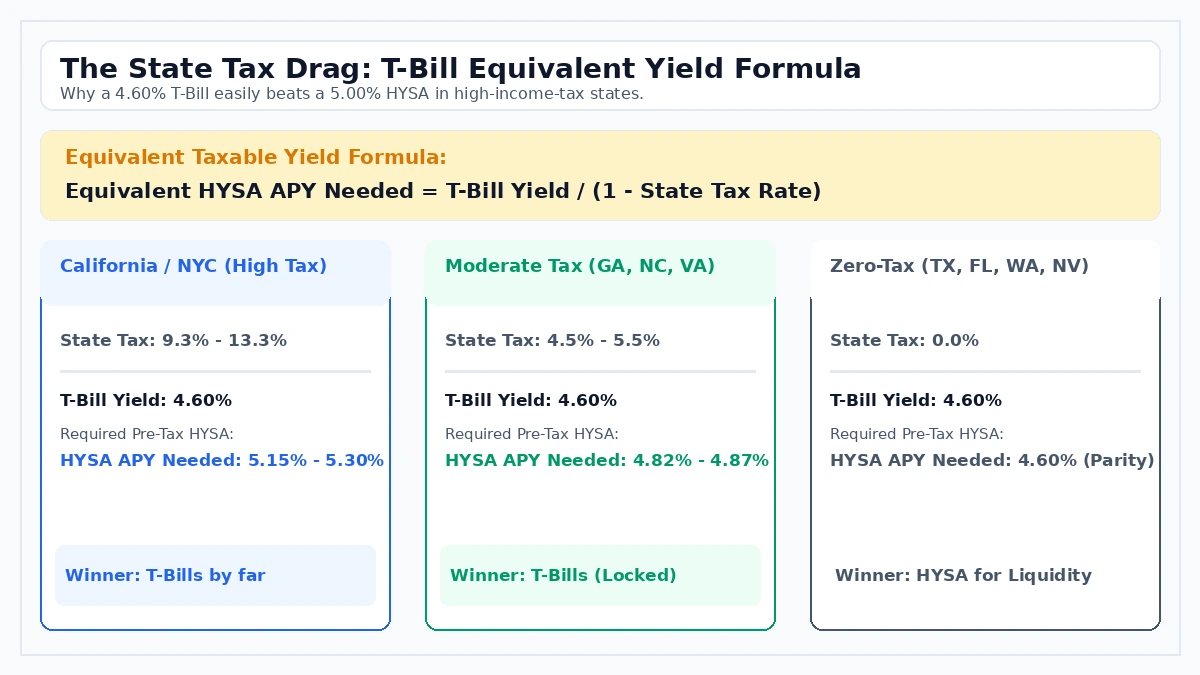
How to Calculate Equivalent Taxable Yield
To find the HYSA APY required to match a state-tax-free T-Bill, use this simple formula:
Equivalent HYSA APY = T-Bill Yield ÷ (1 – State Income Tax Rate)
Let’s look at a concrete real-world comparison: suppose a 13-week T-Bill yields 4.60% and a top online bank offers an HYSA at 4.85% APY:
- In a Zero-Tax State (Texas, Florida, Washington, Nevada, Tennessee): There is no state income tax. The HYSA’s 4.85% APY pays more than the 4.60% T-Bill. An HYSA or a CD ladder structure is the clear winner for pure yield.
- In a Moderate-Tax State (Virginia, North Carolina at ~5%): The 4.60% T-Bill has an effective yield of
4.60% / (1 - 0.05) = 4.84%. The T-Bill and the HYSA are virtually identical in net earnings, but the T-Bill locks in the rate. - In a High-Tax State (California at 9.3% marginal rate): The 4.60% T-Bill has an effective yield of
4.60% / (1 - 0.093) = 5.07%. Even though the HYSA headline rate appears higher (4.85%), the T-Bill leaves you with significantly more take-home cash after taxes.
Dollar Simulation: $10,000 Saved Over 12 Months
To visualize the real-world impact, consider an investor in New York (6.5% state tax bracket + 3.8% NYC local tax = 10.3% total state/local tax) parking $10,000 in cash for one year across both options:
12-Month Net After-Tax Cash Earnings ($10,000 Deposit)
$460.00 Gross
Federal Tax (24%): -$110.40
State & Local Tax: $0.00 (Exempt)
Net Take-Home Cash: $349.60
$485.00 Gross
Federal Tax (24%): -$116.40
State & Local Tax (10.3%): -$50.00
Net Take-Home Cash: $318.60
Result: The T-Bill generates an extra $31.00 net cash profit (+9.7% higher net return) on identical $10,000 capital simply by eliminating state tax drag.
Interest Rate Lock vs Variable APY: The Fed Rate Cut Factor
Beyond taxes, monetary policy risk is the defining factor for 2026 cash management. When the Federal Reserve cuts the federal funds rate, online banks reduce their HYSA yields almost immediately—often within 48 to 72 hours of an FOMC announcement.
In contrast, when you purchase an 8-week, 13-week, 26-week, or 52-week Treasury Bill, your discount yield is mathematically locked for the entire duration of the term. Even if the Fed reduces rates by 50 basis points next month, your Treasury Bill continues paying its guaranteed return until its maturity date.
Liquidity & Emergency Access Differences
While Treasury Bills offer superior tax protection and rate lock-in, high-yield savings accounts maintain an undeniable advantage in liquidity:
- HYSA Access: Funds can be transferred to a linked checking account via ACH within 1 to 2 business days, and many banks provide debit cards or wire services for same-day access. You can withdraw any partial dollar amount at any time without penalty.
- T-Bill Access: If purchased via TreasuryDirect.gov, your money is illiquid until maturity. TreasuryDirect does not maintain a secondary trading marketplace; to liquidate early, you must transfer the bill to a commercial brokerage firm. If purchased via a brokerage (such as Fidelity, Charles Schwab, or Vanguard), you can sell your T-Bill on the secondary market before maturity during market trading hours, though the price may fluctuate slightly based on prevailing market yields.
Masterclass: How to Buy and Compare Treasury Bills
To see how Treasury Bills function in practice and how to purchase them fee-free on brokerage platforms or TreasuryDirect, watch this comprehensive walkthrough by personal finance educator Rob Berger:
The 3-Tier Cash Allocation Strategy
Smart cash management does not force you to make an all-or-nothing choice between Treasury Bills and an HYSA. The most effective approach is a tiered cash allocation model:
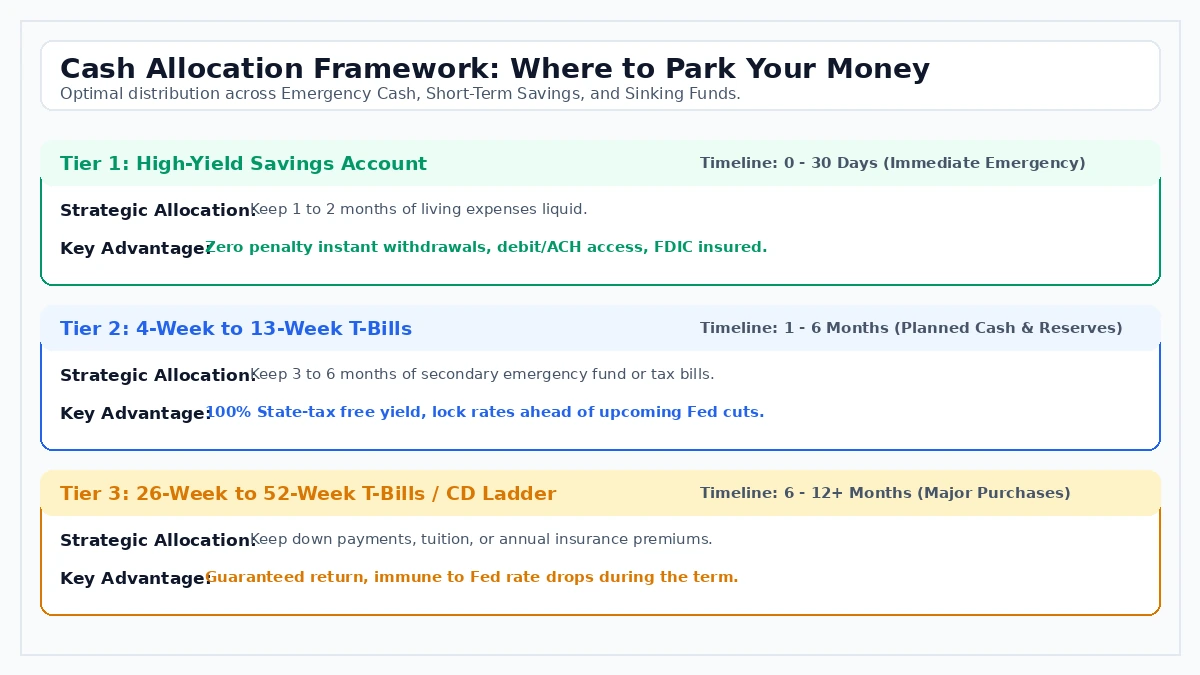
- Tier 1: Immediate Emergency Cash (HYSA): Maintain 1 to 2 months of baseline living expenses in your high-yield savings account. This ensures you can handle urgent car repairs, medical copays, or immediate household bills instantly without liquidating securities.
- Tier 2: Short-Term Reserves & Sinking Funds (4 to 13-Week T-Bills): Place 2 to 4 months of expenses or dedicated sinking funds (such as estimated quarterly taxes, holiday travel, or planned home maintenance) into a 4-week or 13-week rolling T-Bill ladder. Enable “Auto-Roll” on your brokerage account so principal reinvests automatically upon maturity until you need the cash.
- Tier 3: Planned Capital Reserves (26 to 52-Week T-Bills or CD Ladders): For funds earmarked for a home down payment or tuition within the next 12 to 24 months, lock in longer-term yields with 6-month or 1-year T-Bills to protect against further monetary easing.
How to Buy Treasury Bills Step-by-Step
You can purchase Treasury Bills through two zero-fee channels:
- Method A: Major Brokerage Account (Recommended): On Fidelity, Charles Schwab, or Vanguard, navigate to the Fixed Income / Bonds tab, select “Treasury Auctions”, choose your maturity term (e.g., 4-week, 13-week, 26-week), and enter your order in $1,000 increments (or $100 on select platforms). You can enable Auto-Roll with a single click, and you retain the ability to sell on the secondary market if an unexpected emergency arises.
- Method B: TreasuryDirect.gov: Open a free account at TreasuryDirect, link your checking account, and participate directly in weekly non-competitive Treasury auctions in $100 increments. While functional, the website interface is outdated and secondary market sales require transferring assets out to a brokerage.
Frequently Asked Questions: Treasury Bills vs HYSA
Are Treasury Bills safer than high-yield savings accounts?
Both instruments are essentially risk-free. T-Bills are backed directly by the full faith and credit of the United States federal government, which issues the currency. An HYSA is backed by the Federal Deposit Insurance Corporation (FDIC) or NCUA up to $250,000 per depositor, per institution. However, for cash balances exceeding $250,000, Treasury Bills offer unlimited government backing without requiring multi-bank sweep networks.
Can I lose money in a Treasury Bill?
If you hold a Treasury Bill until its maturity date, you cannot lose money; you will receive the full face value guaranteed by the US government. The only scenario where you could experience a minor loss is if you choose to sell your T-Bill on the secondary market prior to maturity during a period when interest rates have risen sharply.
How do I report Treasury Bill interest on my tax return?
At tax time, your brokerage or TreasuryDirect will issue a Form 1099-INT. Interest earned on T-Bills is reported in Box 3 (Interest on U.S. Savings Bonds and Treasury Obligations). This interest is included in your federal adjusted gross income but automatically subtracted from your state tax return, ensuring zero state or local tax is assessed.
What is T-Bill Auto-Roll and how does it work?
Auto-Roll is an automated feature offered by brokerages (such as Fidelity and Schwab) and TreasuryDirect. When your T-Bill matures, the principal proceeds are automatically used to purchase a new T-Bill of the same term at the next Treasury auction, allowing you to maintain continuous compound yield without manual intervention.
Should I use a Treasury Bill ETF like SGOV or BIL instead?
Ultrashort Treasury ETFs like SGOV (iShares 0-3 Month Treasury Bond ETF) or BIL offer extreme convenience and intraday liquidity with low expense ratios (~0.07% to 0.14%). They also pass through state tax exemptions. However, holding individual T-Bills directly incurs zero management expense fees and allows you to lock in an exact maturity yield.
Final Verdict: Which Cash Option Is Right for You?
Neither Treasury Bills nor High-Yield Savings Accounts are universally superior—they solve different cash dilemmas:
If you value instant liquidity and simple automated banking, prioritize a top-tier high-yield savings account. But if you reside in a state with income tax and want to protect your yield against Fed rate cuts, allocating secondary cash reserves into Treasury Bills will mathematically maximize your take-home wealth.

Jaiveer Hooda is the Lead Financial Researcher & Personal Finance Analyst at Grow Your Money Smart. Specializing in personal wealth optimization, index fund compounding, high-yield savings mechanics, and consumer debt elimination strategies. With a background in computer engineering, he applies mathematical modeling, cashflow simulations, and empirical risk analysis to evaluate personal finance vehicles and credit products. Every analysis is backed by verified regulatory disclosures, IRS tax schedules, and empirical APY compounding math.
Areas of Expertise: Personal Finance · High-Yield Savings Accounts (HYSA) · Index Funds & S&P 500 Compounding · Retirement Planning (401k/IRA) · Debt Optimization · Credit Card APR Mechanics.
Transparency & Editorial Policy: Editorial Standards | Report a Correction