
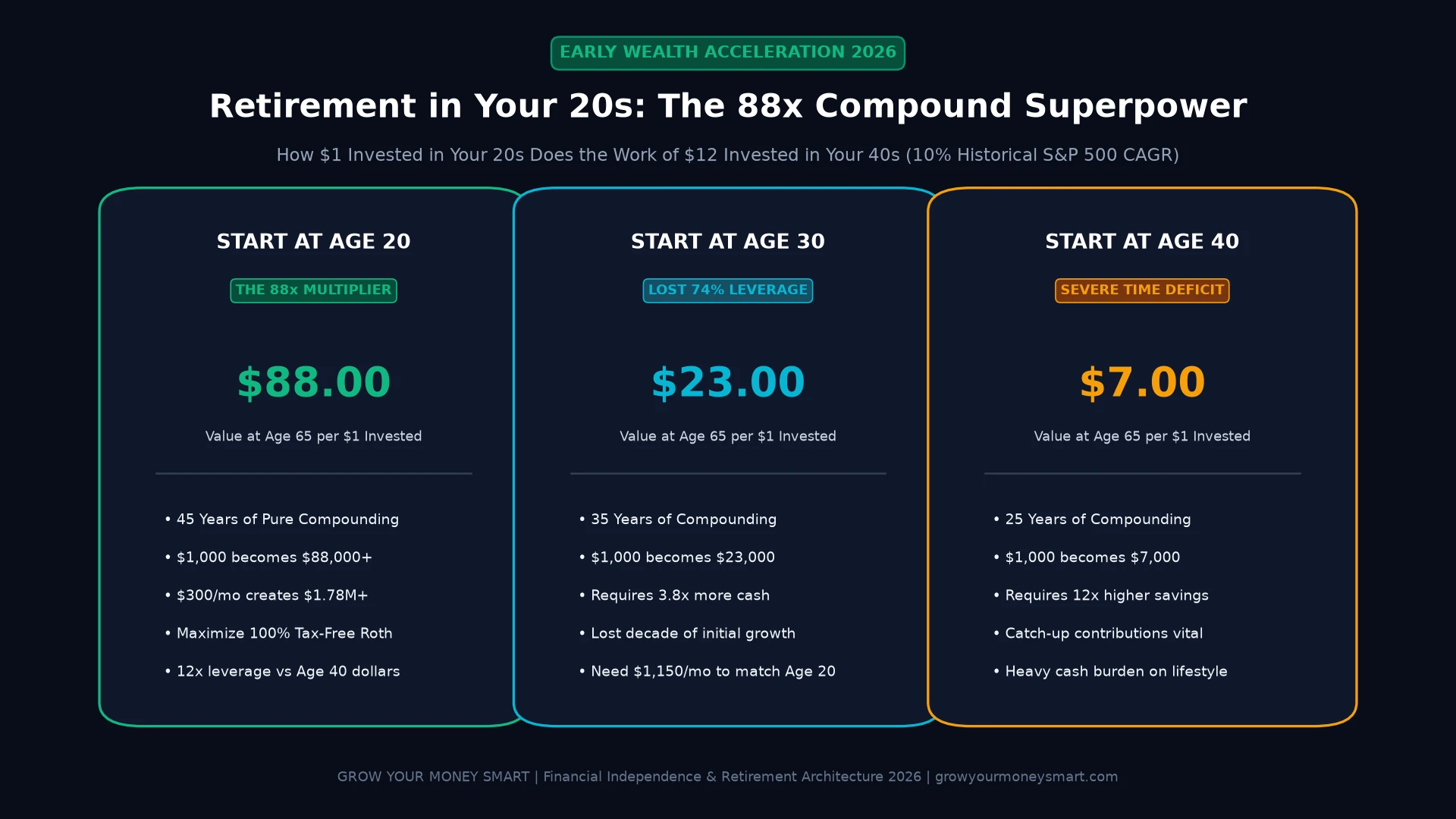
- The 88x Wealth Multiplier: Every $1 invested at age 20 compounds into approximately $88 by age 65 (assuming historical 10% S&P 500 CAGR), compared to just $23 at age 30 and $7 at age 40.
- The $300/Month Phenomenon: Investing $300/month from age 20 to 30 ($36,000 total) and never adding another cent produces over $1.72 million at age 65—outperforming someone who saves $126,000 starting at age 30.
- The 2026 Waterfall Strategy: 1. Capture 100% employer 401(k) match → 2. Build 3–6 month emergency fund → 3. Max out Roth IRA ($7,000 limit) → 4. Utilize Triple-Tax HSA & low-cost index ETFs (VOO/VTI).
- Zero Market Timing: Automate contributions into low-cost index funds to eliminate behavioral panic and achieve compounding velocity.
Achieving true multi-generational wealth and retiring early does not require an executive salary or complex day-trading algorithms. It requires leveraging the single most powerful mathematical asset on Earth: time. When you master retirement planning in your 20s, you gain an insurmountable structural advantage over older investors, turning modest early savings into an automated multi-million-dollar compound wealth engine.
In modern macroeconomics—characterized by persistent structural inflation, shifting interest rate cycles, and evolving IRS tax brackets—young investors face distinct financial challenges. Yet, by synthesizing mathematical compounding discipline with tax-advantaged account prioritization, early retirement transitions from an abstract dream into an engineered certainty. For personalized calculations on your liability payoff and budgeting trajectory, utilize our interactive Debt Payoff Calculator and Household Budget Calculator.
The Mathematical Compounding Engine: Why 20s Dollars Are Supercharged
The foundational principle of early retirement planning is the exponential time horizon. When money compounds, your earnings generate their own earnings. Over 40 to 45 years, the compounding curve shifts from linear gradual gains into a near-vertical hockey-stick expansion.
According to empirical data from the Securities and Exchange Commission (SEC) and long-term asset return analyses, the U.S. stock market (represented by the S&P 500) has delivered an average annualized nominal return of approximately 10% over the past century. At 10% annual growth, invested capital doubles roughly every 7.2 years according to the Rule of 72.
| Starting Age | Years of Compounding to Age 65 | Number of 7.2-Year Doublings | Value of a Single $1,000 Investment | Effective Wealth Multiplier |
|---|---|---|---|---|
| Age 20 | 45 Years | 6.25 Doublings | $72,890 – $88,000 | 73x – 88x Multiplier |
| Age 25 | 40 Years | 5.55 Doublings | $45,259 | 45x Multiplier |
| Age 30 | 35 Years | 4.86 Doublings | $28,102 | 28x Multiplier |
| Age 40 | 25 Years | 3.47 Doublings | $10,835 | 11x Multiplier |
| Age 50 | 15 Years | 2.08 Doublings | $4,177 | 4.2x Multiplier |
As demonstrated in the matrix above, waiting from age 20 to age 30 to start investing reduces your terminal capital by over 65% to 74% (compare your decade trajectory against institutional retirement savings benchmarks by age). To learn how your time horizon dictates your optimal asset allocation, explore our comprehensive guide on Investment Time Horizons.
Quantitative Simulation: The Tale of Three 20s Investors
To grasp the staggering real-world impact of early compounding, consider this mathematical simulation comparing three distinct investors saving under identical 10% annual market return assumptions:
• Investor A (The Early Sprinter): Invests $300 per month ($3,600/year) from age 20 to 30 only. After 10 years, Investor A stops contributing entirely. Total out-of-pocket cash invested: $36,000.
• Investor B (The Patient Late Starter): Starts investing at age 30 and contributes $300 per month continuously every single month for 35 straight years until age 65. Total out-of-pocket cash invested: $126,000.
• Investor C (The Mid-Career Starter): Starts at age 40 and contributes $300 per month for 25 continuous years until age 65. Total out-of-pocket cash invested: $90,000.
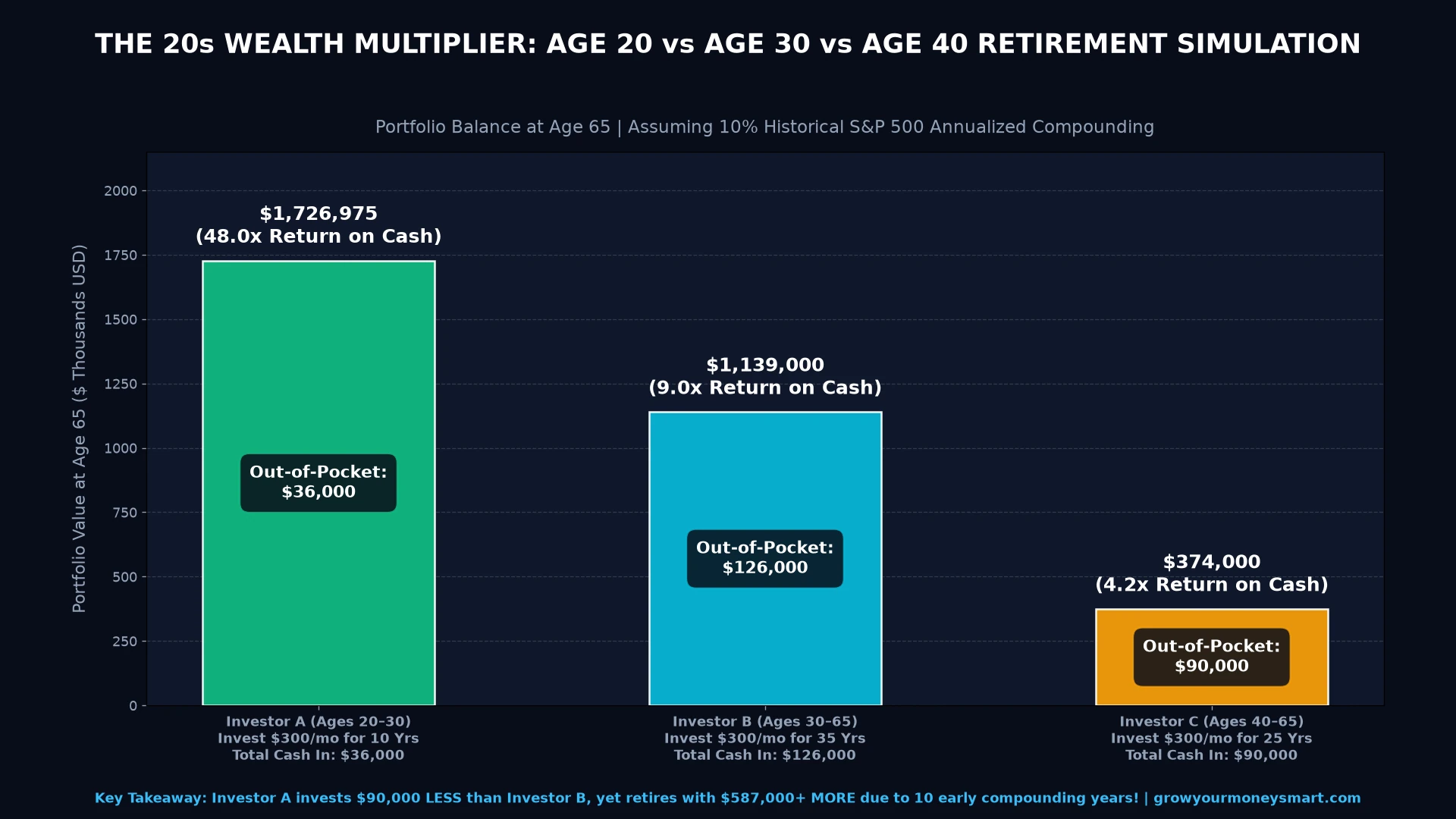
The results are extraordinary: Investor A ends up with $1,726,975 at age 65, despite having invested $90,000 less cash than Investor B ($1,139,000). Investor A’s money had a 10-year head start, creating a compounding base that Investor B could never catch up to despite 35 years of disciplined monthly labor. Discover the full path through each financial milestone in our 5 Stages of Retirement Planning.
The 20s Priority Wealth Waterfall (Where to Put Your Money First)
To avoid tax leakage and maximize your returns, capital should flow through a strict four-tiered priority waterfall:
Step 1: Capture the Full Employer 401(k) Match (100% Instant Return)
If your employer offers a 4% or 5% dollar-for-dollar 401(k) match, this is an instant, guaranteed 100% return on your investment. Never leave matching dollars on the table under any circumstance.
Step 2: Build a 3-to-6 Month High-Yield Emergency Buffer
Before locking away excessive capital into illiquid investments, deposit 3 to 6 months of essential living expenses into an FDIC-insured High-Yield Savings Account (HYSA) earning competitive yields. This liquidity shield prevents you from taking high-interest credit card debt or liquidating retirement assets during emergencies. Calculate your required emergency fund with our Emergency Fund Calculator.
Step 3: Max Out Your Roth IRA ($7,000 – $7,500 Limit)
In your 20s, you are likely in the lowest federal income tax bracket of your career. Contributing after-tax dollars into a Roth IRA allows 100% of your multi-decade dividend growth and capital gains to be withdrawn completely tax-free in retirement.
Step 4: Maximize Health Savings Accounts (HSA) & Broad Index Funds
If enrolled in a qualifying High Deductible Health Plan (HDHP), utilize an HSA for its rare triple tax advantage: pre-tax contributions, tax-free growth, and tax-free medical withdrawals. Allocate any surplus cash into broad-market taxable brokerage index funds.
2025/2026 Statutory Limits & SECURE 2.0 Provisions
Navigating modern retirement planning requires tracking statutory contribution thresholds enacted under the IRS Revenue Procedures and SECURE 2.0 legislation:
• Workplace Plans (401k, 403b, 457): Employee elective deferral limit is $23,500 for 2025 ($24,500 in 2026).
• Individual Retirement Accounts (Roth & Traditional IRAs): Annual contribution cap is $7,000 ($7,500 in 2026).
• Health Savings Accounts (HSAs): Annual limits are $4,300 for self-only and $8,550 for family coverage ($4,400 and $8,750 respectively in 2026).
• 529-to-Roth Rollover Flexibility: SECURE 2.0 allows up to $35,000 in unused 529 education funds to be rolled over directly into a beneficiary’s Roth IRA after 15 years, penalty-free.
Expert Video Masterclass: Step-by-Step 20s Investing Blueprint
To reinforce these theoretical principles with actionable asset allocation modeling, watch this comprehensive walkthrough by renowned personal finance educator Daniel Braun on “How to Invest in Your 20s | 7 BEST Places to Put Your Money”:
Low-Cost Asset Allocation: What Exactly to Buy
Investing in your 20s does not mean picking volatile penny stocks or timing crypto swings. Institutional research from Vanguard and the SEC confirms that over 90% of long-term returns stem from broad asset allocation rather than individual stock picking. A modern, bulletproof 20s portfolio can be constructed using just 2 or 3 ultra-low-cost index funds:
| Asset Category | Target Allocation | Recommended Low-Cost ETFs / Index Funds | Expense Ratio |
|---|---|---|---|
| Total U.S. Stock Market / S&P 500 | 70% – 80% | VTI (Total Market), VOO (S&P 500), FZROX (Zero Fee) | 0.00% – 0.03% |
| Total International Equities | 15% – 20% | VXUS (Total International), IXUS, FTIHX | 0.06% – 0.07% |
| Emerging Tech / Real Estate / Bonds | 0% – 10% | VNQ (REITs), BND (Total Bond Market), Cash Buffer | 0.03% – 0.12% |
Behavioral Pitfalls: The Costliest Mistakes 20-Somethings Make
Behavioral finance studies prove that investor psychology is the greatest threat to wealth accumulation. Watch out for these four common traps:
1. Lifestyle Inflation: Automatically upgrading your apartment, car, and dining habits with every salary increase instead of directing at least 50% of raises into automated investment accounts.
2. High-Fee Financial Products: Buying whole life insurance policies, indexed universal life (IUL), or paying 1.5%+ active management fees that strip hundreds of thousands of dollars from your compound gains.
3. Keeping Excess Cash in Low-Yield Checking Accounts: Letting tens of thousands of dollars sit in 0.01% checking accounts, silently losing 3% to 4% annually to inflation.
4. Panic-Selling During Corrections: Market downturns of 10% to 25% occur regularly. In your 20s, a market crash is a golden discount opportunity to buy shares on sale, not a reason to sell.
Actionable 5-Step Execution Plan for Your 20s
Follow this checklist to activate your compounding engine within the next 30 days:
1. Set Up Automatic Transfers: Schedule an automatic investment transfer of at least 15% of your take-home pay directly on payday.
2. Enable Employer 401(k) Match: Verify in your HR portal that you are contributing enough to capture the full match.
3. Open a Roth IRA: Open a low-cost Roth IRA at Vanguard, Fidelity, or Charles Schwab, and automate recurring index fund purchases.
4. Audit Recurring Subscriptions: Free up an extra $50 to $100 per month by canceling unused services and directing savings into index funds.
5. Stay the Course: Commit to never selling during market drawdowns and letting the 45-year compound curve do the heavy lifting.
Frequently Asked Questions (FAQs)
Below are clear, authoritative answers to the most common questions young professionals ask about retirement planning in their 20s:
Because of exponential compound interest. A single $1 invested at age 20 has 45 years to double repeatedly, compounding into approximately $88 by age 65 at historical S&P 500 returns (10% CAGR). At age 30, that same dollar only compounds into $23, and at age 40 into just $7. Your 20s dollars possess up to 12x more wealth-building leverage than 40s dollars.
Financial planners recommend saving 15% to 20% of your gross annual income. However, even starting with just $100 to $300 per month in low-cost broad-market index funds builds massive momentum. Investing $300 monthly from age 20 to 30 ($36,000 total out-of-pocket) can compound into over $1.72 million by age 65 without adding another penny.
Follow the optimal wealth waterfall: Step 1 is contributing enough to your employer 401(k) to capture 100% of any company match (an immediate 100% risk-free return). Step 2 is funding a Roth IRA up to the annual limit ($7,000 in 2025 / $7,500 in 2026), where your investments compound 100% tax-free forever while you are in a lower income tax bracket.
For 2025, the workplace 401(k)/403(b) employee limit is $23,500 ($24,500 in 2026). The Roth/Traditional IRA limit is $7,000 ($7,500 in 2026). The Health Savings Account (HSA) limit is $4,300 for individuals and $8,550 for families ($4,400 and $8,750 in 2026).
Focus on ultra-low-cost broad-market index funds and ETFs with expense ratios under 0.05%. Top core vehicles include S&P 500 index funds (e.g., VOO, IVV, FXAIX), Total US Stock Market index funds (e.g., VTI, FZROX), and Total International funds (e.g., VXUS). Avoid speculative stock picking and high-fee actively managed mutual funds.
Always capture your employer 401(k) match first regardless of debt. Next, compare your loan interest rates: high-interest debts above 7-8% (credit cards, private loans) should be aggressively eliminated first. For low-interest debt below 5-6% (federal student loans), prioritize investing in Roth IRAs and index funds where historical returns (8-10%) outperform the interest cost.
The single costliest mistake is ‘waiting until I make more money.’ Delaying investing by just 10 years destroys up to 74% of your compounding potential, forcing you to save 3 to 4 times more cash per month in your 30s and 40s to achieve the exact same retirement nest egg.
If enrolled in a qualifying HDHP, an HSA offers a unique triple tax advantage: contributions are tax-deductible, investment growth is 100% tax-free, and withdrawals for qualified medical expenses are tax-free. After age 65, funds can be withdrawn for any non-medical purpose penalty-free (taxed as ordinary income, identical to a traditional 401k).
Final Expert Takeaways
Mastering Retirement Planning in Your 20s is not about extreme deprivation or living on instant noodles. It is about deploying small, consistent amounts of capital into low-cost index funds and letting the unmatched physics of time and compound growth multiply your wealth. By taking action today, capturing employer matches, and automating your Roth IRA contributions, you build complete lifelong financial independence.
🌱 Young Adult Wealth Multipliers & Account Blueprints
Harness your greatest financial asset—time—with these beginner investing and retirement frameworks:
- Early Advantage: start early retirement saving: the unbeatable advantage — discover the compound interest math that allows 20-somethings to retire rich with modest contributions.
- Low-Barrier Entry: how to start investing with $100 a month — step-by-step guide to setting up automated index fund investing.
- Core Tax Vehicles: how to max out 401(k) and Roth IRA — capturing the 100% immediate return on employer 401(k) matching funds.
- Early Exit Models: types of FIRE: Lean FIRE vs Fat FIRE vs Barista FIRE — exploring aggressive financial independence movements.
- Target Milestones: how much to save by age 30 benchmarks — how to reach 1x your annual salary saved before your 30th birthday.

Jaiveer Hooda is the Lead Financial Researcher & Personal Finance Analyst at Grow Your Money Smart. Specializing in personal wealth optimization, index fund compounding, high-yield savings mechanics, and consumer debt elimination strategies. With a background in computer engineering, he applies mathematical modeling, cashflow simulations, and empirical risk analysis to evaluate personal finance vehicles and credit products. Every analysis is backed by verified regulatory disclosures, IRS tax schedules, and empirical APY compounding math.
Areas of Expertise: Personal Finance · High-Yield Savings Accounts (HYSA) · Index Funds & S&P 500 Compounding · Retirement Planning (401k/IRA) · Debt Optimization · Credit Card APR Mechanics.
Transparency & Editorial Policy: Editorial Standards | Report a Correction