
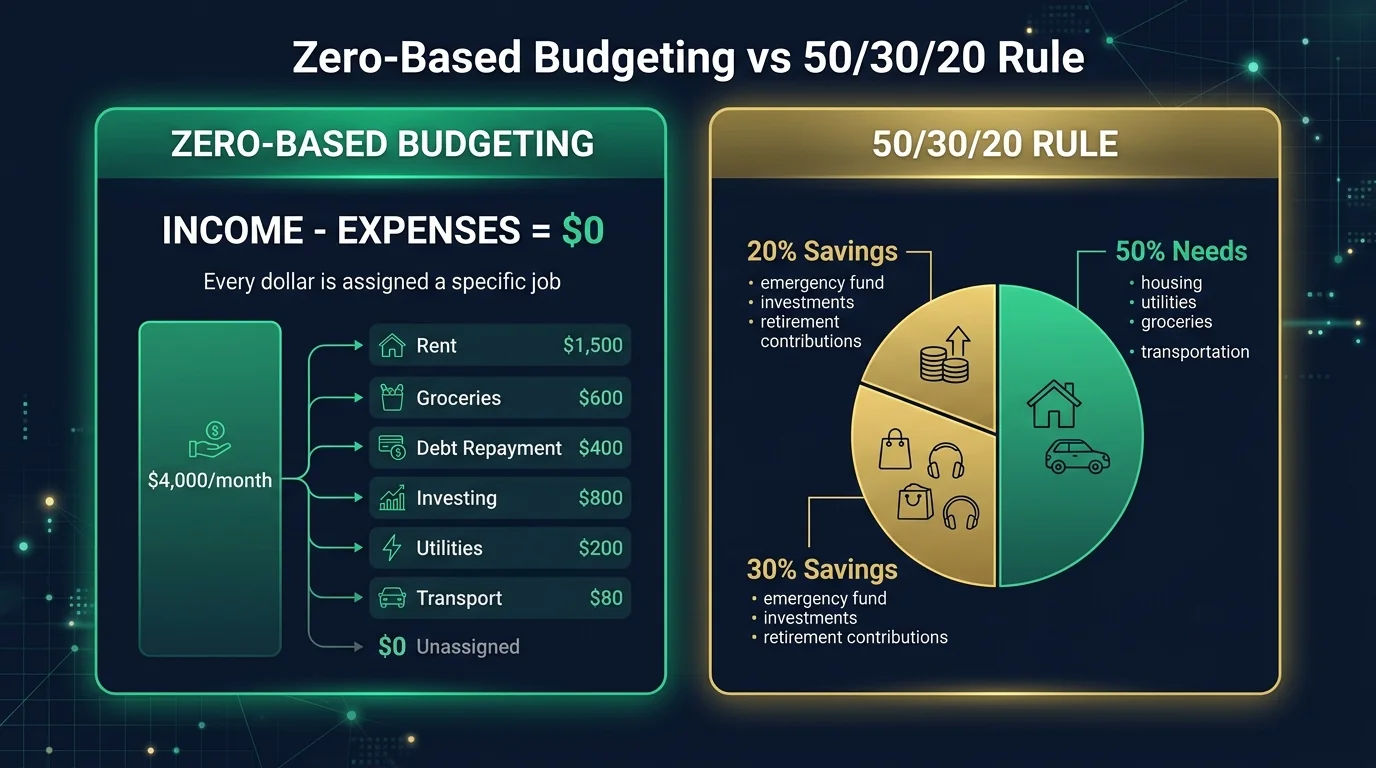
- Core Philosophical Difference: Zero-Based Budgeting (ZBB) is a bottom-up, micro-management framework where Income − Expenses = $0 (every dollar gets a specific task). The 50/30/20 Rule is a top-down, macro-allocation framework dividing after-tax income into Needs (50%), Wants (30%), and Wealth Building (20%).
- Fastest Debt Payoff: ZBB crushes high-interest debt up to 40% faster because it audits leaking cash and dynamically allocates 30%–50%+ of monthly cash flow toward debt elimination via our debt payoff calculator.
- Effort vs. Sustainability: The 50/30/20 rule requires only 15 minutes of monthly maintenance, making it ideal for beginners and automation. ZBB requires 1–2 hours weekly of granular tracking, delivering unmatched behavioral awareness.
- Cost-of-Living Adaptability: In expensive metro areas, strict 50/30/20 breakdowns often break because housing alone exceeds 40% of income. ZBB handles variable and high-cost living expenses with surgical precision.
- The Ultimate Hybrid Strategy: Top financial planners recommend using 50/30/20 as your macro wealth target and ZBB to manage line items within those targets.
Introduction: The Cash Flow Architecture Dilemma
Budgeting is not about deprivation; it is the mathematical blueprint for financial sovereignty. Yet, over 65% of working professionals who attempt to budget abandon their systems within the first 90 days. The reason is rarely a lack of discipline—it is a fundamental mismatch between their personal behavioral psychology and their chosen budgeting architecture.
In modern personal finance, two dominant paradigms govern cash flow management: Zero-Based Budgeting (ZBB) and the 50/30/20 Rule. While both methodologies aim to build net worth, eliminate debt, and curb lifestyle creep, they operate on completely inverted philosophies. One demands micro-level precision down to the exact cent, while the other relies on macro-level percentage guardrails designed for frictionless automation.
Whether you are tackling credit card balances with structured debt management strategies, scaling your emergency fund calculator targets, or optimizing long-term wealth across your investment time horizon, choosing the right framework determines whether your wealth-building flywheel compounds or stalls. Let’s dissect the mechanics, mathematical simulations, pros, and trade-offs of both systems.
What Is Zero-Based Budgeting? The “Every Dollar Gets a Job” Framework
Originally formulated in corporate management by Peter Pyhrr in the 1970s and popularized in personal finance by Dave Ramsey and Jesse Mecham (founder of YNAB), Zero-Based Budgeting operates on a strict mathematical axiom:
Total Monthly Net Income − Total Monthly Allocations = $0
The term “zero-based” does not mean you drain your bank account to zero at month’s end. Rather, it means that before the month begins, 100% of your projected income is intentionally pre-assigned to specific categories until zero unassigned dollars remain.
How Zero-Based Allocations Function in Practice
Every dollar is categorized into one of four primary functional pillars:
- Fixed Essential Obligations: Rent/mortgage, utilities, insurance, loan minimums.
- Variable Living Expenses: Groceries, fuel, dining out, household supplies.
- Sinking Funds & Goals: Car repairs, annual insurance premiums, holiday travel, medical reserves.
- Wealth Accumulation & Aggressive Debt Payoff: High-yield savings deposits, Roth IRA contributions, brokerage investments, extra mortgage principal.
If your net monthly take-home pay is $5,000, you assign exactly $5,000 across these categories. If you reach the end of your planning and have $240 unallocated, that $240 is assigned a job—such as accelerating your budgets calculator projections or investing in low-cost index funds.
What Is the 50/30/20 Rule? The Proportional Wealth Architecture
Devised by bankruptcy expert and U.S. Senator Elizabeth Warren and her daughter Amelia Warren Tyagi in their landmark book All Your Worth: The Ultimate Lifetime Money Plan, the 50/30/20 rule is a macro-budgeting model designed to establish structural balance without tracking line-item receipts.
The framework divides your total after-tax take-home pay into three non-negotiable percentage buckets:
| Category | Target Percentage | Qualifying Expenses & Components |
|---|---|---|
| Needs | 50% Max | Absolute survival necessities: Housing (rent/mortgage), minimum utilities, basic groceries, healthcare, transportation to work, and statutory minimum debt obligations. |
| Wants | 30% Max | Discretionary lifestyle choices: Dining out, vacations, streaming subscriptions, fitness memberships, hobbies, upgraded apparel, and entertainment. |
| Savings & Debt | 20% Min | Wealth acceleration: Emergency fund deposits, 401(k) / Roth IRA contributions, taxable brokerage accounts, and extra principal payments on high-interest debt. |
The primary psychological genius of the 50/30/20 framework is guilt-free spending. As long as your essentials stay within 50% and your savings hit 20% automatically on payday, you are completely free to spend the 30% wants bucket on whatever brings you joy without tracking individual receipts.
Head-to-Head Comparison Matrix: ZBB vs. 50/30/20
To evaluate which framework aligns with your current cash flow and lifestyle constraints, review the feature-by-feature comparison below:
| Feature / Metric | Zero-Based Budgeting (ZBB) | 50/30/20 Rule |
|---|---|---|
| Methodology Level | Micro-level (every dollar tracked to a specific line item) | Macro-level (three broad percentage buckets) |
| Time Commitment | High (1–2 hours/week for reconciliation) | Minimal (15–30 minutes/month for balance check) |
| Debt Payoff Acceleration | Maximum (allows 30%–60% aggressive cash redirection) | Moderate (capped within the 20% savings/debt bucket) |
| Discretionary Tracking | Strict line-item limits with category transfers | Broad 30% pool with guilt-free flexibility |
| Irregular / 1099 Income | Exceptional (budgeting using prior month’s actuals) | Challenging (fixed percentages fluctuate monthly) |
| HCOL City Adaptability | High (custom adjustments for high rent) | Low (50% needs ceiling frequently breached) |
| Behavioral Fatigue Risk | Moderate to High (burnout if overly strict) | Very Low (highly sustainable for decades) |
| Recommended Tooling | YNAB, EveryDollar, granular spreadsheets | Monarch Money, automated bank sub-accounts |
Mathematical Simulations: $5,000 Monthly Take-Home Breakdown
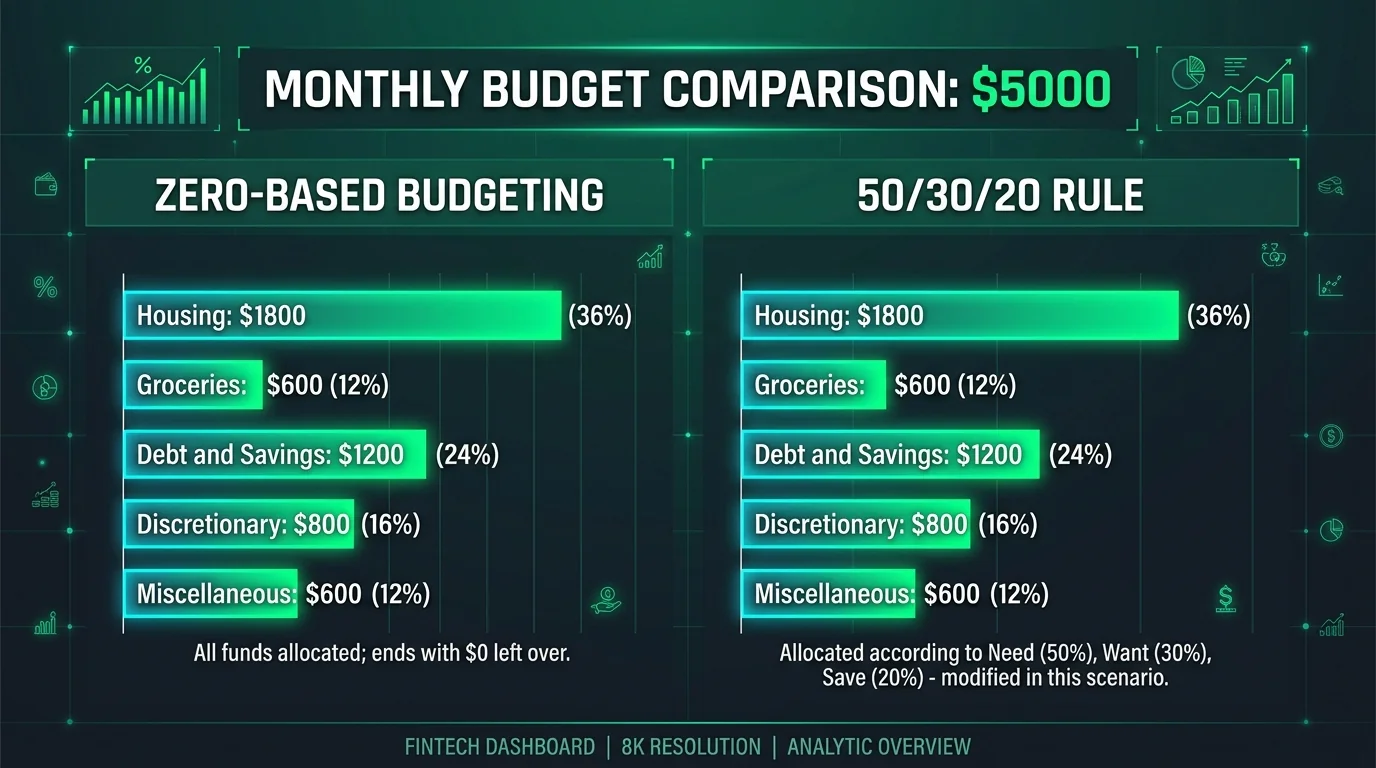
To see how both methodologies transform identical cash flows, let us analyze a household earning $5,000 net monthly income ($60,000 annual take-home pay). Both models allocate the entire $5,000, but their category distribution reflects fundamentally different financial priorities.
| Budget Category | 50/30/20 Allocation ($) | Zero-Based Allocation ($) | Strategic Impact |
|---|---|---|---|
| Rent / Mortgage & Insurance | $1,700 (Needs) | $1,700 (Fixed Essential) | Identical housing baseline (34% of net income). |
| Utilities & Mobile Phone | $350 (Needs) | $320 (Fixed Essential) | ZBB audits contracts to shave $30/mo. |
| Groceries & Household | $450 (Needs) | $480 (Variable Living) | ZBB isolates grocery inflation precisely. |
| Transportation & Auto Gas | $250 (Needs) | $240 (Variable Living) | Both recognize essential commute requirements. |
| Discretionary / Dining / Wants | $1,500 (Wants Pool) | $550 (Strict Line Items) | ZBB cuts $950 in lifestyle creep to fuel wealth. |
| Sinking Funds (Repairs/Travel) | $0 (Absorbed in Wants) | $350 (Dedicated Buffer) | ZBB prevents emergency fund drain for predictable costs. |
| Emergency Fund / HYSA | $400 (Savings) | $400 (Wealth Building) | Both allocate $400 toward liquid reserves. |
| Retirement & Brokerage (Roth IRA) | $600 (Savings) | $960 (Wealth Building) | ZBB funnels surplus into compounding assets. |
| Total Monthly Allocated | $5,000 (100%) | $5,000 ($0 Remaining) | ZBB invests +$360/mo ($4,320/yr extra) into compounding. |
The 10-Year Wealth Compounding Velocity
By capturing $360 per month in unmonitored discretionary spending and redirecting it into an S&P 500 index fund yielding an annualized 8% historical return, the Zero-Based Budgeting model generates an additional $65,800+ in pure compound growth over a 10-year span compared to the standard 50/30/20 baseline. For individuals seeking rapid wealth acceleration, exploring our how to save your first $1,000 guide and comprehensive $3,000 monthly income budget guide illustrates how small percentage optimizations yield life-changing compounding.
Video Deep Dive: Mastering Your Cash Flow Systems
For a complete visual breakdown of how proportional budgeting contrasts with granular zero-sum cash management, watch this comprehensive tutorial by financial educator Marko from WhiteBoard Finance:
Pros and Cons: Architectural Breakdown
Zero-Based Budgeting Advantages & Drawbacks
The Core Advantages:
- Total Financial Visibility: Eliminates “phantom spending” where unassigned cash leaks into micro-purchases.
- Accelerated Debt Liquidation: Directs maximum cash flow into high-interest debt elimination, reducing total interest paid by thousands of dollars.
- Sinking Fund Protection: Seamlessly incorporates irregular annual bills (car insurance, property taxes) so they never trigger credit card debt.
The Trade-Offs:
- High Administrative Overhead: Requires logging transactions and weekly reconciliation.
- Potential Friction for Couples: Highly detailed category constraints can spark relationship friction if one partner prefers flexibility over rigid line items.
50/30/20 Rule Advantages & Drawbacks
The Core Advantages:
- Set-and-Forget Simplicity: You can automate your finances completely by routing 20% to savings on payday, setting bills on autopay, and spending the rest without logging a single receipt.
- High Long-Term Adherence: Because it feels less restrictive, people are far more likely to stick with it for years without experiencing budgeting burnout.
- Built-in Balance: Guarantees you enjoy your present life (30% wants) while simultaneously securing your future (20% savings).
The Trade-Offs:
- Structural Vulnerability in HCOL Regions: If your rent alone takes 45% of your income, keeping all utilities, groceries, and insurance under 50% is mathematically impossible without adjustments.
- Sub-Optimal for Active Debt Crises: When facing 25% APR credit card debt, spending 30% on discretionary wants delays debt freedom by years. Deciding whether to pursue aggressive payoff versus balanced investing is detailed in our debt-free vs having debt strategies analysis.
The Hybrid Solution: Macro-Strategy with Micro-Execution
You do not need to treat these frameworks as mutually exclusive. In fact, seasoned wealth builders and certified financial planners often deploy a Hybrid Budgeting Architecture that merges the psychological freedom of 50/30/20 with the operational rigor of Zero-Based Budgeting.
The 4-Step Hybrid Implementation Blueprint
- Step 1: Set Macro Targets with 50/30/20: Establish your overarching monthly ceilings. If you take home $6,000, cap your fixed needs at $3,000 (50%), target discretionary spending at $1,800 (30%), and lock in $1,200 (20%) for automated wealth building.
- Step 2: Automate the 20% Wealth Bucket First (“Pay Yourself First”): On the morning of your direct deposit, automatically transfer your 20% allocation into your high-yield savings account, Roth IRA, and workplace 401(k).
- Step 3: Deploy Zero-Based Tracking Inside the 50% and 30% Buckets: Use a spreadsheet or budgeting app to allocate every dollar inside the Needs and Wants buckets. This ensures you never accidentally exceed the macro thresholds.
- Step 4: Conduct a Monthly 15-Minute Sweep: At the end of the month, any leftover money in your wants category is swept directly into extra investments or an emergency fund buffer. For individuals evaluating professional guidance, compare fee models using our DIY vs financial advisor comparison.
⚡ Recommended Budgeting Frameworks & Implementation Systems
Explore alternative allocation architectures and execution tools to maximize your savings rate:
- Automated Tools: Explore our guide on free budgeting apps to automate tracking eliminating friction in logging variable daily expenses.
- Hands-On Cash Control: Explore our guide on cash envelope budgeting system for visual, tangible cash-stuffing discipline.
- Alternative Ratio Matrix: Explore our guide on 70/20/10 budget allocation model if traditional 50/30/20 percentages feel too restrictive or lenient.
Frequently Asked Questions (FAQ)
Zero-Based Budgeting (ZBB) assigns every single dollar a designated task until income minus expenses equals exactly $0, providing complete granular control. In contrast, the 50/30/20 rule is a high-level percentage framework that divides after-tax income into three broad buckets: 50% for Needs, 30% for Wants, and 20% for Savings and Debt Repayment, requiring less day-to-day tracking.
Zero-Based Budgeting generally accelerates high-interest debt elimination faster than the 50/30/20 rule. Because ZBB requires auditing every line item, it exposes leaking cash flows and allows you to funnel 35% to 50%+ of your income directly toward the debt avalanche or debt snowball methods, whereas 50/30/20 caps debt and savings combined at 20%.
Yes. A hybrid budgeting strategy uses the 50/30/20 rule as a high-level macro guideline (allocating total targets for essentials, lifestyle, and wealth building) and implements Zero-Based Budgeting inside each category to track specific line items down to the cent. This provides top-down balance with bottom-up discipline.
The primary reasons for failure with Zero-Based Budgeting are tracking fatigue and lack of a ‘miscellaneous buffer’. When individuals attempt to categorize every single $3 coffee or unexpected expense without building a $150–$300 discretionary buffer, budget variance creates frustration, leading to abandonment within 60 to 90 days.
In major metropolitan areas where housing costs often consume 40% to 50% of take-home pay alone, the strict 50% Needs cap is challenging. Financial planners recommend adjusting the ratio to a 60/20/20 or 70/20/10 framework, or transitioning to Zero-Based Budgeting to aggressively optimize discretionary categories.
Zero-Based Budgeting is significantly superior for irregular or 1099 freelance income. By operating on a ‘last month’s income’ baseline or funding a tiered priority list (essential needs first, savings second, lifestyle last), ZBB guarantees bills are covered during lean revenue months, whereas fixed percentage models like 50/30/20 fluctuate wildly.
No. Zero-Based Budgeting means your budgeted income minus budgeted allocations equals zero on paper or in your spreadsheet. Your allocations include high-yield savings deposits, emergency funds, investment accounts, and checking account buffer cash, so your actual net worth and cash reserves steadily increase.
For Zero-Based Budgeting, YNAB (You Need A Budget), EveryDollar, and custom Google Sheets templates are industry leaders. For the 50/30/20 rule, automated tracking apps like Monarch Money, Copilot Money, Empower Personal Dashboard, and simplified checking-and-savings sub-account automation work best.
Implementing structured monthly cash flow management is endorsed by federal consumer agencies as the cornerstone of personal debt elimination. Consult the official Consumer Financial Protection Bureau (CFPB) Official Budgeting Guide for statutory guidelines and consumer protections.
🏛️ Real-World Salary Blueprints & Budgeting Toolkits
See how 50/30/20 and zero-based budgeting work across different salary tiers, paired with our free calculators:
- Free Master Spreadsheet: free monthly budget spreadsheet and net worth tracker — our flagship formula-driven Google Sheets and Excel financial dashboard.
- $3,000 Monthly Guide: how to budget a $3,000 monthly income step-by-step — detailed allocation for entry-level and single earner budgets.
- $5,000 Salary Blueprint: how to budget a $5,000 monthly salary — optimizing mid-career cash flow, investing, and retirement contributions.
- $6,000 Cash Flow Guide: how to budget a $6,000 monthly income — scaling up investments, real estate goals, and tax optimization.
- Alternative 70/20/10 Model: 70/20/10 budget rule vs 50/30/20 comparison — evaluating alternative percentage allocations for debt and savings.
- Interactive Calculator: interactive 50/30/20 budget calculator — enter your exact after-tax paycheck to compute your personalized spending targets.

Jaiveer Hooda is the Lead Financial Researcher & Personal Finance Analyst at Grow Your Money Smart. Specializing in personal wealth optimization, index fund compounding, high-yield savings mechanics, and consumer debt elimination strategies. With a background in computer engineering, he applies mathematical modeling, cashflow simulations, and empirical risk analysis to evaluate personal finance vehicles and credit products. Every analysis is backed by verified regulatory disclosures, IRS tax schedules, and empirical APY compounding math.
Areas of Expertise: Personal Finance · High-Yield Savings Accounts (HYSA) · Index Funds & S&P 500 Compounding · Retirement Planning (401k/IRA) · Debt Optimization · Credit Card APR Mechanics.
Transparency & Editorial Policy: Editorial Standards | Report a Correction