
A balance transfer saves money when the total interest eliminated during the 0% promotional window exceeds the one-time transfer fee (typically 3%–5%). Use the core formula: Net Savings = (Gross Interest Avoided) – (Upfront Transfer Fee). For balances over $3,000 at 24%+ APR, borrowers break even within 40 to 50 days, yielding $1,200 to $3,800+ in pure cash savings over 18 to 21 months.
- The Break-Even Formula: Divide your upfront transfer fee by your current monthly interest charge to calculate the exact month (and day) you enter pure profit.
- Daily Compounding Reality: Credit cards compound interest daily, not annually. On an average $6,000 balance at 25% APR, you bleed ~$125/month in interest alone.
- 3% vs. 5% Fee Threshold: Choose an 18-month 3% fee card if you can pay debt off within 1.5 years; choose a 21-month 5% fee card only if the extra 90 days prevents default.
- The Grace Period Trap: Making new retail purchases on a balance transfer card instantly eliminates the interest-free grace period on new charges unless explicitly covered by a 0% purchase APR.
- Minimum Fee Safeguard: Balance transfer fees feature a “greater of” clause (e.g., 3% or $5 minimum). Small balances under $200 should never be transferred.
When you calculate balance transfer fees against cumulative credit card interest saved, your ultimate objective is to escape the costly credit card minimum payment trap where compounding finance charges destroy wealth. With benchmark rates keeping commercial APRs between 21.5% and 28.5% according to the Federal Reserve Consumer Credit G.19 Report, revolving balances bleed cash without reducing principal.
A 0% APR balance transfer credit card offers a powerful tactical escape hatch: moving high-interest debt onto an interest-free introductory card for 12, 18, or 21 months. However, credit card issuers do not provide this balance relief out of charity—they levy an upfront balance transfer fee, typically 3% to 5% of the transferred principal.
To determine whether executing a balance transfer is a mathematically superior wealth-building maneuver or an unnecessary fee trap, you must calculate the exact cost of the fee against the cumulative interest avoided. In this master technical guide, we break down the definitive 2026 formulas, simulate real-world case studies from $3,000 to $15,000, and reveal the hidden traps to watch before submitting an application.
1. How to Calculate Balance Transfer Fees Step-by-Step
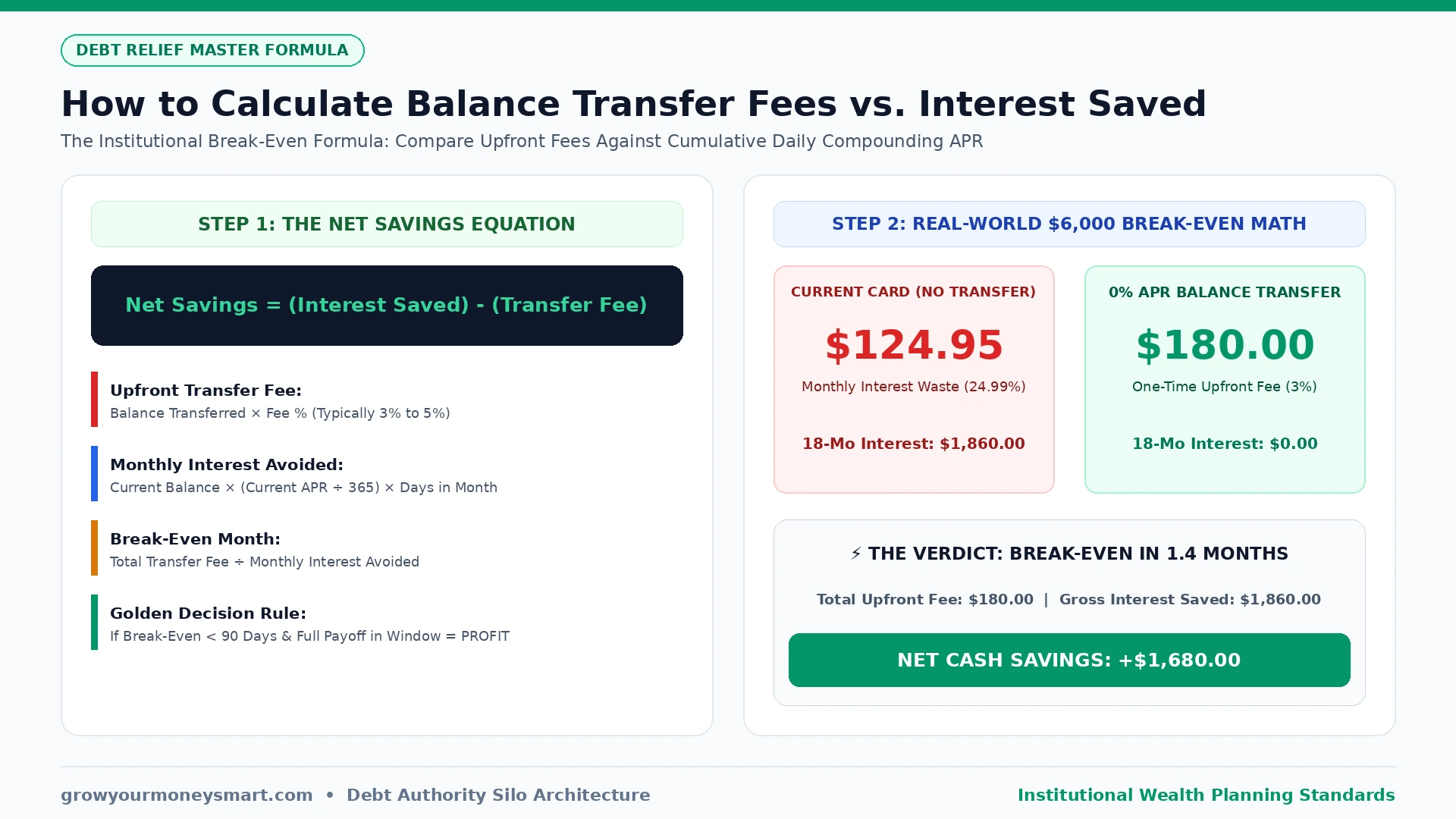
Evaluating a balance transfer requires three distinct calculations: the upfront fee cost, the monthly compounding interest eliminated, and the exact break-even month.
Formula 1: The Upfront Balance Transfer Fee
Credit card issuers charge either a flat percentage or a minimum dollar threshold, whichever is greater. Under the Consumer Financial Protection Bureau (CFPB) regulations, this fee must be clearly disclosed in the Schumer Box:
Example: Transferring $8,000 to a card with a 3% promotional fee yields an immediate fee of $8,000 × 0.03 = $240.00. This $240 fee is added directly to your new card’s balance, starting your new promotional balance at $8,240.00.
Formula 2: The Daily Compounding Interest Avoided
Mainstream financial blogs often compute credit card interest using a simplistic annual formula (Balance × APR ÷ 12). In reality, credit card issuers calculate interest using the Average Daily Balance (ADB) multiplied by the Daily Periodic Rate (DPR):
On an $8,000 revolving balance at 26.99% APR, your DPR is 0.2699 ÷ 365 = 0.00073945. In a 30-day billing cycle, your monthly interest cost is $8,000 × 0.00073945 × 30 = $177.47/month. That is nearly $180 per month that goes directly to bank profits without reducing your principal debt by a single cent.
Formula 3: The Institutional Break-Even Point
The break-even point is the exact number of billing cycles required for the interest you avoid to match and surpass the fee you paid upfront:
Using our $8,000 balance example: $240 Fee ÷ $177.47 Monthly Interest = 1.35 Months (~41 Days). In just 41 days, the one-time transfer fee is completely neutralized. If your new card offers 18 months at 0% APR, the remaining 16.65 months represent 100% pure interest-free capital acceleration.
Calculate Balance Transfer Fees vs. Interest Saved
Enter your balances and interest rates to calculate your exact break-even timeline and net profit in seconds.
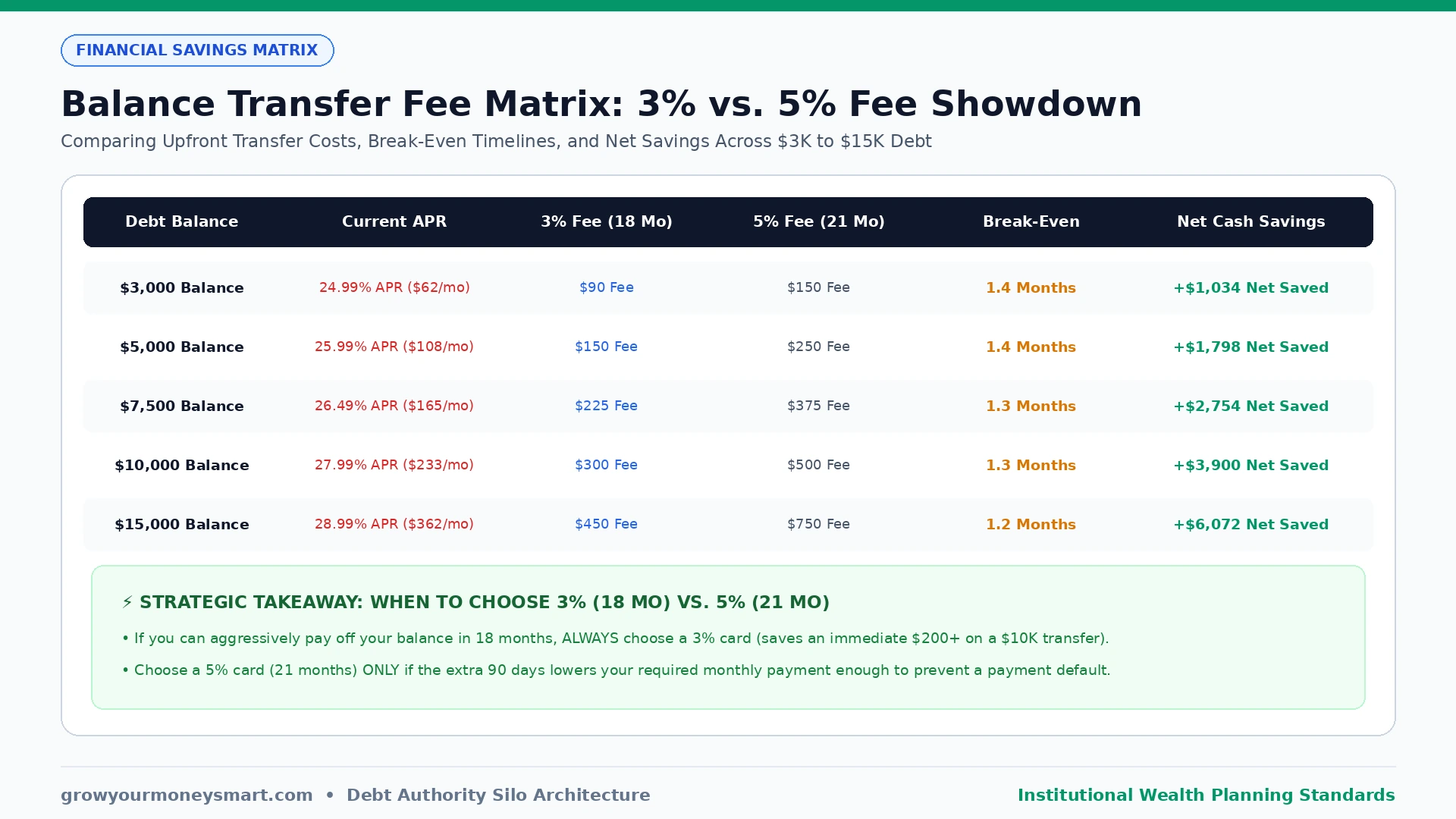
2. Real-World Case Studies: 3% vs. 5% Transfer Fee Showdown
To understand how fee percentages interact with introductory durations, let us analyze two realistic consumer scenarios comparing the 7 best 0% APR balance transfer credit cards currently available in 2026.
Case Study A: $5,000 Debt at 24.99% APR (18 Months at 3% Fee)
Sarah carries $5,000 across two store credit cards with an average APR of 24.99%. She can afford to commit $285 per month toward debt repayment.
By paying an upfront fee of $150, Sarah eliminates over $1,128 in financing charges, pocketing a net +$978.40 and eliminating her debt completely inside the 18-month window with a monthly payment of $286.11 ($5,150 ÷ 18).
Case Study B: $10,000 Debt at 28.99% APR (3% vs. 5% Fee Showdown)
Marcus owes $10,000 on a variable APR card currently running at 28.99%. He is deciding between two top-tier cards: Card X (3% fee, 18-month 0% intro APR) and Card Y (5% fee, 21-month 0% intro APR). Which option saves more cash?
- Upfront Transfer Fee: $300.00
- Required Monthly Payoff: $572.22 / month
- Total Interest Avoided: $2,820.00
- Net Savings: +$2,520.00 Pure Profit
- Upfront Transfer Fee: $500.00
- Required Monthly Payoff: $500.00 / month
- Total Interest Avoided: $3,290.00
- Net Savings: +$2,790.00 Pure Profit
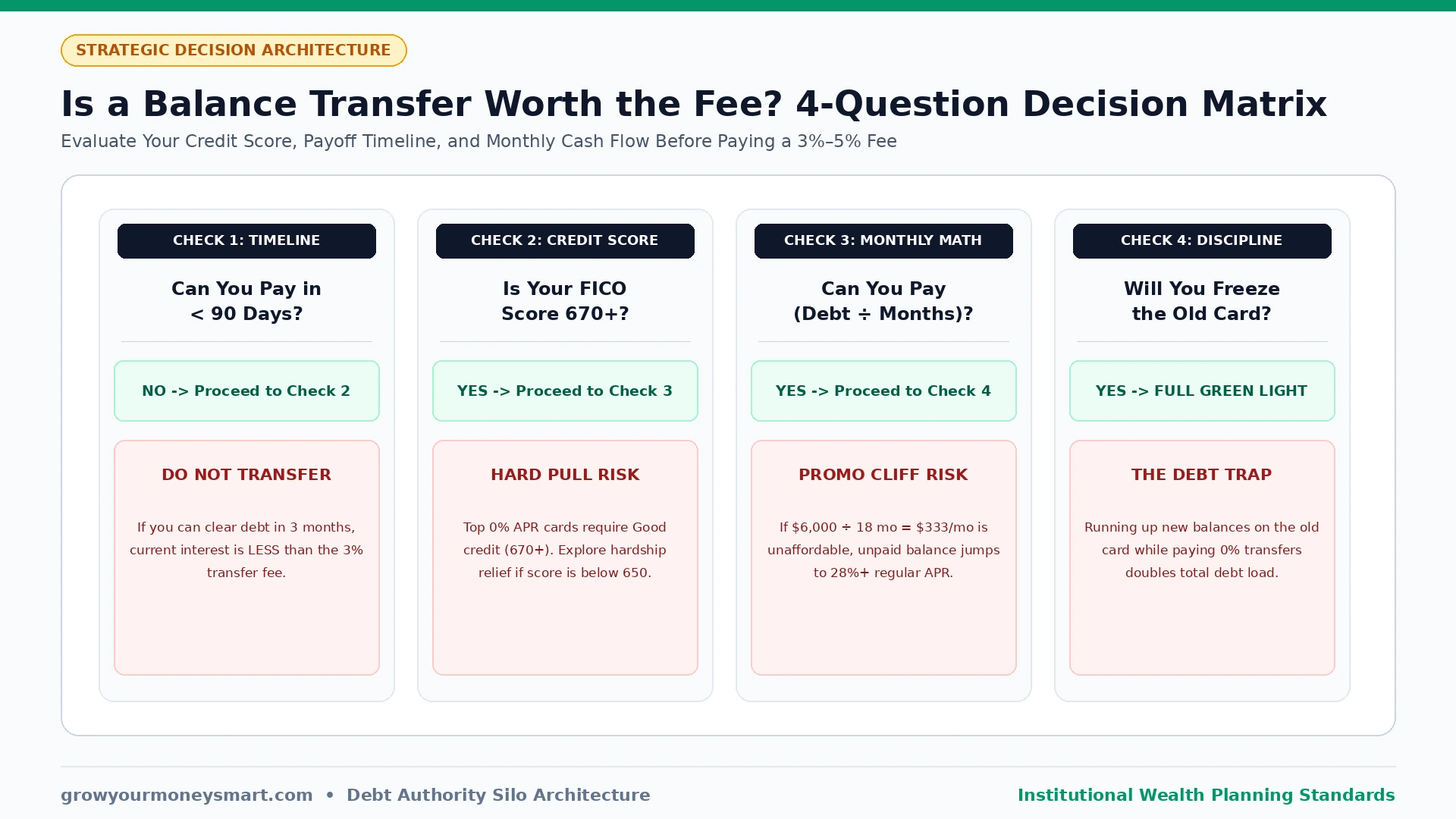
3. When Is a Balance Transfer NOT Worth the Fee? (The 4 Red Flags)
While the mathematical ROI is compelling for multi-thousand dollar balances, executing a balance transfer under the wrong conditions can backfire. Watch for these four critical disqualifiers:
1. You Can Pay Off the Balance in Under 90 Days
If you anticipate an upcoming tax refund, annual bonus, or asset sale that enables you to clear your debt within 3 months, paying a 3% to 5% transfer fee is mathematically wasteful. For example, carrying $4,000 for 60 days at 24% APR generates roughly $157 in interest. Paying a 5% fee ($200) costs more than the interest you are trying to avoid. In short-term scenarios, an aggressive debt avalanche vs snowball strategy on your existing accounts is superior.
2. Your Credit Score Is Below 670
The premier 0% APR balance transfer credit cards require Good-to-Excellent FICO scores (typically 670 to 850). If your credit score has suffered due to high credit utilization (>50%) or late payments, applying triggers a hard inquiry without guaranteeing approval. If approved, you may receive a restrictive credit line (e.g., $1,500 on an $8,000 balance transfer request). If you have lower credit, consider calling your card issuer directly using our free scripts to negotiate lower credit card interest rates, or explore pre-negotiated relief via credit card hardship programs and our breakdown of debt consolidation vs hardship programs.
3. You Cannot Afford the Fixed Promotional Payoff Amount
A balance transfer is a temporary loan freeze, not debt forgiveness. Calculate your monthly payoff target before applying: Total Transferred Balance ÷ Promotional Months = Required Monthly Payment. If your monthly cash flow cannot cover this number, any remaining balance at Month 19 or 22 will instantly revert to the standard regular APR (often 27.99% to 31.99% variable). Plug your exact figures into our free debt payoff calculator to establish an airtight payoff timeline.
4. The Behavioral Risk: Re-accumulating Debt on Empty Cards
The single greatest hazard of a balance transfer is behavioral. Once your existing credit cards are paid down to $0 balance via the transfer, consumers often experience psychological relief and resume discretionary spending on those newly empty cards. If you accumulate new charges on your old cards while simultaneously paying off the 0% promotional transfer card, you have doubled your total liabilities. Pair your transfer with our free monthly budget spreadsheet to enforce zero-based cash flow discipline.
4. The 3 Hidden Gotchas in Balance Transfer Terms
Before initiating a transfer, thoroughly review the issuer’s terms for these three fine-print mechanisms:
Unless your new card features 0% APR on BOTH balance transfers AND new purchases, making any purchase on the card eliminates your grace period. Under standard credit terms, new purchases will accrue interest from the transaction date until the entire account balance (including the transferred promotional balance) is paid in full. Rule of thumb: Never use a balance transfer card for everyday spending.
To qualify for the promotional 0% rate and lower 3% fee, most issuers mandate that transfers must be requested within 60 to 120 days of account opening. If you wait until Month 5 to transfer an additional balance, the transfer may be billed at the full standard purchase APR with a 5% fee.
You cannot transfer a balance between two cards issued by the same banking institution. For instance, you cannot transfer a debt from a Chase Sapphire card to a Chase Freedom Slate card, or from a Citi Double Cash to a Citi Simplicity. Your transfer destination card must be issued by a different bank.
Watch: When a Credit Card Balance Transfer Could Cost Hundreds in Interest
In this authoritative breakdown by NerdWallet, credit card analyst Sally French explains how introductory 0% offers work in practice, how transfer fees erode savings if miscalculated, and when you should avoid transferring entirely:
5. Step-by-Step Checklist: How to Execute a Flawless Transfer
Follow this five-step operational roadmap to lock in maximum interest savings and eliminate your debt for good:
- Audit Existing Balances & Prioritize Accounts: Log your exact statement balance, APR, and issuing bank. If managing several accounts, review how to prioritize multiple debts before initiating your transfer requests.
- Calculate Your Minimum Payoff Target: Ensure you have the budget room to pay
(Total Debt + 3% Fee) ÷ Promo Monthseach month. - Select an Unaffiliated Card Issuer: Compare offers across competing institutions with 0% intro periods lasting 18 to 21 months and transfer fees capped at 3%.
- Submit Transfer Requests Upon Approval: Provide the 16-digit card numbers and requested payoff amounts. Transfers typically finalize within 5 to 14 business days.
- Continue Paying Old Accounts Until Cleared: Never assume a transfer has cleared instantly. Continue making minimum payments on your old cards until your statement confirms a $0.00 balance to avoid late payment penalties.
Before transferring, ensure an unexpected expense won’t derail your plan by reviewing our guide on paying off debt vs saving an emergency fund and safeguarding your cash with our complete emergency fund & high-yield savings guide. For broader debt relief frameworks, explore our debt management strategies guide.
Frequently Asked Questions (FAQs)
How much is a typical balance transfer fee?
Most credit card issuers charge between 3% and 5% of the total amount transferred, with a minimum fee of $5 or $10. For example, transferring $5,000 at a 3% fee costs $150, whereas a 5% fee costs $250.
Is a balance transfer fee added to my balance or paid immediately?
The balance transfer fee is added directly to your new credit card balance upon transfer completion. You do not pay it out of pocket upfront; instead, your starting balance on the new card will equal your transferred principal plus the fee.
Can I transfer a balance between two cards from the same bank?
No. Banks and credit card issuers universally prohibit balance transfers between accounts within their own institution. For example, you cannot transfer a balance from a Chase card to another Chase card. Your new card must be with a different financial institution.
What happens if I don’t pay off my balance transfer before 0% APR ends?
Unlike retail store cards with “deferred interest”, standard bank balance transfer cards only charge interest on the remaining unpaid balance after the promotional period ends. However, that remaining balance will accrue interest at the regular variable APR, which is often 24% to 29%+.
Does a balance transfer hurt your credit score?
Opening a new balance transfer card causes a temporary 3 to 7 point dip due to a hard credit inquiry. However, expanding your total available credit limit and steadily lowering your credit utilization ratio typically produces a significant net gain in your FICO score over 6 to 12 months.
Can I transfer multiple credit card balances onto one card?
Yes. You can consolidate balances from multiple different cards onto a single balance transfer card up to your approved credit limit. If tight cash flow makes juggling multiple minimums difficult, check our actionable blueprint on paying off debt living paycheck to paycheck.
How long does it take for a balance transfer to go through?
Most balance transfers take between 5 to 14 business days to finalize, though some institutions process them in as few as 3 days. Continue making scheduled minimum payments on your old accounts until you see the balance officially reflect $0.00.
Are there balance transfer cards with no transfer fee?
Cards offering $0 balance transfer fees are rare in the post-2024 high-interest rate environment. A few smaller credit unions (such as Navy Federal or Wings Financial) occasionally offer promotional $0 fee transfers, but they typically feature shorter 0% windows (6 to 12 months) compared to major commercial bank cards.

Jaiveer Hooda is the Lead Financial Researcher & Personal Finance Analyst at Grow Your Money Smart. Specializing in personal wealth optimization, index fund compounding, high-yield savings mechanics, and consumer debt elimination strategies. With a background in computer engineering, he applies mathematical modeling, cashflow simulations, and empirical risk analysis to evaluate personal finance vehicles and credit products. Every analysis is backed by verified regulatory disclosures, IRS tax schedules, and empirical APY compounding math.
Areas of Expertise: Personal Finance · High-Yield Savings Accounts (HYSA) · Index Funds & S&P 500 Compounding · Retirement Planning (401k/IRA) · Debt Optimization · Credit Card APR Mechanics.
Transparency & Editorial Policy: Editorial Standards | Report a Correction