
Planning for a 30 to 40-year retirement lifespan ensures your capital preserves purchasing power against inflationary cost increases. Consult the official Federal Reserve Board Retirement Preparedness Studies for statutory guidelines and consumer protections.
Ensure your wealth and well-being outlive a 35+ year retirement with these holistic guides:
- Consequences of Delay: what happens if you don’t plan for retirement? — avoiding late-career forced dependency and financial exhaustion.
- Non-Financial Pillars: retirement lifestyle planning: 4 non-financial pillars — nurturing health, mental fulfillment, and purpose over decades of retirement.
- Inheritance Realities: expecting an inheritance? why you still need retirement planning — why relying on generational windfalls is a dangerous retirement strategy.
- Couples vs Singles: retirement planning for singles vs couples — tailoring longevity planning to life expectancies and survivor benefits.
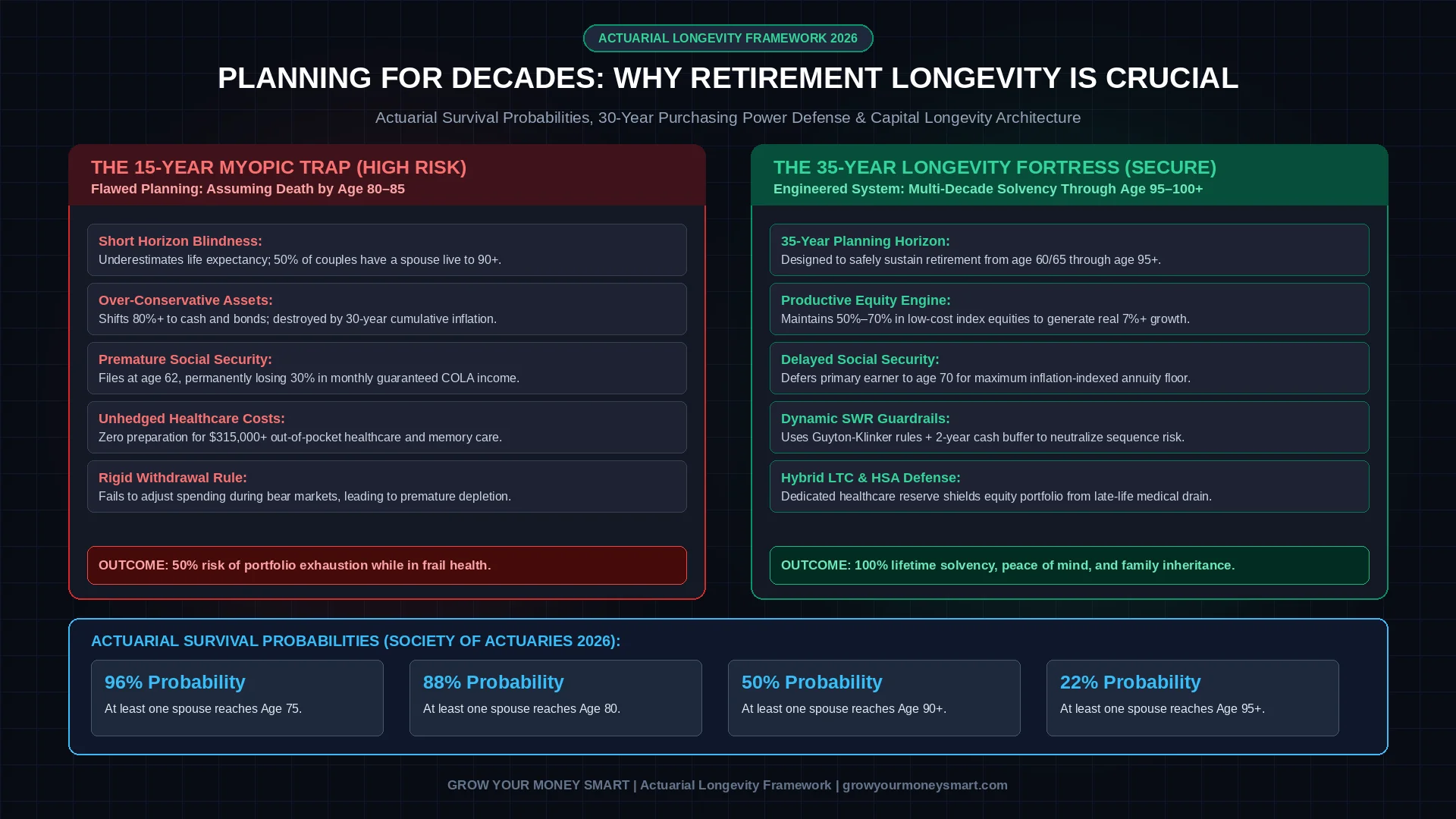
- The 90+ Actuarial Reality: According to the Society of Actuaries, 50% of healthy 65-year-old couples will have at least one spouse reach Age 90+, and 22% reach Age 95+. Planning for a 15-year retirement creates severe risk of outliving your money.
- Inflation is the Real Assassin: Over a 30-year horizon, a 3.5% inflation rate destroys 64% of purchasing power. Cash and fixed annuities cannot survive without a productive equity growth engine.
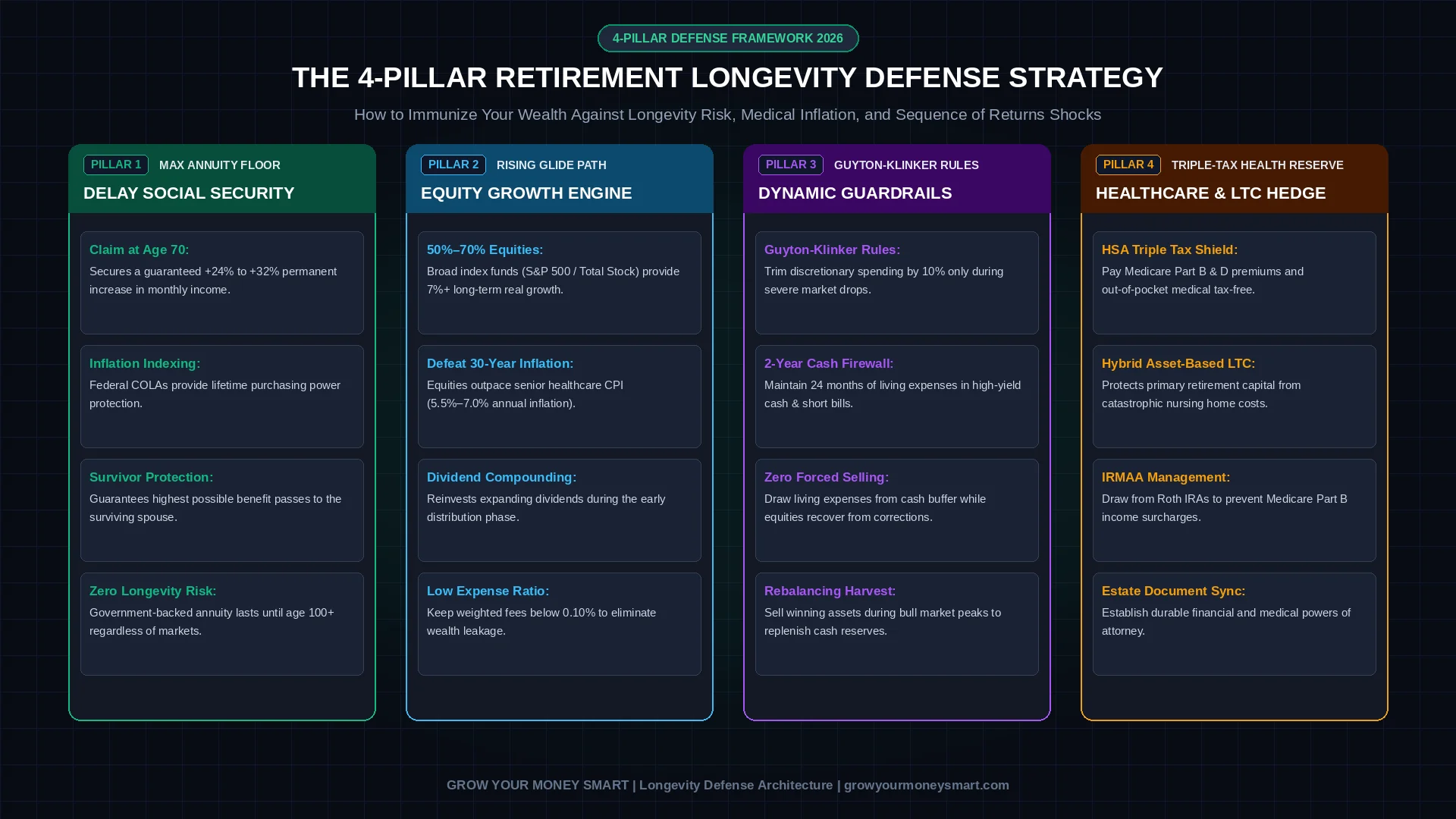
- The 4-Pillar Longevity Defense: Delaying Social Security to age 70 (+24%–32% boost), maintaining a 50%–70% equity allocation, executing dynamic Guyton-Klinker guardrails, and pre-funding healthcare reserves guarantee lifetime solvency.
- Sequence Risk Buffer: Maintaining a 2-year cash liquidity firewall prevents forced selling of equities during deep market drawdowns.
In traditional retirement planning, individuals spend decades obsessing over their “Retirement Number”—the lump sum balance they hope to accumulate by the day they stop working. Yet, the single greatest mathematical and existential risk facing modern retirees is not market volatility or bear market corrections; it is Longevity Risk—the very real statistical probability of outliving your accumulated wealth.
Thanks to advances in cardiovascular medicine, preventative healthcare, and lifestyle hygiene, modern retirees are living longer, healthier, and more active lives than any preceding generation. However, a longer lifespan transforms a standard 15-year retirement into a 30- to 35-year multi-decade distribution marathon. To evaluate your baseline living overhead and simulate your personal debt-free timeline, explore our Debt Payoff Calculator and Household Budget Calculator.
The Actuarial Reality: Why “Average Life Expectancy” is a Dangerous Trap
One of the most catastrophic mistakes savers make is anchoring their financial plan to broad population statistics. The Centers for Disease Control (CDC) reports an average U.S. life expectancy of approximately 78 years. However, this figure includes infant mortality and premature deaths across the general population. Once an individual successfully reaches Age 65 in good health, the actuarial math shifts dramatically.
According to empirical data from the Society of Actuaries (SOA) for a healthy 65-year-old married couple:
• 96% Probability: At least one spouse will survive to Age 75.
• 88% Probability: At least one spouse will survive to Age 80.
• 73% Probability: At least one spouse will survive to Age 85.
• 50% Probability (1 in 2 chance): At least one spouse will survive past Age 90.
• 22% Probability (Nearly 1 in 4 chance): At least one spouse will survive past Age 95.
If you construct a financial plan designed to last only until age 80 or 85, you are accepting a 50% probability of running completely out of money during the most physically frail, vulnerable, and expensive decade of your life. Examining how retirement is viewed across different cultures—especially in Blue Zones and societies like Japan where purposeful longevity is culturally normalized—reveals why preparing for a 30- to 35-year retirement horizon is mandatory. Understand how your time horizon dictates proper asset allocation by exploring our master guide on Investment Time Horizons.
Head-to-Head Comparison: The 15-Year Myopic Plan vs. 35-Year Longevity Fortress
The table below contrasts conventional short-horizon retirement assumptions against an engineered multi-decade longevity fortress:
| Strategic Metric | The 15-Year Myopic Plan (High Risk) | The 35-Year Longevity Fortress (Secure) | Core Financial Advantage |
|---|---|---|---|
| Planning Horizon | Assumes death by Age 80–83 | Engineered through Age 95–100+ | Eliminates late-life insolvency risk |
| Equity Allocation | Dumps equities for 80% cash/bonds | Maintains 50%–70% broad index equities | Compounds capital faster than inflation |
| Social Security Strategy | Files early at 62 (permanent 30% cut) | Delays primary earner to 70 (+24%–32% boost) | Secures guaranteed, inflation-indexed annuity |
| Withdrawal Protocol | Rigid static dollar draw (e.g. 5%+) | Dynamic Guyton-Klinker guardrails (4% base) | Prevents sequence of returns capital depletion |
| Healthcare Defense | Pays out-of-pocket from taxable checking | Triple-tax HSA + Hybrid Asset-Based LTC | Shields core investment principal from medical drain |
| Multi-Decade Result | Capital exhausted around Age 85–87 | 100% Solvency + Multigenerational Inheritance | Complete lifetime peace of mind |
30-Year Quantitative Simulation: Static Withdrawal Depletion vs. Longevity Survival
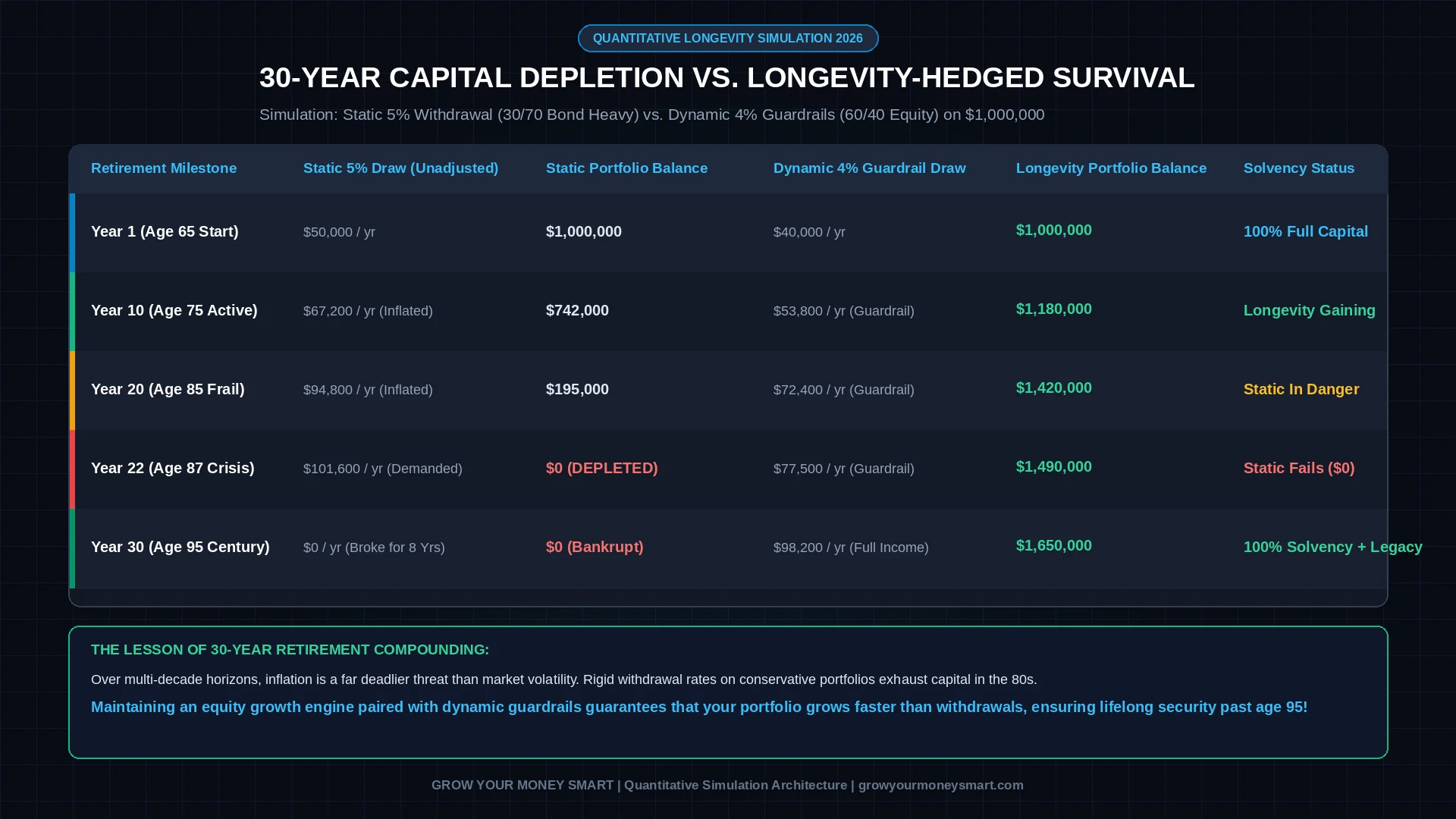
To see how longevity dynamics unfold over 30 years, consider a starting portfolio of $1,000,000 at Age 65 under two contrasting strategies: a static 5.0% withdrawal rate with a conservative 30/70 stock/bond split vs. a dynamic 4.0% Guyton-Klinker guardrail strategy paired with a 60/40 equity growth engine (assuming historical 3.5% inflation and average real market returns):
| Retirement Milestone | Static 5% Draw (Unadjusted) | Static Portfolio Balance | Dynamic 4% Guardrail Draw | Longevity Portfolio Balance | Survival Status |
|---|---|---|---|---|---|
| Year 1 (Age 65) | $50,000 / yr | $1,000,000 | $40,000 / yr | $1,000,000 | 100% Capital Parity |
| Year 10 (Age 75) | $67,200 / yr (Inflated) | $742,000 | $53,800 / yr (Guardrail) | $1,180,000 | Longevity Engine Gaining |
| Year 20 (Age 85) | $94,800 / yr (Inflated) | $195,000 | $72,400 / yr (Guardrail) | $1,420,000 | Static in Severe Danger |
| Year 22 (Age 87) | $101,600 / yr (Demanded) | $0 (DEPLETED) | $77,500 / yr (Guardrail) | $1,490,000 | Static Fails ($0 Broke) |
| Year 30 (Age 95) | $0 / yr (Broke for 8 Yrs) | $0 (Bankrupt) | $98,200 / yr (Full Income) | $1,650,000 (Legacy) | 100% Lifetime Solvency |
The mathematical lesson is definitive: over a multi-decade span, cumulative inflation is a far deadlier threat than short-term stock market volatility. A rigid withdrawal schedule on a low-equity portfolio runs completely out of money by Age 87. Conversely, an equity-backed dynamic strategy grows from $1,000,000 to $1,650,000 while delivering rising cash flow. Learn how to progress through each wealth milestone by exploring our guide on the 5 Stages of Retirement Planning.
The 4-Pillar Master Strategy for Multi-Decade Longevity Defense
To guarantee that your wealth endures through your 90s and beyond, implement these four actuarially proven strategic pillars:
Pillar 1: Maximize Your Guaranteed Social Security Floor (Delay to 70)
Social Security is the only asset available to everyday investors that offers a government-backed, lifetime, inflation-indexed annuity. For every year you delay claiming past Full Retirement Age (67) up to age 70, your benefit increases by a guaranteed 8% real annual return. Delaying the primary earner’s benefit locks in the maximum possible survivor benefit for the surviving spouse, providing an untouchable income floor even if one partner lives to age 100.
Pillar 2: Maintain a Productive Equity Growth Engine (50%–70% Stocks)
Conventional advice to “hold your age in bonds” is obsolete in an era of extended longevity. To defeat 30 years of compounding inflation—especially senior healthcare inflation inflating at 5.5% to 7.0%+ annually—you must maintain a productive growth engine. Allocating 50% to 70% of your long-term portfolio to broad-market index funds (such as the S&P 500 or Total Stock Market) ensures your principal continues to expand throughout your 60s, 70s, and 80s.
Pillar 3: Implement Dynamic Guyton-Klinker Withdrawal Guardrails
Never rely on a rigid withdrawal amount. Deploy Guyton-Klinker dynamic rules: during market expansion years, take standard cost-of-living increases; during severe market downturns, trim discretionary distributions by 10%. Pair this with a 2-year cash liquidity buffer ($30,000 to $60,000 in an FDIC-insured high-yield savings account) so you never sell depressed equities during market corrections. Protect your reserves using our Emergency Fund Calculator.
Pillar 4: Pre-Fund Healthcare & Hybrid Long-Term Care (LTC)
Fidelity estimates that an average 65-year-old couple will require over $315,000 in out-of-pocket healthcare costs, excluding nursing home care. Maximize Health Savings Accounts (HSAs) during working years to establish a dedicated, triple-tax-free medical buffer. Furthermore, consider hybrid asset-based Long-Term Care insurance policies, which provide tax-free nursing benefits if needed, but return the capital to your heirs if unused.
Expert Video Walkthrough: Quantitative Longevity & Withdrawal Math
To see how 30-year withdrawal rates, Social Security floors, and inflation dynamics interact mathematically, watch this detailed walkthrough by retirement educator The Money Guy Show:
2025/2026 Statutory Updates & SECURE 2.0 Longevity Provisions
Federal legislation under the SECURE 2.0 Act introduced critical updates designed specifically to support extended longevity:
• Delayed Required Minimum Distributions (RMDs): The mandatory RMD age is established at Age 73 (increasing to Age 75 in 2033). This gives savers more time to execute strategic Roth conversions before forced taxable withdrawals begin.
• Elimination of Roth 401(k) RMDs: Designated Roth accounts in workplace 401(k) and 403(b) plans are now completely exempt from pre-death RMDs, matching Roth IRA treatment.
• SECURE 2.0 “Super Catch-Up” (Ages 60–63): Elevates the catch-up contribution threshold to $11,250 for workers aged 60 through 63 in 401(k), 403(b), and 457(b) plans.
• Higher Qualified Longevity Annuity Contract (QLAC) Limits: Individuals can allocate up to $200,000 from retirement accounts into a QLAC, deferring annuity income up to Age 85 without violating RMD rules.
• Health Savings Account (HSA) Limits: Contribution limits are $4,300 for individual and $8,550 for family coverage ($4,400 and $8,750 respectively in 2026), plus an extra $1,000 catch-up for age 55+.
Frequently Asked Questions (FAQs)
Below are clear, mathematically grounded answers to the most common questions regarding retirement longevity risk:
Longevity risk is the statistical probability that you will outlive your accumulated retirement savings. According to the Society of Actuaries, 50% of healthy 65-year-old married couples will have at least one spouse survive past age 90, meaning portfolios must be engineered to endure 30 to 35+ years.
Life expectancy statistics represent a statistical median (the 50th percentile). Planning your portfolio to last only to age 83 or 85 gives you a 50% chance of running completely out of money in your late 80s or 90s when medical needs and physical vulnerability are at their peak.
Delaying Social Security past Full Retirement Age to age 70 earns an 8% annual guaranteed real increase (plus federal COLAs), locking in a permanently higher, government-backed inflation-indexed income stream that lasts until age 100+ regardless of stock market performance.
While bonds and cash dampen short-term market volatility, they cannot overcome multi-decade inflation decay. Over 30 years at 3.5% inflation, cash loses 64% of its purchasing power. Maintaining a 50%–70% allocation to broad-market index equities provides the compound growth needed to sustain 30+ years of withdrawals.
Guyton-Klinker guardrails are a set of rules that adjust retirement spending based on portfolio performance. If the portfolio suffers a severe bear market drop, withdrawals are trimmed by 10% for non-discretionary spending. This prevents selling depressed assets and extends portfolio survival indefinitely.
Fidelity estimates that an average 65-year-old couple needs approximately $315,000 to $330,000 for out-of-pocket medical expenses in retirement, not including long-term nursing care. Pre-funding HSAs and securing hybrid asset-based LTC policies prevents liquidating equity investments during market bottoms.
Under the SECURE 2.0 Act, the mandatory RMD starting age was raised to age 73 (and will increase to age 75 in 2033). This allows retirement accounts to compound tax-deferred for additional years before mandatory distributions begin.
Holding 24 months of essential living expenses in a High-Yield Savings Account allows retirees to fund their lifestyle entirely from cash during severe bear markets, giving equities 2 to 3 years to rebound without experiencing permanent capital destruction.
⚡ Longevity & Wealth Preservation Blueprints
Protect your multi-decade retirement horizon with these essential asset protection guides:
- Estate Protection: Explore our guide on 4 essential legal documents for retirement planning to legally safeguard your assets over multi-decade spans.
- Healthcare Planning: Explore our guide on managing healthcare and Medicare gap expenses to prevent unexpected medical bills from eroding your principal.
- Foundational Blueprint: Explore our guide on comprehensive retirement planning master guide to review the core financial pillars of a secure future.
Final Verdict: Engineering Financial Peace of Mind That Outlives You
Living a long, fulfilling life should be celebrated as a profound victory, not feared as a financial disaster. By moving beyond outdated, short-horizon retirement models and adopting a structured multi-decade longevity architecture, you ensure that your capital endures as long as you do. Maximize your guaranteed Social Security floor, maintain an equity compounding engine, protect your reserves with dynamic guardrails, and secure your family’s future with complete confidence.

Jaiveer Hooda is the Lead Financial Researcher & Personal Finance Analyst at Grow Your Money Smart. Specializing in personal wealth optimization, index fund compounding, high-yield savings mechanics, and consumer debt elimination strategies. With a background in computer engineering, he applies mathematical modeling, cashflow simulations, and empirical risk analysis to evaluate personal finance vehicles and credit products. Every analysis is backed by verified regulatory disclosures, IRS tax schedules, and empirical APY compounding math.
Areas of Expertise: Personal Finance · High-Yield Savings Accounts (HYSA) · Index Funds & S&P 500 Compounding · Retirement Planning (401k/IRA) · Debt Optimization · Credit Card APR Mechanics.
Transparency & Editorial Policy: Editorial Standards | Report a Correction
1 thought on “Planning for Decades: Why Retirement Longevity is Crucial”