
Learning how to max out 401(k) and Roth IRA in 2026 is the single most powerful strategy for building multi-generational wealth and achieving complete financial independence. If you have legacy accounts from previous employers, learn how to rollover a 401(k) to an IRA cleanly without triggering taxes or penalties. For high-income earners and disciplined savers alike, fully utilizing both tax-advantaged accounts creates an impenetrable financial fortress, slashing current income taxes while generating millions of dollars in 100% tax-free retirement growth.
- 2026 Maximum Limits: The IRS employee elective deferral for 401(k) plans is $24,500. The Roth IRA contribution limit is $7,500. Combined annual total: $32,000 (under age 50).
- Catch-Up Power: Savers age 50+ can contribute an extra $8,000 to their 401(k) and $1,100 to their Roth IRA (totaling $41,100). Ages 60–63 get the enhanced $11,250 super catch-up.
- Financial Order of Operations: 1) 401(k) up to employer match → 2) Max out Roth IRA ($7,500) → 3) Max out remaining 401(k) ($24,500 total) → 4) Mega Backdoor Roth or Taxable Brokerage.
- Monthly Budget Target: Maxing out both accounts requires saving $2,666.67 per month ($942.31 401k + $288.46 Roth IRA bi-weekly).
- 30-Year Compounding Result: Contributing $32,000 annually at an 8% average return grows into a staggering $4,910,230 nest egg.
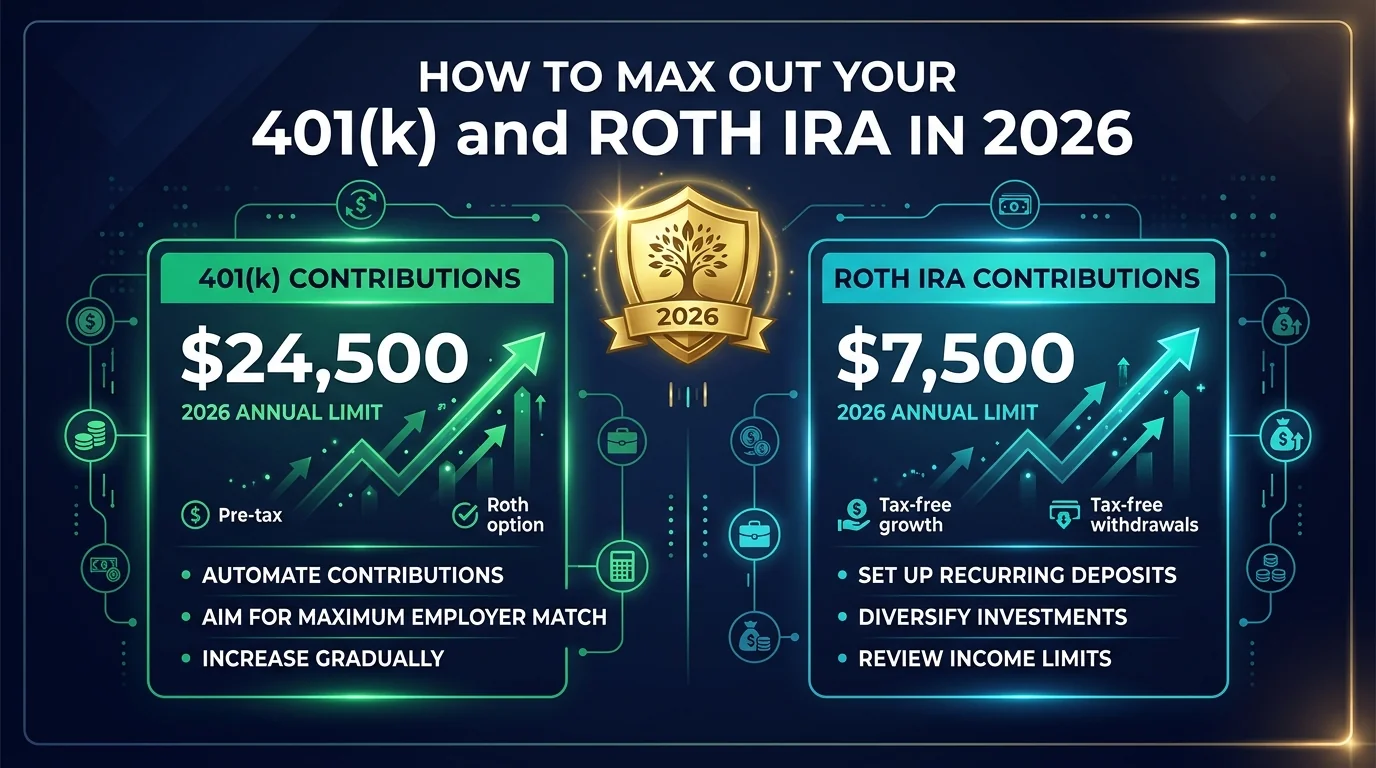
How to Max Out 401(k) and Roth IRA in 2026: The Official Contribution Limits
Each year, the Internal Revenue Service adjusts retirement account thresholds under cost-of-living adjustments (COLA). For the 2026 tax year, the IRS has expanded contribution caps across both employer-sponsored plans and individual retirement arrangements. Knowing these exact thresholds is crucial to optimizing your tax liability and building a multi-decade investment time horizon.
1. The 401(k), 403(b), and 457(b) Limits for 2026
For 2026, the employee elective deferral limit is set at $24,500. This applies across pre-tax Traditional 401(k) and after-tax Roth 401(k) employee deferrals combined. If your company offers an employer match or profit-sharing contribution, the total combined Section 415(c) plan limit jumps to $72,000 (or $80,000+ for catch-up eligible savers).
Crucially, under the SECURE 2.0 Act, two pivotal rules govern 2026 contributions:
- Enhanced Super Catch-Up (Ages 60–63): Workers aged 60, 61, 62, and 63 can contribute a special catch-up amount of $11,250 instead of the standard $8,000 catch-up, allowing an elective deferral of up to $35,750.
- High-Earner Mandatory Roth Catch-Up Rule: If your prior-year FICA wages from your employer exceeded $150,000, all age-50+ catch-up contributions must be directed into a designated Roth account, eliminating the upfront pre-tax deduction for catch-up dollars.
2. The 2026 Roth IRA & Traditional IRA Limits
The 2026 individual retirement account (IRA) contribution ceiling is $7,500 for savers under age 50, with a catch-up allowance of $1,100 for those age 50 and older (totaling $8,600). This limit is shared across all Traditional and Roth IRAs under your name.
Unlike 401(k)s, direct contributions to a Roth IRA are governed by strict Modified Adjusted Gross Income (MAGI) phase-outs. When designing your financial strategy across the stages of the retirement plan lifecycle, keeping within or navigating around these brackets determines your eligibility.
| Filing Status | Full Contribution (MAGI) | Phase-Out Range (Partial) | Direct Contribution Ineligible |
|---|---|---|---|
| Single / Head of Household | Under $153,000 | $153,000 – $168,000 | $168,000 or more |
| Married Filing Jointly | Under $242,000 | $242,000 – $252,000 | $252,000 or more |
| Married Filing Separately | $0 | $0 – $10,000 | $10,000 or more |
Head-to-Head Comparison: 401(k) vs Roth IRA
While both accounts allow your investments to grow free of annual dividend and capital gains taxes, their structural rules, withdrawal flexibilities, and tax mechanisms differ significantly. The table below provides a comprehensive architectural breakdown:
| Feature / Dimension | Traditional 401(k) | Roth 401(k) | Roth IRA |
|---|---|---|---|
| 2026 Contribution Limit | $24,500 ($32,500 if 50+) | $24,500 ($32,500 if 50+) | $7,500 ($8,600 if 50+) |
| Tax Treatment | Pre-tax dollars (reduces current taxable income) | Post-tax dollars (no upfront deduction) | Post-tax dollars (no upfront deduction) |
| Withdrawal Taxation | Taxed as ordinary income at retirement | 100% Tax-Free qualified distributions | 100% Tax-Free qualified distributions |
| Income Eligibility Caps | None (available to all eligible employees) | None (no income caps) | Phased out at $153k-$168k (Single) / $242k-$252k (Married) |
| Early Contribution Access | Restricted; 10% penalty + tax prior to 59½ | Pro-rata ordering rules apply | 100% penalty-free & tax-free access to principal anytime |
| Required Minimum Distributions (RMDs) | Yes (begins age 73/75) | Eliminated by SECURE 2.0 (No RMDs) | Zero RMDs for the original owner’s lifetime |
| Investment Choices | Curated employer menu (~15–30 mutual funds) | Curated employer menu (~15–30 mutual funds) | Virtually unlimited (stocks, index ETFs, REITs, bonds) |
| Annual Admin Fees | Plan admin & recordkeeper fees (0.20%–1.50%) | Plan admin & recordkeeper fees (0.20%–1.50%) | $0 at major discount brokerages (Fidelity, Schwab, Vanguard) |
The Mathematical Compounding Power of Maxing Out Both ($32,000/Year)
What happens when you systematically invest $32,000 every year ($24,500 into your 401(k) and $7,500 into your Roth IRA)? Because your money compounds entirely shielded from annual drag, long-term returns accelerate exponentially. Calculating your monthly cash flow with a reliable budgets calculator ensures you stay on track throughout every market cycle.
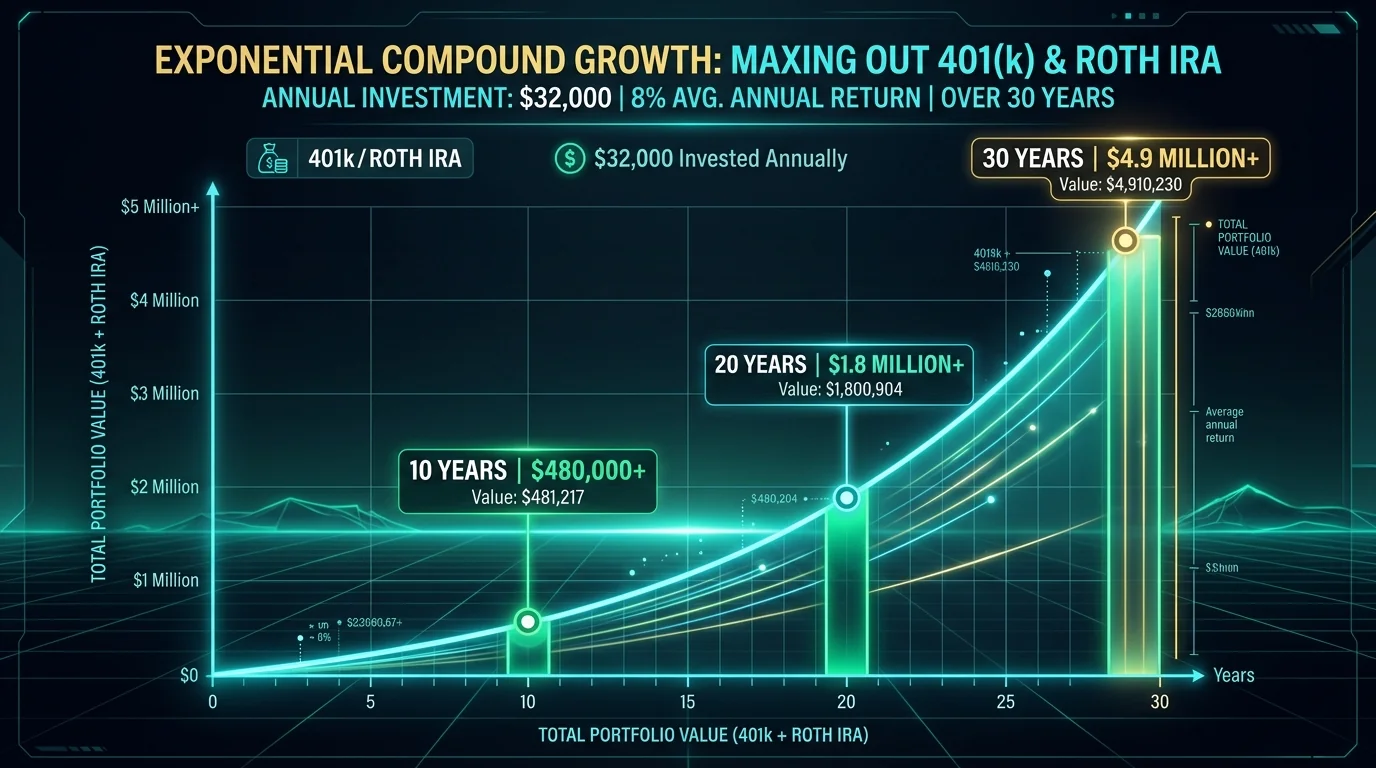
| Timeline | Total Principal Invested | Conservative Growth (6% APY) | Historical Average (8% APY) | Aggressive Growth (10% APY) |
|---|---|---|---|---|
| 5 Years | $160,000 | $180,394 | $193,169 | $206,901 |
| 10 Years | $320,000 | $421,786 | $481,217 | $551,326 |
| 15 Years | $480,000 | $744,834 | $904,496 | $1,106,317 |
| 20 Years | $640,000 | $1,176,515 | $1,800,904 | $1,999,996 |
| 25 Years | $800,000 | $1,753,589 | $2,528,784 | $3,440,094 |
| 30 Years | $960,000 | $2,529,862 | $4,910,230 | $5,782,192 |
Notice the staggering math: Over 30 years, out of a total $4.91 Million portfolio, your out-of-pocket contributions account for only $960,000—while pure compound growth generates $3,950,230 in pure investment gains! Furthermore, because roughly a quarter of that balance sits in a Roth IRA, you hold over $1.15 Million in 100% tax-exempt capital upon retirement.
The Strategic Financial Order of Operations: Step-by-Step Blueprint
Attempting to max out both accounts simultaneously without a systematic cash flow plan can leave you cash-strapped or misallocating tax benefits. Follow this battle-tested 5-step allocation priority:
Step 1: Capture 100% of Employer 401(k) Match (Free 50%–100% ROI)
Never skip free money. If your employer offers a 50% match up to 6% of your salary, contributing 6% generates an instant, guaranteed 50% return on day one. Before putting a single penny into any secondary retirement vehicle, establish payroll deferrals to unlock your full corporate match.
Step 2: Eliminate High-Interest Debt & Secure Liquid Reserves
Credit card balances charging 20% to 28% APR will destroy your compounding wealth faster than the stock market can generate returns. Use our proven debt payoff calculator to systematically wipe out toxic liabilities. Simultaneously, park 3 to 6 months of living expenses in an FDIC-insured account using our emergency fund calculator so you never need to make premature retirement withdrawals.
Step 3: Max Out Your Roth IRA ($7,500 in 2026)
Once your employer match is secured and high-interest debt is eliminated, shift your focus to filling your Roth IRA to the $7,500 limit ($8,600 if 50+). Why prioritize the Roth IRA over the remaining 401(k) space? Three decisive reasons:
- Zero Expense Ratios: You can invest in total market index funds with ultra-low expense ratios (0.00%–0.03%) at brokerages like Fidelity or Schwab, bypassing expensive 401(k) plan administration fees.
- Penalty-Free Principal Liquidity: Your original contributions can be withdrawn at any time without taxes or early withdrawal penalties if an unavoidable emergency strikes.
- Tax Diversification: Locking in tax-free future withdrawals shields you against future tax rate hikes. If you are debating whether to manage your investments yourself or hire help, review our guide on DIY investing vs hiring a financial advisor.
Step 4: Return to 401(k) and Fill Remaining Space ($24,500 Total)
After your Roth IRA is fully funded for the year, return to your employer portal and increase your elective payroll deferral percentage until your total 401(k) contributions hit the $24,500 cap. If you are in the 24%, 32%, or 35% federal tax bracket, channeling these contributions into a Traditional 401(k) generates immediate tax savings of $5,880 to $8,575 on your 2026 tax return.
Step 5: Unlock the Mega Backdoor Roth or Taxable Brokerage
If you have successfully maxed out $24,500 in your 401(k) and $7,500 in your Roth IRA and still have surplus cash flow, investigate whether your employer 401(k) plan offers After-Tax Non-Roth contributions with in-service distributions (The “Mega Backdoor Roth”). This advanced strategy lets high earners funnel up to the $72,000 total Section 415(c) limit in tax-free Roth growth.
Payroll Deferral Math: How Much to Save Per Paycheck
The most reliable way to hit both maximum limits without feeling a year-end squeeze is automatic dollar-cost averaging. Breaking the $32,000 annual target down by payroll schedule prevents late-year cash crunches. If you are starting on a modest budget, learn foundational saving steps in our guide on how to save your first $1,000 or optimize your monthly allocation with our $3,000 monthly income budget guide.
| Pay Frequency | 401(k) Target ($24,500) | Roth IRA Target ($7,500) | Total Savings Per Paycheck |
|---|---|---|---|
| Monthly (12 Pay Periods) | $2,041.67 / mo | $625.00 / mo | $2,666.67 / mo |
| Semi-Monthly (24 Pay Periods) | $1,020.83 / pay | $312.50 / pay | $1,333.33 / pay |
| Bi-Weekly (26 Pay Periods) | $942.31 / pay | $288.46 / pay | $1,230.77 / pay |
| Weekly (52 Pay Periods) | $471.15 / week | $144.23 / week | $615.38 / week |
High-Income Workaround: The Backdoor Roth IRA Blueprint
If your Modified Adjusted Gross Income exceeds $168,000 as a single filer or $252,000 as a married couple, IRS regulations prohibit direct Roth IRA contributions. However, high-income professionals routinely bypass this barrier using the legally sanctioned Backdoor Roth IRA strategy.
How to Execute a Backdoor Roth IRA in 4 Steps:
- Open Accounts: Establish both a Traditional IRA and a Roth IRA at the same brokerage (such as Fidelity, Charles Schwab, or Vanguard).
- Make a Non-Deductible Contribution: Deposit $7,500 (or $8,600 if 50+) into the Traditional IRA. Specify that this contribution is non-deductible on your tax filings.
- Convert to Roth IRA: Once the cash settles (typically 1 to 2 business days), initiate a transfer/conversion of the entire balance into your Roth IRA. Do not invest the cash in the Traditional IRA while waiting for the conversion to prevent short-term taxable gains.
- File IRS Form 8606: When filing your annual tax return, submit IRS Form 8606 to track your non-deductible basis and prove to the IRS that the converted funds are non-taxable.
If you hold existing pre-tax money in any Traditional IRA, SEP IRA, or SIMPLE IRA on December 31st of the conversion year, the IRS treats all your IRAs as one collective account. The conversion will be taxed proportionally across pre-tax and after-tax assets. To avoid unexpected taxes, roll over any existing pre-tax Traditional IRA balances into your current employer’s 401(k) plan before initiating a Backdoor Roth conversion.
Expert Video Walkthrough: 401(k) vs Roth 401(k) vs Roth IRA Strategy
To see a visual financial modeling walkthrough on allocating your savings between traditional and Roth accounts, watch this master breakdown by personal finance educator Humphrey Yang:
Frequently Asked Questions (FAQs)
For the 2026 tax year, an individual under age 50 can contribute up to $24,500 into an employer-sponsored 401(k) and up to $7,500 into a Roth IRA (or Traditional IRA), creating a combined annual personal contribution ceiling of $32,000. Individuals aged 50 and older can contribute an additional $8,000 catch-up to their 401(k) and $1,100 catch-up to their Roth IRA, totaling $41,100 annually. For those ages 60 to 63, the SECURE 2.0 super catch-up raises the 401(k) catch-up to $11,250.
The optimal financial order of operations is: 1) Contribute enough to your 401(k) to capture 100% of your employer matching dollars (an immediate guaranteed 50% to 100% return). 2) Max out your Roth IRA ($7,500 in 2026) to benefit from broader investment choices, zero administrative fees, and tax-free withdrawals in retirement. 3) Return to your 401(k) to max out the remaining elective deferral balance up to $24,500.
For 2026, single filers can make a full Roth IRA contribution if their Modified Adjusted Gross Income (MAGI) is under $153,000, phasing out between $153,000 and $168,000. For married couples filing jointly, the phase-out range is $242,000 to $252,000. If your income exceeds these limits, you cannot contribute directly, but you can utilize the legal Backdoor Roth IRA strategy.
A Backdoor Roth IRA is a two-step process: 1) Make a non-deductible contribution to a traditional IRA (up to $7,500 in 2026). 2) Immediately convert those funds into a Roth IRA before any investment growth occurs. Because non-deductible contributions are made with after-tax money, the conversion is tax-free, provided you have no existing pre-tax balances in traditional, SEP, or SIMPLE IRAs subject to the IRS pro-rata rule.
Under the SECURE 2.0 Act, starting in 2026, employees whose FICA wages from the same employer exceeded $150,000 in the prior tax year must make all age-50+ catch-up contributions (up to $8,000 or $11,250 for ages 60-63) to a Roth (after-tax) account within their employer plan, rather than a pre-tax traditional 401(k).
The Mega Backdoor Roth allows workers whose 401(k) plans permit after-tax non-Roth contributions and in-service distributions to shelter up to the overall Section 415(c) limit ($72,000 in 2026). After contributing the employee elective deferral of $24,500 and receiving employer matches, you contribute additional post-tax dollars and convert them immediately to a Roth 401(k) or Roth IRA.
To max out both a 401(k) ($24,500) and a Roth IRA ($7,500) in 2026 ($32,000 total), you must save $2,666.67 per month. On a bi-weekly payroll schedule (26 pay periods), this equates to $942.31 per paycheck toward your 401(k) and $288.46 per paycheck toward your Roth IRA (totaling $1,230.77 per pay period).
With a Roth IRA, you can withdraw your original direct contributions at any time, for any reason, with zero taxes and zero penalties. Earnings withdrawn before age 59½ and before 5 years of account seasoning are subject to taxes and a 10% penalty, with exceptions for qualified first-time home purchases ($10,000) and education. Traditional 401(k) early withdrawals trigger ordinary income tax plus a 10% penalty unless using specific exceptions like the Rule of 55, 72(t) SEPP distributions, or plan loans.
⚡ Next-Level Retirement Optimization & Target Guides
Take your retirement savings beyond standard workplace accounts with these strategic resources:
- Tax Vehicle Showdown: Explore our guide on Traditional IRA vs Roth IRA tax strategy guide to decide where to allocate your secondary retirement dollars.
- Retiring Early at 60 Target: Explore our guide on retiring early at age 60 savings targets to see whether maxing both accounts provides sufficient capital by 60.
- Three-Legged Income Framework: Explore our guide on multi-tier retirement income architecture integrating Social Security and personal taxable investments.
Final Action Checklist to Max Out Both Accounts in 2026
- Log Into Employer Payroll Portal: Set your 401(k) elective deferral to automatically hit $24,500 across your remaining paychecks ($942.31/bi-weekly).
- Automate Monthly Roth IRA Transfers: Set up a recurring $625.00 monthly deposit ($288.46 bi-weekly) into your brokerage Roth IRA.
- Verify Income Phase-Out Status: If your MAGI approaches $153,000 (Single) or $242,000 (Married), prep your accounts for a clean Backdoor Roth conversion.
- Review Asset Allocation: Direct your retirement contributions toward diversified broad-market index funds (Total US Stock Market, S&P 500, and International equities) to maximize compound growth.
- Rebalance Annually: Conduct a yearly review to adjust for new IRS limits, tax law updates, and career milestones.
The IRS updates annual elective deferral limits for 401(k), 403(b), and Individual Retirement Arrangements based on cost-of-living adjustments. Consult the official Internal Revenue Service (IRS) Annual IRA and 401(k) Contribution Limits for statutory guidelines and consumer protections.
🏡 Real Estate Down Payments, Budgeting Systems & Next Steps
Coordinate your retirement account contributions with other major life milestones and cash flow strategies:
- Housing vs Retirement: house deposit vs retirement fund savings strategy — determine whether to pause retirement investing to save for a home deposit.
- Advanced Budgeting: smart budgeting strategies for 2026 — optimize daily cash flow to hit maximum annual 401(k) and IRA limits.
- Down Payment Savings: how to save for a house down payment fast — keep short-term capital protected in high-yield vehicles.
- Master Spreadsheet: free monthly budget spreadsheet and net worth tracker — track monthly contributions and net worth trajectory.

Jaiveer Hooda is the Lead Financial Researcher & Personal Finance Analyst at Grow Your Money Smart. Specializing in personal wealth optimization, index fund compounding, high-yield savings mechanics, and consumer debt elimination strategies. With a background in computer engineering, he applies mathematical modeling, cashflow simulations, and empirical risk analysis to evaluate personal finance vehicles and credit products. Every analysis is backed by verified regulatory disclosures, IRS tax schedules, and empirical APY compounding math.
Areas of Expertise: Personal Finance · High-Yield Savings Accounts (HYSA) · Index Funds & S&P 500 Compounding · Retirement Planning (401k/IRA) · Debt Optimization · Credit Card APR Mechanics.
Transparency & Editorial Policy: Editorial Standards | Report a Correction