
Retirement planning is not a one-time static calculation—it is a multi-decade dynamic continuum that evolves through five distinct phases. Success requires systematically shifting your strategic focus from aggressive asset accumulation to sequence-of-returns defense, tax-efficient distribution, and legacy governance.
- Stage 1 (Ages 20s–40s – Accumulation): 90% Equities / 10% Cash. Maximize time in the market, capture employer 401(k) matches, automate Roth IRAs, and invest HSAs.
- Stage 2 (Ages 50s – Acceleration): 75% Equities / 25% Fixed. Leverage SECURE 2.0 catch-up limits ($11,250 super catch-up for ages 60–63) and eliminate non-mortgage liabilities.
- Stage 3 (Ages 60–65 – Transition “Red Zone”): 60% Equities / 40% Fixed. Build a 24-month cash/bond firewall, execute strategic pre-RMD Roth conversions, and map Medicare Part A/B/D.
- Stage 4 (Ages 65–75 – Active Distribution): 50% Equities / 50% Fixed. Execute dynamic 4% withdrawal guardrails and follow the tax-efficient waterfall (Taxable $ ightarrow$ Pre-tax $ ightarrow$ Roth).
- Stage 5 (Ages 75+ – Legacy & RMDs): 40% Equities / 60% Fixed. Manage statutory RMDs, utilize Qualified Charitable Distributions (QCDs), and activate hybrid Long-Term Care protections.
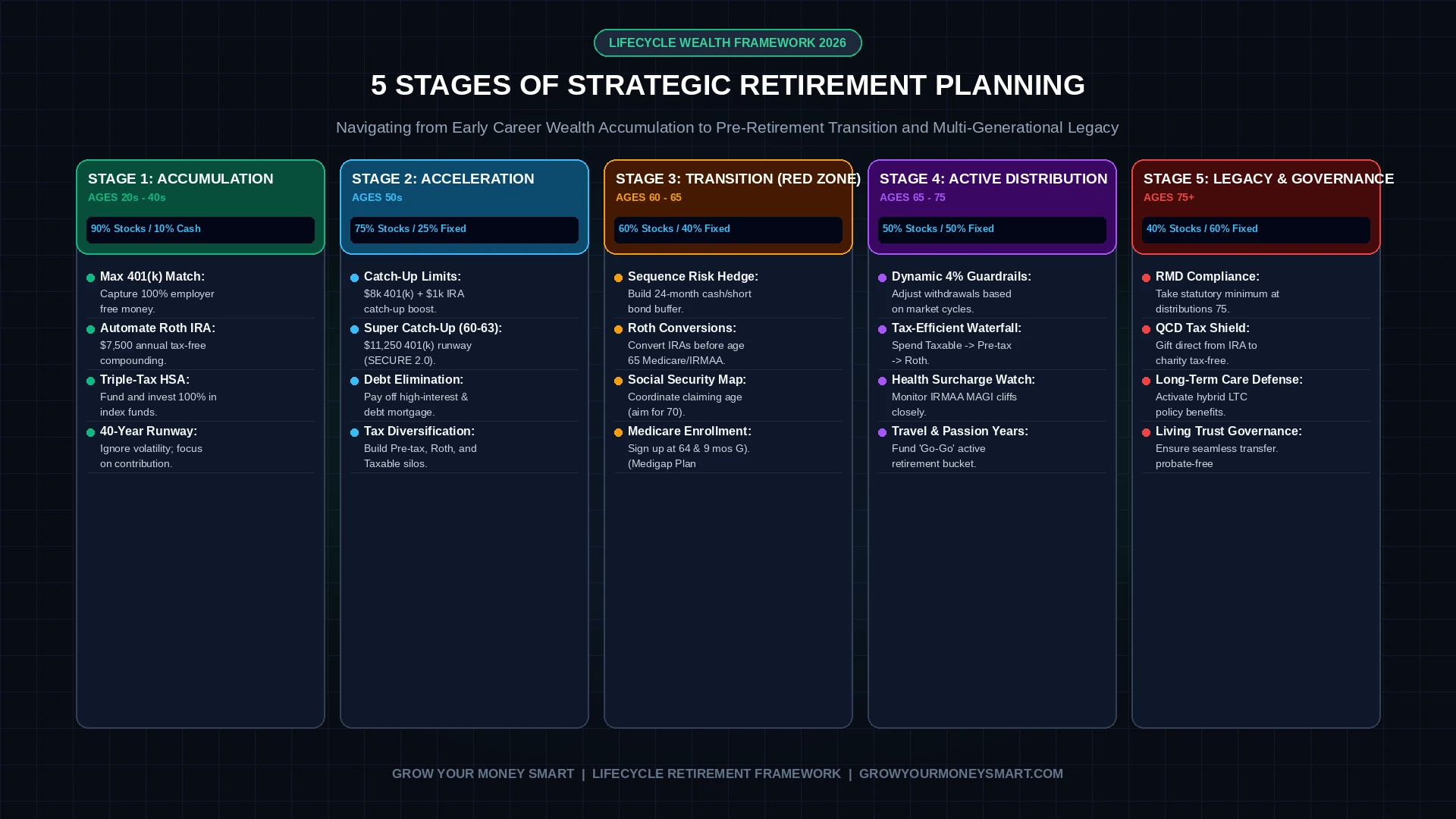
The Lifecycle Evolution: Why Retirement Planning Is a Five-Phase Continuum
Most everyday savers treat retirement planning as a single milestone: reach age 65, amass an arbitrary lump sum, and stop working. However, institutional wealth management reveals that retirement is an evolving five-stage lifecycle architecture. Each phase requires fundamentally different asset allocation models, tax strategies, risk mitigations, and legal safeguards.
An investment strategy that accelerates wealth in your 30s (such as 100% equity concentration with zero cash drag) becomes potentially catastrophic in your early 60s, where an unhedged market crash can trigger permanent Sequence of Returns Risk. Conversely, adopting an overly conservative bond-heavy posture in your 30s destroys hundreds of thousands of dollars in compound growth potential.
To construct an unshakeable roadmap, you must align your current chronological age and capital base with its corresponding lifecycle phase. To understand how your specific time horizon dictates portfolio volatility tolerance, review our foundational guide on Investment Time Horizons and audit your personal liquidity reserves with our Emergency Fund Calculator.
Stage 1: Early Career Accumulation & Compounding Engine (Ages 20s–40s)
The primary objective of Stage 1 is capital accumulation velocity. With a 25-to-45 year investment horizon ahead, your greatest asset is time. During this phase, daily market volatility and macroeconomic headlines are virtually irrelevant; your sole priority is maximizing recurring monthly contributions into diversified, low-cost broad-market equities.
- Asset Allocation Glide Path: 90% Growth Equities / 10% Cash Reserves. Maintain low-cost total stock market and S&P 500 index funds (e.g., VTI, VOO) paired with a 3-month cash buffer in an FDIC-insured High-Yield Savings Account.
- Priority Account Waterfall: 1. Capture 100% of employer 401(k) matching funds; 2. Maximize a Roth IRA ($7,000–$7,500/year); 3. Fully fund a triple-tax-advantaged Health Savings Account (HSA); 4. Direct excess cash flow to low-cost taxable brokerage index funds.
- The $150/Month Compounding Law: A 22-year-old contributing just $150 per month into index funds earning an 8% annualized return accumulates over $700,000+ by age 65, with nearly 90% of the total balance generated by compound growth rather than out-of-pocket savings. Explore our guide on how to start saving your first $1,000.
Stage 2: Peak Earnings Acceleration & Catch-Up Window (Ages 50s)
Stage 2 coincides with peak career earning power and declining household dependents. With 10 to 15 years remaining until retirement, the strategic objective transitions from pure asset accumulation to supercharged catch-up funding, debt eradication, and tax location diversification.
- Asset Allocation Glide Path: 75% Equities / 25% Fixed Income & Cash. Begin introducing short-to-intermediate duration Treasuries and dividend-growth assets to dampen volatility while preserving aggressive compounding momentum.
- SECURE 2.0 Catch-Up Optimization: Workers aged 50 and older can contribute an additional $7,500–$8,000 to their 401(k) ($23,500 base + $8,000 catch-up = $31,500 total in 2025/2026) and an extra $1,000 to their IRA. For savers aged 60 to 63, the SECURE 2.0 “Super Catch-Up” provision elevates the catch-up allowance to $11,250.
- Three-Bucket Tax Diversification: Build balance across all three IRS tax silos: Pre-Tax (Traditional 401k/IRA), After-Tax Tax-Free (Roth IRA / Roth 401k), and Taxable (Individual Brokerage). Having capital across all three buckets provides complete flexibility to engineer your tax bracket in retirement. Model your debt payoff trajectories using our Debt Payoff Calculator.
Stage 3: Pre-Retirement Transition & The “Red Zone” (Ages 60–65)
The 5 years immediately preceding retirement and the first 3 years of distributions represent the “Retirement Red Zone”. During this critical window, a severe equity bear market (such as 2008 or 2020) can inflict devastating Sequence of Returns Risk, permanently impairing your portfolio’s multi-decade survival probability if you are forced to sell depressed stocks to fund living expenses.
- Asset Allocation Glide Path: 60% Equities / 40% Fixed Income & Cash Buffer. Construct a dedicated 24-month cash and short-term Treasury buffer in a high-yield account. If the stock market drops 30%, you can live off your cash buffer for two full years without liquidating a single share of stock at a loss.
- Pre-65 Roth Conversion Windows: Between your career retirement date (when your W-2 wages drop to $0) and age 65 (Medicare enrollment lookback), execute systematic Roth conversions up to the 12% or 22% federal tax bracket. This shrinks future Required Minimum Distributions (RMDs) and avoids Medicare IRMAA surcharges.
- Social Security & Medicare Coordination: Map out your exact enrollment schedule. Enroll in Medicare Part A, Part B, and Medigap Plan G at age 64 and 9 months (Initial Enrollment Period) to prevent medical underwriting exclusions. Strategically delay Social Security toward age 70 for the higher earner to lock in the maximum 24% delayed retirement credit.
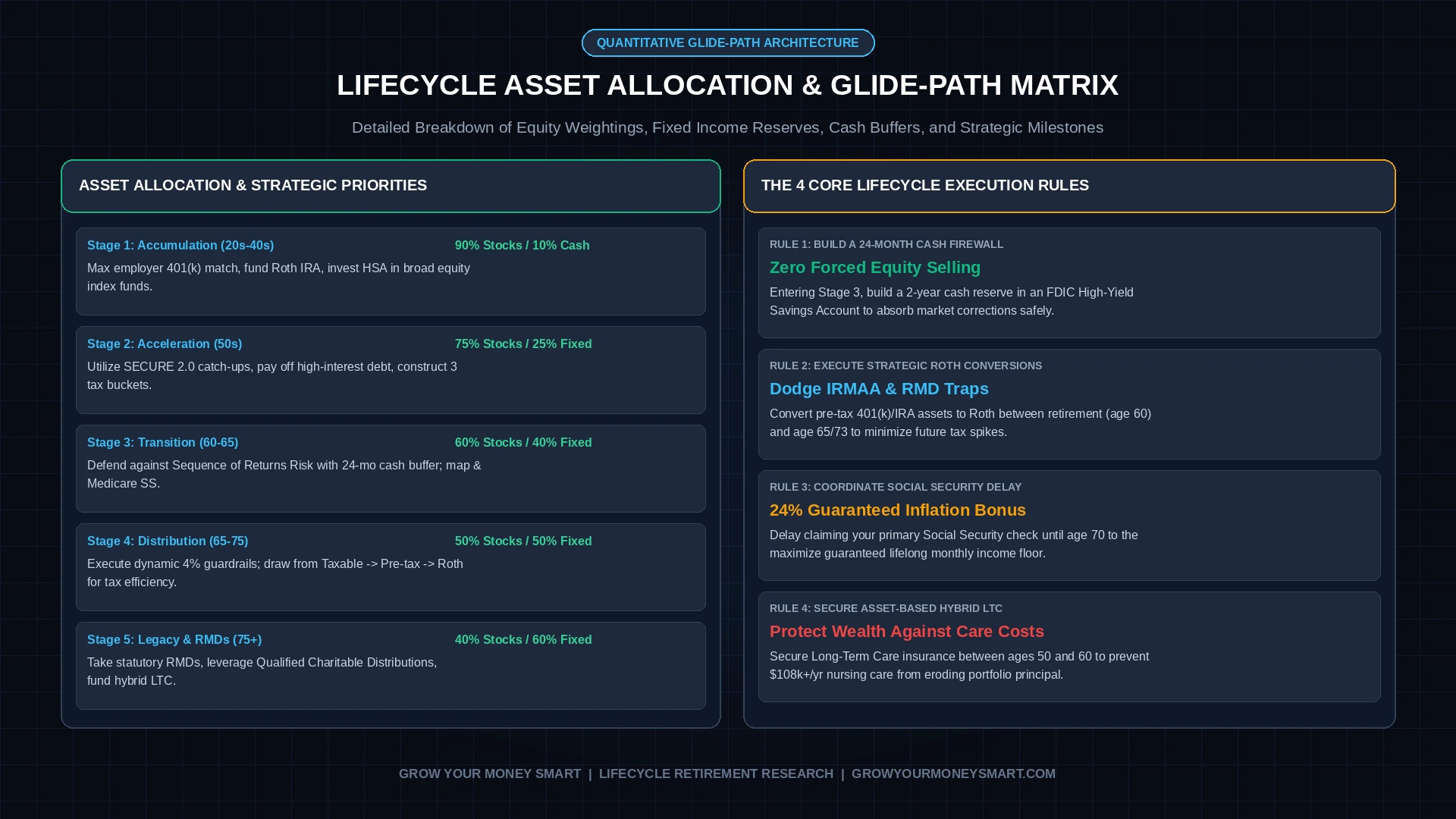
Institutional Lifecycle Matrix: Allocation, Risks & Priorities by Stage
The comparative matrix below details the core asset allocations, tax targets, primary risks, and actionable milestones governing each of the 5 retirement planning phases:
| Retirement Stage | Typical Age Band | Target Asset Allocation | Primary Risk Focus | Core Actionable Milestone |
|---|---|---|---|---|
| Stage 1: Accumulation | Ages 20s – 40s | 90% Stocks / 10% Cash | Inflation & Under-Saving Drag | Capture 100% 401(k) match; automate Roth IRA & HSA |
| Stage 2: Acceleration | Ages 50s | 75% Stocks / 25% Fixed | Lifestyle Creep & High Debt | Utilize SECURE 2.0 catch-ups; construct 3 tax buckets |
| Stage 3: Transition (Red Zone) | Ages 60 – 65 | 60% Stocks / 40% Fixed | Sequence of Returns Risk | Build 24-mo cash firewall; execute pre-65 Roth conversions |
| Stage 4: Active Distribution | Ages 65 – 75 | 50% Stocks / 50% Fixed | Excessive Spending & IRMAA | Apply 4% dynamic guardrails; follow tax waterfall |
| Stage 5: Legacy & RMDs | Ages 75+ | 40% Stocks / 60% Fixed | Long-Term Care & Probate | Execute RMDs/QCDs; fund hybrid LTC; establish living trusts |
Stage 4: Early Active Distribution & Dynamic Withdrawal Phase (Ages 65–75)
Stage 4 represents the early active retirement phase (the “Go-Go Years”). With career employment concluded, your portfolio transitions from a wealth-accumulation vessel into a monthly income generation engine. The primary objective is tax-efficient withdrawal execution and dynamic safe withdrawal management.
- The Tax-Efficient Withdrawal Waterfall: To minimize income taxes and Medicare premium surcharges, withdraw living capital in this sequence: 1. Required mandatory cash distributions and taxable brokerage interest/dividends; 2. Taxable brokerage capital gains (taxed at 0%–15% preferential capital gains rates); 3. Pre-tax Traditional 401(k)/IRA withdrawals up to the top of the 12% or 22% tax bracket; 4. Roth IRA withdrawals last, preserving tax-free compounding for as long as possible.
- Dynamic Safe Withdrawal Guardrails (Guyton-Klinger Protocol): Rather than adhering to a rigid 4% inflation-adjusted withdrawal rule, utilize dynamic guardrails. In strong bull market years, increase your withdrawal rate to 4.5%–5.0% to fund bucket-list travel; during equity bear market contractions, trim discretionary spending by 10% to prevent selling capital at cyclical market bottoms. Audit your spending benchmarks with our Household Budget Calculator.
Stage 5: Late Distribution, RMDs & Multi-Generational Legacy (Ages 75+)
Stage 5 encompasses the late retirement years (the “Slow-Go” and “No-Go” phases). Travel and discretionary expenditures naturally decline, while healthcare, custodial assistance, and wealth transfer governance become the predominant concerns.
- Required Minimum Distribution (RMD) Management: Starting at age 73 (increasing to age 75 under SECURE 2.0), the IRS mandates annual taxable withdrawals from pre-tax Traditional 401(k) and IRA accounts based on the IRS Uniform Lifetime Table. Failing to take an RMD incurs a stiff 25% excise tax penalty (reducible to 10% if corrected promptly).
- Qualified Charitable Distributions (QCDs): Retirees aged 70½ and older can transfer up to $108,000 per year directly from an IRA to a qualified 501(c)(3) charity. A QCD counts toward satisfying your statutory RMD for the year but is 100% excluded from your Adjusted Gross Income (AGI)—preventing Medicare IRMAA surcharges and tax bracket spikes.
- Long-Term Care Defense & Living Trust Administration: Activate benefits from hybrid asset-based Long-Term Care policies to cover assisted living or in-home custodial care ($108,000+/year). Ensure your Revocable Living Trust, Durable Power of Attorney, and Healthcare Proxy are updated with clear successor trustees to avoid expensive probate court proceedings.
Expert Video Masterclass: 13 Critical Steps 5 Years Before Retirement
To see a visual walkthrough on navigating the critical Stage 3 transition window, avoiding sequence of returns traps, and organizing your accounts, watch this acclaimed tutorial by financial author Rob Berger:
5-Phase Actionable Implementation Checklist: Where Are You Today?
To execute the 5 stages of retirement planning with mathematical precision, identify your current phase and execute the corresponding checkpoints:
If You Are in Stage 1 (20s–40s):
1. Confirm you are capturing 100% of your employer 401(k) match.
2. Set up automatic monthly transfers of $100–$600 into a low-cost Roth IRA.
3. Open an HSA if enrolled in an HDHP and invest 100% in broad-market index funds.
If You Are in Stage 2 (50s):
1. Enable annual catch-up contributions across workplace 401(k)s and IRAs.
2. Formulate an aggressive debt payoff strategy to eliminate non-mortgage debt.
3. Shop for asset-based hybrid Long-Term Care insurance before health underwriting locks out coverage.
If You Are in Stage 3 (60–65):
1. Establish a 24-month cash and short-term bond reserve in an FDIC High-Yield Savings Account.
2. Execute systematic Roth conversions during low-income gap years.
3. Finalize your Medicare Part A/B/D enrollment schedule and coordinate Social Security delay to age 70.
If You Are in Stage 4 & 5 (65+):
1. Implement the tax-efficient withdrawal waterfall (Taxable $
ightarrow$ Pre-tax $
ightarrow$ Roth).
2. Execute Qualified Charitable Distributions (QCDs) to satisfy RMDs tax-free.
3. Review Revocable Living Trust beneficiary designations and healthcare directives. If you need fiduciary advice, explore our guide on DIY vs Financial Advisor.
⚡ Comprehensive Retirement Planning Deep Dives by Stage
Navigate every phase of wealth accumulation and decumulation with our specialized guides:
- Age 60 Retirement Target: Explore our guide on how much money you realistically need to retire at 60 with 2026 expense benchmarks and safe withdrawal rules.
- Foundation in Your 20s: Explore our guide on comprehensive retirement planning in your 20s guide to leverage 40-year compounding and maximum risk tolerance.
- Income Stream Architecture: Explore our guide on three-legged stool of retirement income model balancing pensions, personal accounts, and Social Security.
- Early Social Security Rules: Explore our guide on Social Security early retirement age penalties and options to evaluate whether claiming at age 62 is worth a 30% cut.
- Inflation Defense: Explore our guide on how inflation erodes long-term retirement savings and which asset classes provide durable purchasing power hedging.
- Healthcare & Medicare Gap: Explore our guide on healthcare costs and Medicare gap planning in retirement to budget for medical expenses before age 65.
- Longevity & 30-Year Runways: Explore our guide on planning for 30+ years of retirement longevity to ensure you never outlive your investment capital.
- Pension Supplementation: Explore our guide on why pension plans are not enough on their own and how personal Roth IRAs bridge the income gap.
- FIRE vs Traditional Plans: Explore our guide on retirement planning vs financial independence (FIRE) exploring aggressive early retirement versus standard paths.
- Portfolio Reality Check: Explore our guide on debunking the multi-million dollar retirement myth with practical budget math for modest, comfortable retirements.
- Marital Tax Nuances: Explore our guide on retirement planning differences for singles vs married couples covering tax bracket shifts and survivorship considerations.
- Real Early Retirement Models: Explore our guide on real-world early retirement case studies demonstrating practical asset allocation formulas in action.
- Semi-Retirement Options: Explore our guide on redefining retirement and semi-retirement work options to combine passions with part-time income streams.
- Estate & Legal Protection: Explore our guide on essential legal documents for retirement and estate protection including healthcare directives, power of attorney, and trusts.
- Global Retirement Models: Explore our guide on how retirement is viewed across different global cultures highlighting diverse cultural perspectives on senior living.
- Mental Well-being Perks: Explore our guide on psychological perks and peace of mind from retirement planning reducing financial anxiety through structured planning.
- Non-Financial Pillars: Explore our guide on non-financial lifestyle factors in retirement to maintain social connectivity, purpose, and health.
- Maxing Retirement Accounts: Explore our guide on step-by-step roadmap to max out your 401(k) and Roth IRA to capture full employer matches and tax-free Roth growth.
Frequently Asked Questions (FAQs)
Below are clear, authoritative answers to the most vital questions savers ask about navigating the 5 retirement lifecycle phases:
The 5 stages are: 1. Early Career Accumulation (Ages 20s–40s); 2. Peak Earnings Acceleration (Ages 50s); 3. Pre-Retirement Transition “Red Zone” (Ages 60–65); 4. Active Early Distribution (Ages 65–75); and 5. Late Distribution & Legacy Governance (Ages 75+).
Stage 3 (Pre-Retirement Transition, ages 60 to 65) carries the highest risk due to Sequence of Returns Risk. A severe market downturn right before or immediately following retirement can permanently impair portfolio longevity if a 2-year cash buffer is not constructed.
A standard institutional glide path moves from 90% equities / 10% cash in Stage 1, to 75/25 in Stage 2, 60/40 in Stage 3 (with a dedicated 24-month cash buffer), 50/50 in Stage 4, and 40/60 in Stage 5 to safeguard non-discretionary living and care costs.
Workers reaching ages 60, 61, 62, or 63 qualify for an elevated 401(k) catch-up contribution threshold of $11,250 per year (instead of the standard $8,000 catch-up for age 50+), providing a massive accelerated savings runway right before retirement.
To minimize taxes and Medicare IRMAA surcharges, draw funds in this order: 1. Taxable brokerage accounts first; 2. Pre-tax accounts (Traditional 401k/IRA) up to lower tax bracket ceilings; 3. Tax-free Roth accounts last, maximizing tax-free growth.
The optimal window occurs during Stage 3 and early Stage 4—between career retirement (when wages drop) and age 65 (Medicare lookback) or age 73/75 (RMD start). Converting during this low-income gap locks in 10%–12% tax rates and eliminates future RMD spikes.
Starting at age 70½, retirees can transfer up to $108,000 per year directly from an IRA to a qualified 501(c)(3) charity. This satisfies your Required Minimum Distribution (RMD) but is 100% excluded from your AGI, preventing tax spikes and IRMAA penalties.
The optimal window to buy hybrid asset-based Long-Term Care insurance is between ages 50 and 60 (Stage 2). Applying during this window locks in lower premiums, avoids health disqualifications, and protects portfolio capital from $108k+/year nursing care costs.
Final Expert Verdict: Transforming Lifecycle Planning into Guaranteed Financial Security
Retirement success is not determined by luck or timing; it is achieved through systematic execution across all five lifecycle phases. By understanding the distinct rules of each stage—from early accumulation and mid-career acceleration to sequence-of-returns defense and estate legacy governance—you can navigate every economic market cycle with unshakeable confidence and engineer lifelong financial independence.
Tax-advantaged retirement accounts are governed by federal tax laws and annual inflation-adjusted contribution schedules. Consult the official Internal Revenue Service (IRS) Retirement Plans Guidance for statutory guidelines and consumer protections.
🏛️ Foundational Retirement Frameworks & Core Terminology
Deepen your retirement lifecycle roadmap with these essential companion analyses and terminology guides:
- The Traditional Foundation: three-legged stool of retirement income model to balance Social Security, private pensions, and personal investments.
- Retirement Benchmark: how much do you really need to retire at 60? with real-world mathematical expense projections.
- Essential Terminology: complete beginner retirement planning glossary explaining accumulation, decumulation, safe withdrawal rates, and sequence of returns risk.
- Independence Roadmap: traditional retirement vs financial independence (FIRE) to evaluate whether early exit is viable for your career.

Jaiveer Hooda is the Lead Financial Researcher & Personal Finance Analyst at Grow Your Money Smart. Specializing in personal wealth optimization, index fund compounding, high-yield savings mechanics, and consumer debt elimination strategies. With a background in computer engineering, he applies mathematical modeling, cashflow simulations, and empirical risk analysis to evaluate personal finance vehicles and credit products. Every analysis is backed by verified regulatory disclosures, IRS tax schedules, and empirical APY compounding math.
Areas of Expertise: Personal Finance · High-Yield Savings Accounts (HYSA) · Index Funds & S&P 500 Compounding · Retirement Planning (401k/IRA) · Debt Optimization · Credit Card APR Mechanics.
Transparency & Editorial Policy: Editorial Standards | Report a Correction