
Deciding whether is long term care insurance worth it depends strictly on your household net worth: It is generally not worth it for individuals with under $300,000 in assets (who qualify for Medicaid) or over $2.5 million (who can self-insure via portfolio yield). However, for households in the $300,000 to $2.5 million sweet spot, modern Hybrid Life/LTC policies are highly recommended to protect home equity and retirement portfolios against $100,000+ annual nursing care expenses while guaranteeing a death benefit if care is never needed.
As life expectancy rises, the single largest unhedged financial liability facing American retirees is the soaring cost of custodial medical and nursing assistance. According to official actuarial benchmarks from the U.S. Administration for Community Living (ACL), someone turning age 65 today has a nearly 70% probability of needing some type of long-term care services and supports in their remaining years, with women requiring care for an average of 3.7 years compared to 2.2 years for men.
With private nursing home room costs averaging $108,000 annually and home health aides exceeding $30 per hour, an extended health decline can rapidly wipe out decades of retirement compounding. But is traditional long-term care insurance the right shield, or are the premiums an expensive financial trap? In this guide, we evaluate policy economics, compare traditional vs. hybrid plans, and reveal when self-insuring makes mathematical sense.
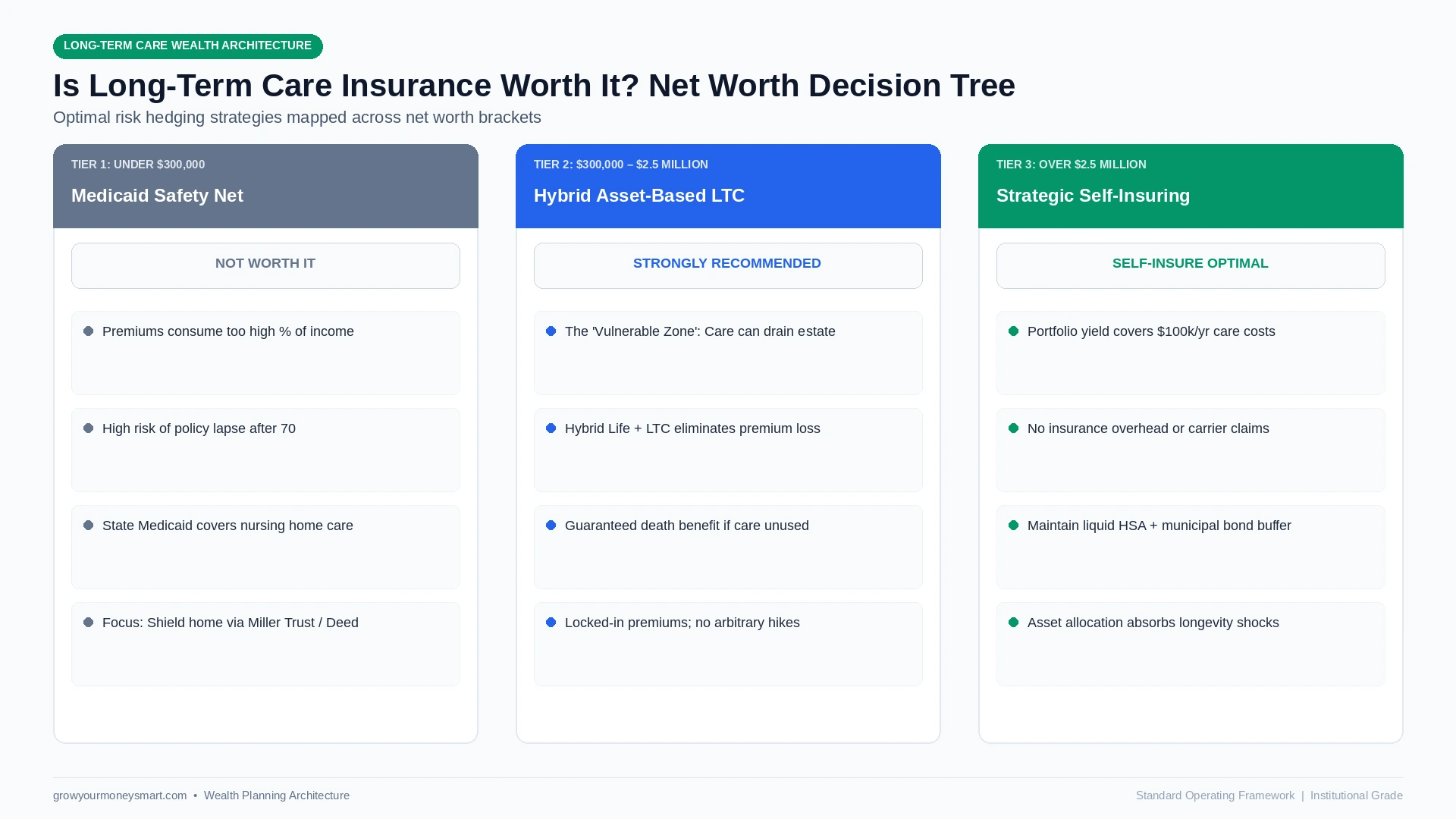
The Net Worth Decision Matrix: Who Needs Coverage?
The decision to purchase long-term care insurance is not emotional; it is an asset-allocation hedge. We divide retirement balance sheets into three distinct tiers:
Tier 1: Net Worth Under $300,000 (Medicaid Safe Harbor)
If your investable assets (excluding your primary residence) are below $300,000, private LTC insurance is almost never mathematically justified. Premium payments of $2,500 to $4,000 per year would consume an unsustainable percentage of your fixed Social Security income, creating an extreme risk that you lapse the policy right before needing care. In this tier, state Medicaid programs step in to cover nursing home care once personal assets are spent down.
Tier 2: Net Worth $300,000 to $2.5 Million (The Vulnerable Sweet Spot)
This is the demographic for whom LTC risk is catastrophic. You have built substantial wealth—a paid-off home, healthy 401(k) balances, and Roth IRAs. You do not qualify for government Medicaid, but an extended 4-year memory care stay costing $400,000 to $500,000 would devastate the surviving spouse’s standard of living and erase any inheritance for children. For this tier, risk-shifting via insurance is essential.
Tier 3: Net Worth Over $2.5 Million (Self-Insuring Territory)
If your liquid portfolio exceeds $2.5 million, a 4% safe withdrawal rate generates $100,000+ in annual portfolio cash flow independent of principal. You can self-insure care expenses out of ongoing dividends, interest, and capital gains without impairing portfolio longevity. You avoid paying insurance carrier underwriting margins, claims friction, and policy restrictions.
To see how your portfolio yield matches your target retirement horizon, review our guides on the 4% rule explained and protecting your portfolio against sequence of returns risk in early retirement.
| Care Setting / Service | National Median Monthly Cost | National Median Annual Cost | Typical Medicare Coverage |
|---|---|---|---|
| Home Health Aide (44 hrs/wk) | $4,500 – $5,400 | $54,000 – $65,000 | $0.00 (Custodial Care Excluded) |
| Assisted Living Facility | $4,800 – $5,800 | $57,600 – $69,600 | $0.00 (Zero Room & Board) |
| Nursing Home (Semi-Private) | $7,900 – $8,900 | $94,800 – $106,800 | Up to 100 days post-hospital only |
| Nursing Home (Private Room) | $9,000 – $10,500 | $108,000 – $126,000 | Up to 100 days post-hospital only |
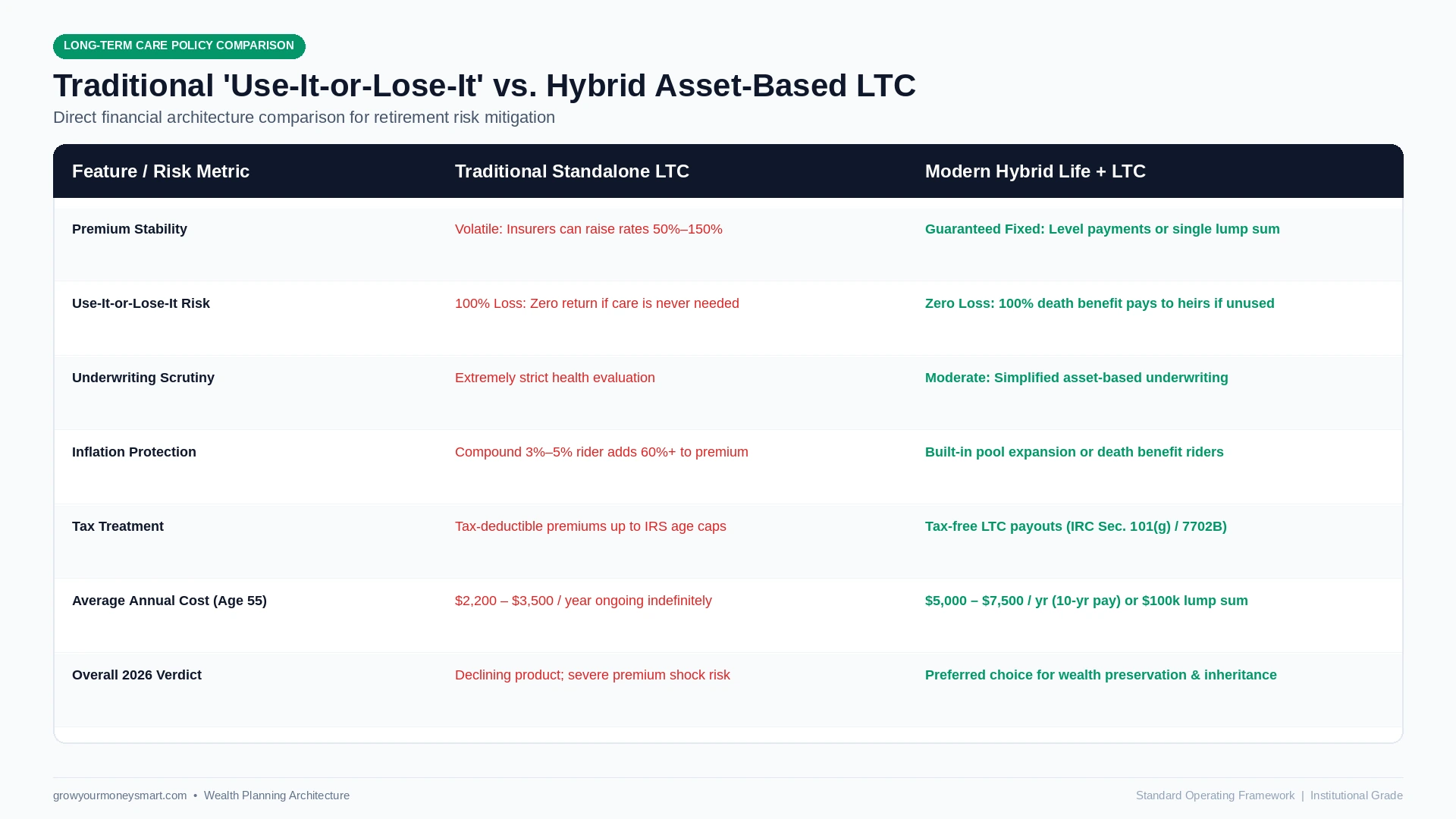
Traditional vs. Hybrid Asset-Based LTC Policies
If you decide to buy coverage, you face a major architectural choice between traditional standalone policies and modern hybrid policies:
1. The Collapse of Traditional Standalone LTC
Traditional standalone LTC insurance works like auto insurance: you pay an annual premium indefinitely. If you need care, it pays out; if you die peacefully without needing care, 100% of your premiums are lost. Over the past twenty years, insurance carriers drastically underestimated claim frequencies and low interest rates, leading state insurance commissioners to approve massive premium hikes (often 50% to 200% on existing policyholders). Today, fewer than six major carriers even sell standalone policies.
2. The Rise of Hybrid Life + LTC (Asset-Based Policies)
Modern hybrid policies link a long-term care rider to a permanent whole life insurance policy or universal life chassis. This structure eliminates the “use-it-or-lose-it” fear:
- Scenario A (You Need Care): The policy pays out tax-free monthly LTC benefits (typically up to 3x to 5x the initial face amount) to cover home care or facility bills.
- Scenario B (You Never Need Care): Upon death, your heirs receive a 100% tax-free life insurance death benefit.
- Scenario C (You Change Your Mind): Many hybrid contracts feature a Return of Premium rider allowing you to surrender the policy and recover your original capital.
- Guaranteed Premiums: Premium schedules are contractual and locked in—the insurance carrier can never raise rates on your policy.
Tax Advantages: HSAs and IRS Deductions
The Internal Revenue Service (IRS Publication 502) provides significant tax breaks for qualified long-term care insurance policies under Internal Revenue Code Section 7702B. You can use pre-tax funds from a Health Savings Account (HSA) to pay tax-deductible LTC insurance premiums up to annual age-based limits ($470 under age 40, up to $5,880 for individuals over age 70).
Furthermore, benefits received from tax-qualified LTC policies are received 100% income-tax-free up to daily IRS per diem limits or actual qualified care expenses. To learn how to build an ultimate healthcare nest egg, explore our breakdown of the HSA triple tax advantage for retirement, benchmark your milestones with our how much to save by age benchmarks, and maintain emergency liquidity with the emergency fund and HYSA master guide, or test your baseline with our free emergency fund calculator.
What Is the Ideal Age to Buy Coverage?
Actuarial data indicates that the optimal sweet spot to purchase long-term care insurance is between age 53 and 62:
- Before Age 50: Premiums are paid for too many decades before benefits are utilized, tying up investment capital that would compound more effectively in broad-market index funds.
- Between Age 53 and 60: Health is typically clean enough to pass medical underwriting, and premium schedules remain affordable.
- After Age 65: Premium costs increase dramatically, and common pre-existing conditions (diabetes, arthritis, mild cognitive impairment, high blood pressure) frequently trigger total underwriting denial.
If you are also coordinating legacy protection, ensure your estate documents coordinate with living trusts by reviewing our guide on will vs living trust difference, coordinating non-probate asset transfers via beneficiary designations vs wills, and studying early retirement transitions in Coast FIRE explained.
Frequently Asked Questions
🛡️ Estate Preservation, Medical Protection & Family Planning
Safeguard your family’s generational wealth from nursing home costs with these comprehensive estate guides:
- Retirement Healthcare: healthcare costs: the elephant in retirement planning — projecting lifetime out-of-pocket medical expenses and Medicare gaps.
- Caregiver Blueprints: sandwich generation financial planning guide — financial strategies for adults supporting both aging parents and growing children.
- Estate Transfer Pitfalls: beneficiary designation vs will: costly traps — preventing costly legal disputes and probate delays on inherited assets.
- Asset Sheltering: will vs living trust: what you need for retirement — how revocable and irrevocable trusts protect real estate and savings from probate.
- Complete Framework: 5 stages of retirement planning lifecycle — integrating elder care and asset preservation into late-stage retirement plans.

Jaiveer Hooda is the Lead Financial Researcher & Personal Finance Analyst at Grow Your Money Smart. Specializing in personal wealth optimization, index fund compounding, high-yield savings mechanics, and consumer debt elimination strategies. With a background in computer engineering, he applies mathematical modeling, cashflow simulations, and empirical risk analysis to evaluate personal finance vehicles and credit products. Every analysis is backed by verified regulatory disclosures, IRS tax schedules, and empirical APY compounding math.
Areas of Expertise: Personal Finance · High-Yield Savings Accounts (HYSA) · Index Funds & S&P 500 Compounding · Retirement Planning (401k/IRA) · Debt Optimization · Credit Card APR Mechanics.
Transparency & Editorial Policy: Editorial Standards | Report a Correction