
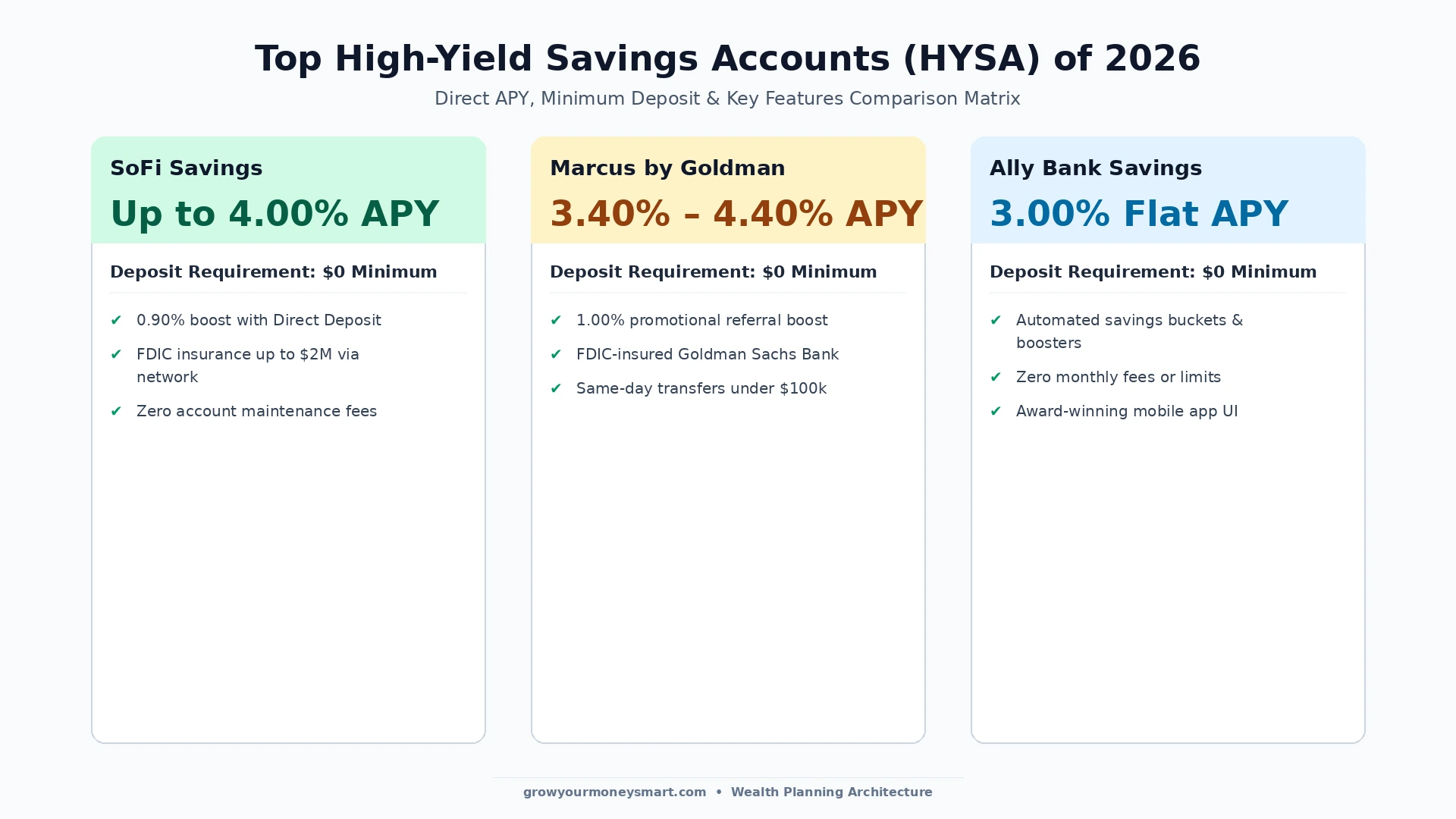
The best high-yield savings accounts in 2026 pay between 3.00% and 4.40% APY—over 10 times the national bank average. Top choices include SoFi (up to 4.00% with direct deposit), Marcus by Goldman Sachs (3.40%–4.40% with bonus), and Ally Bank (3.00% with automated buckets). All are FDIC-insured up to $250,000 with zero monthly fees.
- The 10x APY Advantage: Traditional brick-and-mortar checking and savings accounts pay an average of 0.01% to 0.45% APY, while leading online HYSAs pay 3.00% to 4.40% APY on liquid cash.
- Zero Risk, FDIC Backed: Deposits are federally insured by the FDIC up to $250,000 per depositor, making HYSAs 100% capital protected.
- The $1,000 Difference: Keeping $25,000 in an HYSA generates over $1,000 in annual interest, compared to just $2.50 in a standard checking account.
- Top Standouts: SoFi leads for high-earning direct deposits, Marcus leads for pure transfer speed, and Ally leads for multi-goal savings buckets.
- Complete Liquidity: Unlike CDs or market investments, your cash remains 100% accessible with zero lock-in penalties.
Leaving your emergency fund or short-term cash reserves in a traditional commercial checking account is one of the most expensive financial mistakes in personal finance. In 2026, the national average savings interest rate at legacy brick-and-mortar institutions lingers at a microscopic 0.01% to 0.45% APY. At that rate, inflation quietly devours your purchasing power every single year.
By contrast, the best high-yield savings accounts (HYSAs) currently offer between 3.00% and 4.40% APY. Because online financial institutions do not maintain thousands of expensive physical branches, they return their operational savings directly to account holders. Best of all, your cash remains liquid, accessible within 24 to 48 hours, and backed by the full faith and credit of the United States government via the Federal Deposit Insurance Corporation (FDIC).
Whether you are parking cash for our emergency fund master guide, accumulating a down payment using our house deposit savings strategy, or deciding between market growth in our HYSA vs. Stocks guide, this 2026 review breaks down the top high-yield accounts, their exact APYs, fee structures, and transfer speeds.
Head-to-Head Comparison: The 5 Best HYSAs in 2026
Here is how the market leaders stack up across APY benchmarks, deposit requirements, and core features:
The Mathematical Compounding Power: $25,000 Cash Case Study
To understand why moving your cash to an HYSA is non-negotiable, examine the math of keeping a standard $25,000 emergency fund in a legacy bank (0.01% APY) versus a leading high-yield account (4.00% APY):
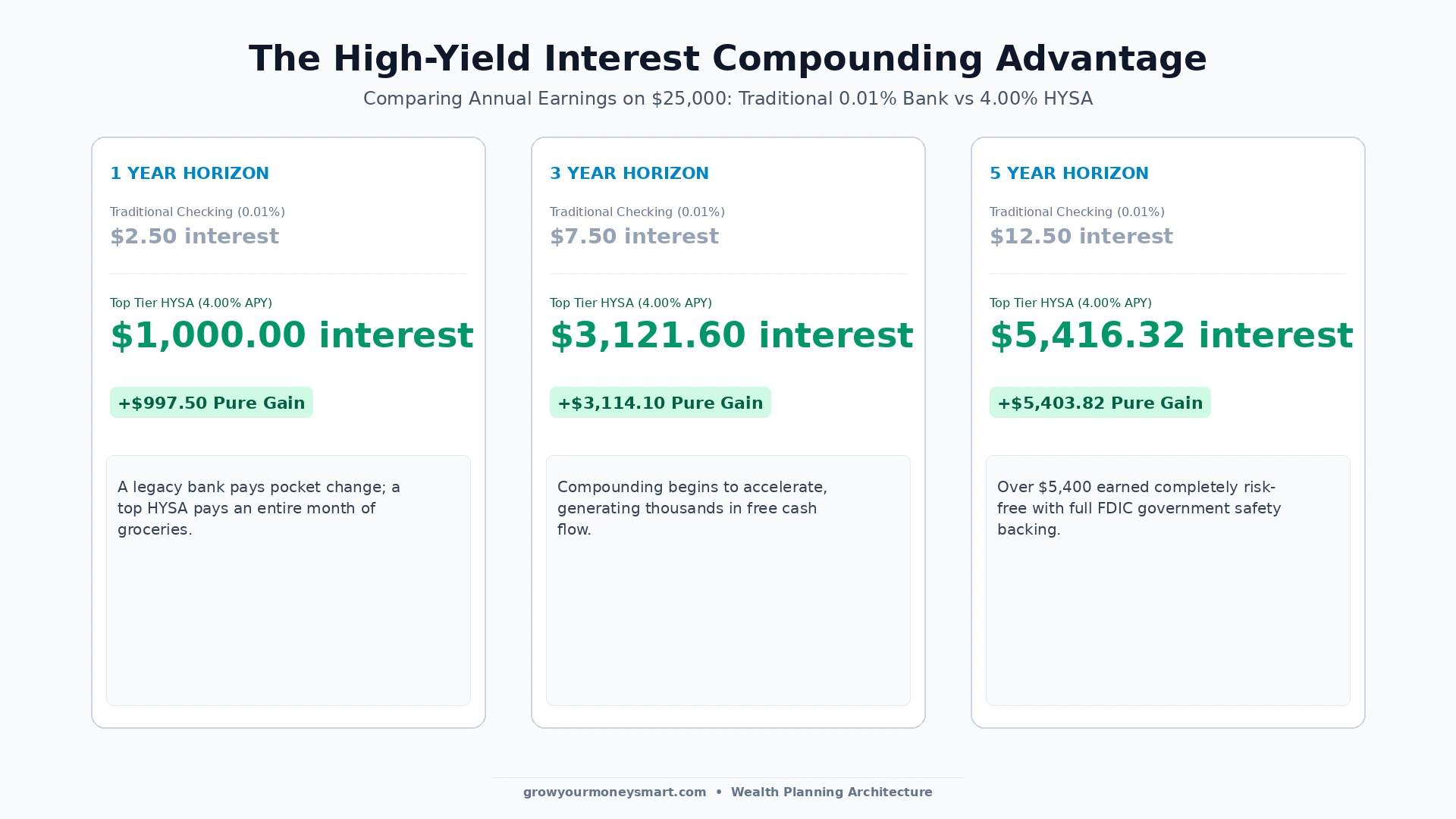
Over a 5-year period, leaving $25,000 in a traditional checking account earns a meager $12.50—essentially zero. In an HYSA compounding monthly at 4.00%, that exact same balance produces $5,416.32 in completely passive, risk-free cash flow. That is over $5,400 of wealth generated with zero effort and zero market volatility risk.
You can simulate your specific cash balance directly using our interactive free emergency fund calculator and our comprehensive budget calculator.
5 Crucial Criteria to Evaluate Before Opening an HYSA
- 1. FDIC / NCUA Government Insurance: Never deposit cash into an uninsured fintech app. Ensure the institution is a direct member of the FDIC or sweeps deposits into FDIC-insured partner banks up to $250,000 per depositor.
- 2. Account Requirements & Direct Deposit Hurdles: Some banks (like SoFi) require active direct deposits to unlock their promotional top tier. If you are self-employed or on an irregular income, choose a bank like Marcus or Ally that offers a flat rate with zero deposit conditions. (See our guide on budgeting on an irregular income).
- 3. Zero Maintenance Fees & Zero Minimums: Top-tier accounts have no monthly maintenance charges, no inactivity penalties, and no balance minimums.
- 4. Transfer Speed & Liquidity: When a true emergency strikes, you need access to cash quickly. Evaluate ACH transfer windows. Marcus and Ally offer same-day ACH transfers under $100,000 to primary linked accounts.
- 5. App Stability & Customer Support: Manage your money seamlessly through high-rated iOS/Android applications with two-factor biometric authentication.
Expert Video Breakdown: Top High-Yield Savings Accounts Compared
For a comprehensive visual walkthrough of current online banking APYs, withdrawal limits, and FDIC protections, watch personal finance expert Humphrey Yang break down the top high-yield savings accounts:
Frequently Asked Questions (FAQs)
A High-Yield Savings Account (HYSA) is a federally insured savings account offered primarily by online banks that pays an Annual Percentage Yield (APY) 10 to 30 times higher than traditional brick-and-mortar banks, while offering full liquidity and zero risk.
Yes. Legitimate high-yield savings accounts are backed by the Federal Deposit Insurance Corporation (FDIC) or National Credit Union Administration (NCUA) up to $250,000 per depositor, per institution, guaranteeing that your money is 100% safe.
Online banks do not have the massive overhead costs of maintaining physical branch networks, tellers, and commercial real estate leases. They pass these operational cost savings directly to customers in the form of higher APY rates and zero monthly fees.
Yes. HYSA rates are variable and fluctuate in response to monetary policy set by the Federal Reserve. When the Fed adjusts benchmark interest rates, online banks adjust their APYs accordingly.
Yes. Interest earned from a high-yield savings account is treated as ordinary income by the IRS and is subject to federal and state income taxes. Banks issue a Form 1099-INT if you earn $10 or more in annual interest.
Electronic ACH transfers typically take 1 to 3 business days to transfer cash from an online HYSA back to your local checking account. Several institutions, such as Marcus and Ally, offer same-day ACH transfers for qualifying amounts.
An HYSA provides variable interest with complete liquidity, allowing you to deposit or withdraw cash at any time. A Certificate of Deposit (CD) locks your interest rate for a fixed term (e.g., 6, 12, or 24 months), but penalizes you if you withdraw capital early.
Most top-rated HYSAs—including Marcus by Goldman Sachs, Ally Bank, and Capital One 360—require a $0 minimum opening deposit and have no minimum monthly balance requirements.

Jaiveer Hooda is a personal finance researcher and the founder of Grow Your Money Smart. With a background in computer engineering, he approaches money the way an engineer approaches any complex system — through data analysis, mathematical modeling, and ruthless optimization.
He built this platform on a single conviction: financial freedom is not a matter of luck. It is a system that can be designed, tested, and executed by anyone willing to follow the right blueprint. Every strategy published here is researched to the numbers, not written to the trend.
Expertise: Debt elimination · Retirement planning · Passive income · Budgeting systems
Connect: Pinterest | growyourmoneysmart.com | Contact Us